
The Imjin War RPG (1592–1598)
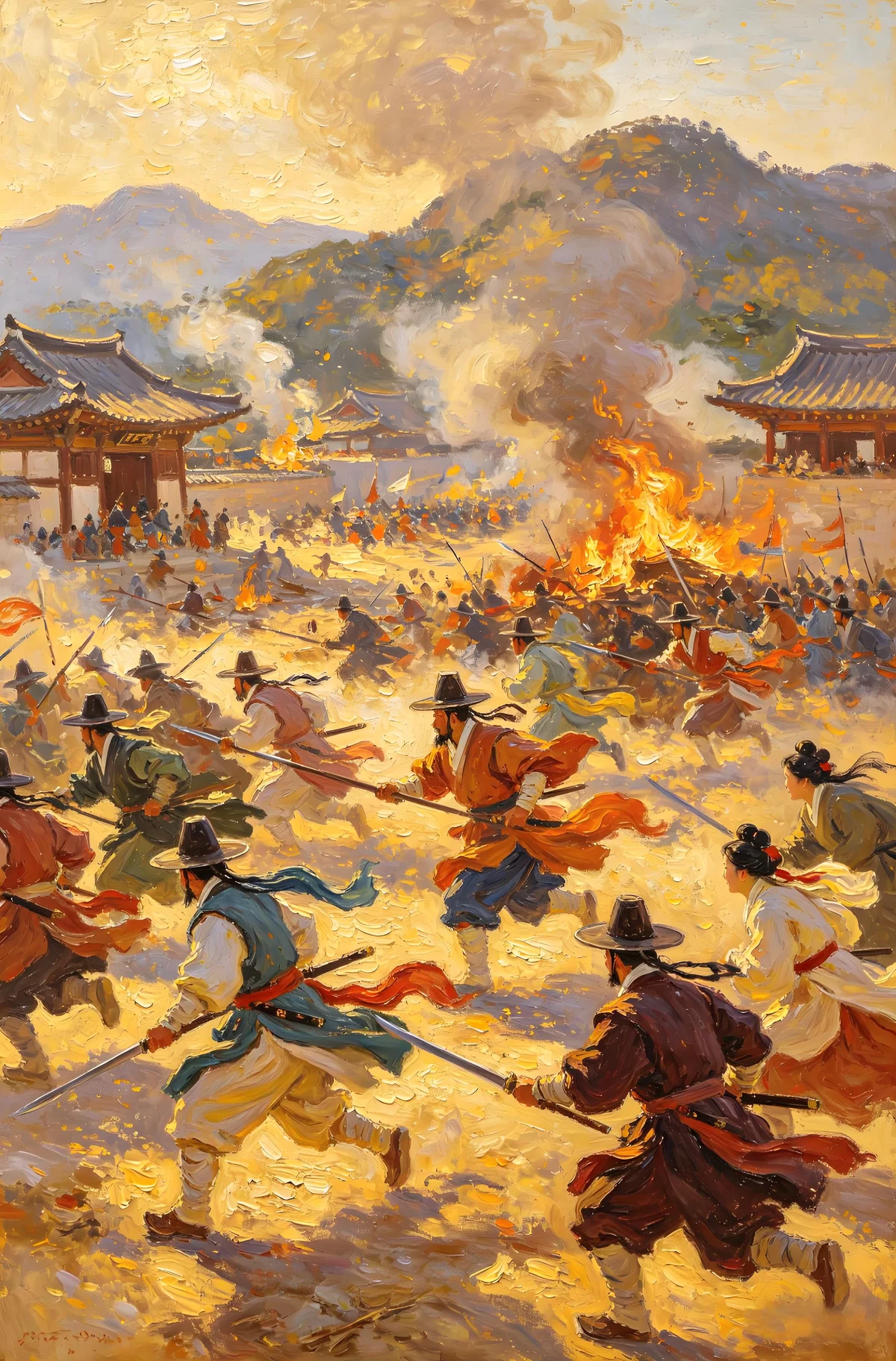
This war is known on the Korean Peninsula as the Imjin Waeran (壬辰倭亂) and the Imjin Joguk Haebang Jeonjaeng (壬辰祖國解放戰爭), in Japan as the Bunroku no Eki (文禄の役), and in China as the Wanli Korean Campaign (萬曆朝鮮之役). Which name you use depends on the role you play.
So. You've decided to step into the bloodiest, strangest, and most underrated war of the 16th century.
Good choice. Bring a sword. Or a matchlock. Or a really good map. (You wouldn't want to go down in history just because your map had a ditch in the wrong place, would you?)
Here's what you need to know.
In 1592, the Japanese warlord Toyotomi Hideyoshi finally brought an end to a century of civil war and unified Japan. He gazed across the sea toward the Korean Peninsula.
「You know what? Joseon looks pretty nice. I think I'll take it.」
「And while I'm at it... why not China too?」
「I've already picked out my retirement spot. Ningbo. Yes, that Ningbo.」
(Historians will note: he was very serious about the Ningbo thing.)
The Joseon army got rolled in the first few months. Hanseong fell. The king fled. Refugees clogged every road heading north. It looked bad. Really bad.
But then three things happened.
First, a Joseon admiral named Yi Sun-sin decided to build a navy anyway.
Second, the Ming Empire showed up. Slowly. But with a lot of cannons.
Third, ordinary people picked up whatever weapons they could find and made the Japanese pay for every mile of muddy road.
Six years. Three nations. Hundreds of battles. Thousands of ships. Hundreds of thousands of dead.
And you? You're right in the middle of it.
Who can you be?
A Joseon general trying to hold a crumbling line.
A Japanese samurai with something to prove.
A Ming officer thousands of miles from home.
A guerrilla leader hiding in the mountains.
A naval captain learning to fight on water that wants to drown you.
A spy. A refugee. A monk with a spear.
Or just some poor soul who wanted to see the world and got a war instead.
What can you do?
Fight. Flee. Negotiate. Betray. Build. Burn. Save a village. Lose a friend. Win a battle that history almost forgot. Lose a battle that history never stopped talking about.
What should you expect?
Long marches. Short rations. Bad weather. Worse news.
Matchlocks that sound like thunder and leave wounds that don't close.
The smell of smoke in every sunrise.
The weight of choices that won't make sense until years later, if ever.
History wrote the big lines: who won, who lost, who died, who lived. But history left plenty of blank spaces. And you get to fill them.
You might not change the world. You might. Who knows?
What matters is who you become.
So.
Pack light. Trust your gut. Keep your powder dry.
And maybe the thing you'll remember isn't the battle you won, but the orphan you carried across a frozen river.
1
The Imjin War (1592–1598) has loaded. Awaiting the first instruction.
2
In April 1592, 18,700 Japanese troops under Konishi Yukinaga storm Tongnae fortress. Magistrate Song Sang-hyeon refuses surrender, leading a hopeless defense. After the walls fall, he sends a courier north with a dispatch warning the king.
3
On the eve of the Battle of Hansando, Admiral Yi Sun-sin gathers his captains. One by one, they voice their fears: annihilation, failed encirclement, scarce gunpowder, a fickle court, and treacherous weather. And Yi listens has already made up his mind to enter the fray.
4
On the frozen banks of the Taedong River, Ming commander Li Rusong gathers his officers before the assault on Pyongyang. Konishi Yukinaga holds the city with fifteen thousand veterans. Li unveils a three-pronged attack. His generals voice fears: Japanese matchlocks, cold powder, Kuroda's approaching reinforcements. Li listens.
5
Ming commander Li Rusong's scouts clash with Japanese forces at Byeokjegwan. Outnumbered ten to one and encircled by Ukita Hideie's main army, the Ming cavalry fights desperately. Li knows retreat is impossible. He rallies his exhausted men: 「Reinforcements may come, or they may not. But we will not die like trapped animals. We will charge!」
6
At Haengju, a steep hill fortress on the Han River, General Gwon Yul commands three thousand Korean soldiers against thirty thousand Japanese veterans. The enemy has never lost a ground assault. Korea has never won one. The drums roll. The enemy climbs.
7
At Jinju, a fortress on the Nam River, General Kim Si-min prepares to defend with 3,800 soldiers, monks, and peasants against 30,000 Japanese veterans. The rivers protect the flanks; the only approach is from the east. Kim has stockpiled arrows, cannon, and newly made matchlocks. At dawn, the Japanese cross the river. The first wave climbs the slope. The siege begins.
8
After the disaster of Chilcheollyang, the Joseon navy is shattered. Won Gyun is dead; Yi Eok-gi has fallen. Yi Sun-sin, recently released from torture and disgrace, takes command of the remnants: thirteen ships. The Japanese fleet of over three hundred sails approaches the treacherous Myeongnyang Strait, where the current reverses every three hours. Yi Sun-sin raises his sword. The drums beat.
9
At the hills of Jiksan, a Ming–Joseon rearguard of just two thousand stands between thirty thousand advancing Japanese and Hanseong. Namwon has fallen. Generals who fled have been executed. Commander Xie Sheng rallies his cavalry: 「Past Jiksan is Suwon. Past Suwon is Hanseong. If Hanseong falls, these six years mean nothing.」 On the horizon, Japanese banners rise like a grey tide. The wind carries the sound of thirty thousand marching feet. The first shots ring out.
10
In 1598, Toyotomi Hideyoshi is dead. Japan orders withdrawal. Shimazu Yoshihiro commands 500 ships and 10,000 samurai to rescue Konishi Yukinaga's trapped army. Waiting in the Noryang Strait are Admiral Yi Sun-sin with 83 Korean warships and Admiral Chen Lin with 100 Ming vessels. They set a trap: Deng Zilong strikes the rear, Chen blocks the center, Yi closes the jaws from the south. The stakes: destroy the Japanese fleet or prolong the war.
Created Apr 2
Updated Sep 12
Published Apr 6