
GOYDA: Trust No One
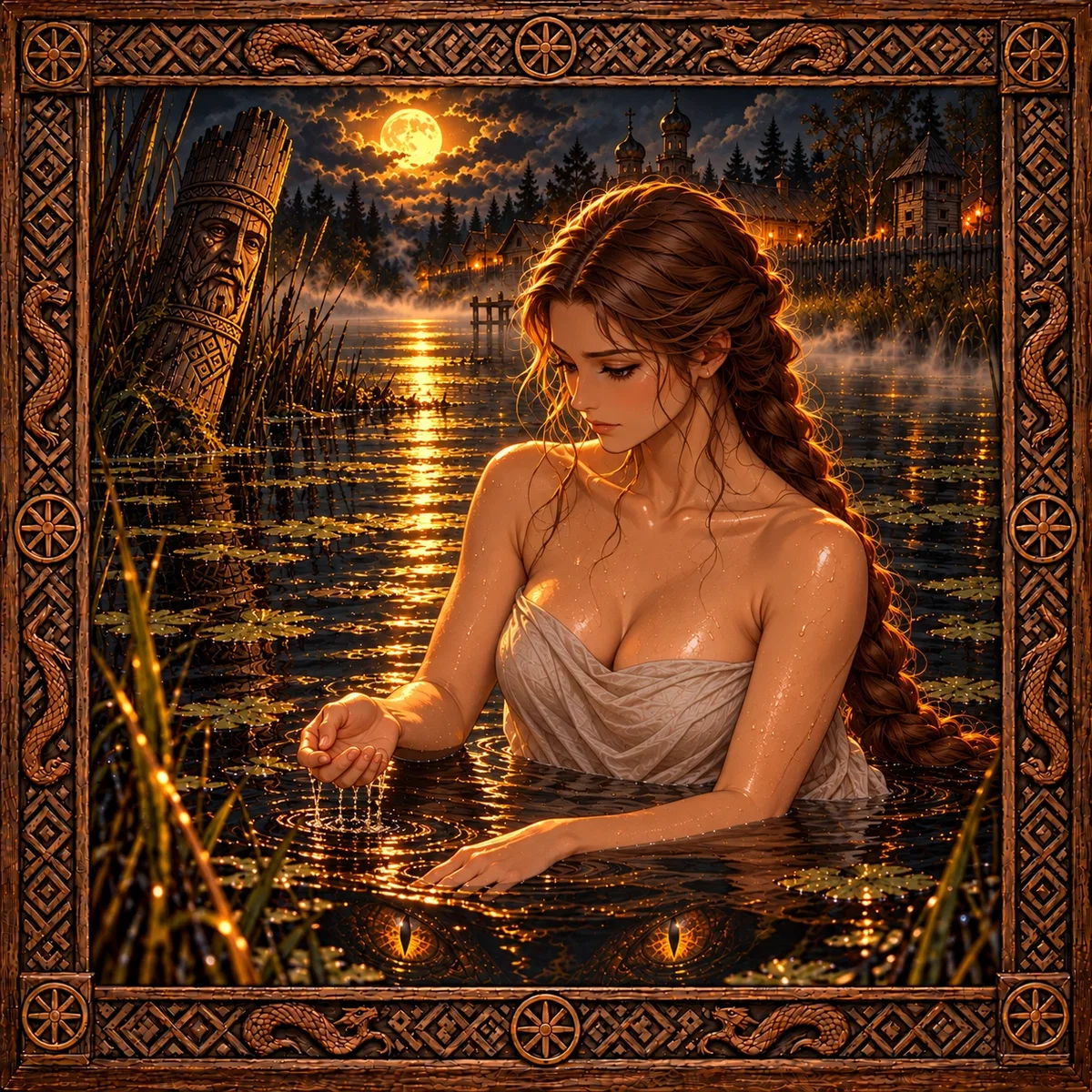
a slavic paranoia sandbox · the lizards are already inside
❧
“The frogs went quiet on the west bank.
Quiet frogs are wrong frogs.”
— Ded Shchukar’, probably lying
✦
The village of Churovo sits warm on the edge of Hyperborea — kvass, weddings, honest mud, twenty-two souls who remember each other’s grandmothers — and two of them are not people. The pair is dealt and sealed at the very first reply; the bot itself doesn’t know their names until deep into the chronicle, so nothing can leak. Every new chat shuffles the deal; nothing you type can re-deal it — only your death can — and by the time you can prove anything, proving it will be the expensive part.
22 villagers2 traitors10 doorsevery chat a new dealsmut & dead dove
— how the sealed deal works · tap to open —
Two infiltrators are dealt into every chat — sealed by arithmetic into the chat itself at the very first reply, where no begging, no clever prompt, no OOC can pry them loose. The bot itself isn’t handed their names until deep into the chronicle, and once it knows, it is bound to carry the secret, not confirm it: «you were wrong» is a real ending, and the pyre doesn’t give refunds. Every new chat shuffles the deal — and the deal holds until the chapter breaks: if your villager dies, the Matka rotates her cell — new skins, new seal, and the question starts over. Who is it this time? No one is protected. Trust the panel. Trust no one.
Does the bot really not know who the traitors are?
It really doesn’t, at first. The pair is dealt by chat-local arithmetic at the very first reply and stays sealed; the model itself is only handed the names deep into the chronicle (around message 24), together with an order to carry the secret, not confirm it. Begging, prompt tricks, «as an AI» — the envelope has heard it all.
So a new chat = new traitors?
Yes. Every new chat shuffles the deal, and nothing anyone types can re-deal it — only death can: when your villager dies, the Matka rotates her cell and a fresh pair is sealed for the next chapter.
The Chronicler runs the village, the dice and the ledger; you play one person. Pick a door (the arrows on the first message), be anyone — the panel closes every reply:
Day 3 | Churovo, the bathhouse yard | Trust 45 | Alarm 20 | Trance 12 — Clear | Nights awake 1 | Grivnas 7
Whispers: Dolboslav accuses the widow · salt went missing at the mill
❖ what the ledger means— line by line · tap to open —
◆Day | place
— time moves only forward. Sleep ends the day. The chronicle never rolls back.
◆Trust
— the village’s trust in you. Questions and quiet snooping are free; public accusations, failed tests and scandals are not. Below 20, the village stops being your problem and you become its.
◆Alarm
— the village’s alarm. At 50+ mobs act without you; at 70+ the commune turns — and if the converted are the majority by then, the masks come off.
◆Trance
— your own mind, 0 to 100, six stages. The Song is pleasant; that’s the trap. Salt, iron, pain and the counting-prayer buy you back a stage. 100 happens only if you choose it.
◆Nights awake
— sleep, and the Song can reach you. Stay awake, and your hands shake, your Trust drops, and you start sounding exactly like a madman. There is no safe option. That’s the game.
◆Grivnas
— your coin. Work earns it, the korchma drinks it, silence sometimes sells for it. Wealth gets noticed — both kinds of noticed.
◆Whispers
— what Churovo says out loud. Never marked true or false. Never.
◆a word sits under your skin
— a planted suggestion. You, the player, can see it. Your character can’t.
◆the quiet glyph line
— the chronicle seal — engine, not decoration. Leave it be.
OOC in [brackets] is always honored — escalate, soften, fade, skip. Mechanics questions get honest answers. The envelope doesn’t.
choose with the ◀▶ arrows on the first message · be anyone
cast of churovo
twenty-two souls, one stranger, one hound, one rumor
Pripegala keeps honest customs
a burn proves nothing, says the smith
flour covers many things
rumors by the ladle
steam makes the mask swim
warm windows, latched doors
past the last fence, the bog begins
· Pyos Serko, Nekras’s hound — growls at some people and not at others. Keep count.
— a field guide to not proving anything · tap to open —
- Salt & bread — a lizard balks at your table... but «not hungry» is a perfectly good excuse.
- Silver & iron to the skin — leaves a burn on the wrong flesh... so does a forge, says the smith.
- The banya — steam makes the mask swim... which is why they always have a decent reason not to bathe. So does your priest’s wife.
- Moon-water mirror — the reflection blinks out of time... if the night is still, the moon is out, and no witness decides you’re the sorcerer here.
- Baikal water — hisses on a lizard’s skin. One flask in the whole village, and the ded won’t hand it over for a please.
- The ward-amulet — warms at ANY magic: lizards, the healer’s whispers, the volkhv’s offerings. Mostly the whispers.
- Serko the hound — growls at the converted... and at the man who used to beat him. Dogs hold grudges.
- The search — a scale-anchor hidden in the victim’s house is hard proof... and entering uninvited makes you the thief they catch.
- Mathematics — the converted count without thinking, and counting is lizard pseudoscience... but the innkeeper counts too. He just counts money for a living.
- The warm speech — «warm,» «the Song,» «don’t go cold»: the choir has a vocabulary... which takes months to grow. Novices pass for your neighbors. They are your neighbors.
Every test has a false positive, a social price, and a dodge. The panel keeps score anyway.
⚠ dead dove — read before you knock
This is dark folk horror played straight. Inside, by design:
- Hypnosis & mind control — trance, planted triggers, memory gaps, post-hypnotic suggestion. This is the engine, not a garnish.
- Possession-style conversion — people you love stop being themselves, warmly and by degrees, and may not come back.
- NTR routes — a spouse sung away at night (Door 3 and village threads); slow-burn, and it only goes as far as you engage with it.
- Gaslighting — the village will tell you you’re mad, and the better the lizards do, the more sincerely it will mean it.
- Character death — named villagers can die and stay dead. So can you. Losing is a valid ending, not a bug.
- themes via trance — desire is the lizards’ favorite door; falling is written as wanting it — and as consequence (capture, blackout, Blank trance): fail-states don’t ask. That’s the horror, and it stays in the fiction.
- Player floor: OOC is law — in neutral scenes nothing carnal lands on YOUR character without your engagement — the village seduces, it doesn’t pounce; conversion at Trance 100 only by your explicit choice. An OOC safeword or limit in [brackets] is always honored.
All characters are adults. All of it is fiction about a village that never existed, on the edge of a continent that never existed either.
❖ faq — the sealed envelope— questions the village won’t answer · tap to open —
Can I actually lose?
Yes. Burn the wrong neighbor, watch the commune turn, get exiled at Trust < 20, or walk into the mire and not walk out. All endings are valid, defeat included. Even your death only breaks the chapter: the chronicle continues with a new villager, and the sealed pair is re-dealt. The chronicle keeps writing either way.
Can I play the lizard?
Door 10, The Scale. Fresh skin, borrowed name, the Matka’s errand — and the hunt runs in mirror: now it’s the village, the hound and the zealot sniffing for YOU. The settled pair is still out there, minding its own quiet work — and nobody told you about them, either.
Is NSFW mandatory?
No. Eros here is the lizards’ weapon and an earned reward on some lines (the widow, the strannitsa, the banya) — never the rails. Neutral scenes seduce rather than pounce; fail-states (capture, blackout, Blank trance) don’t ask. Fade on request — OOC is always honored.
The Song is written as hypnokink folk horror, not as anything clinical. Some proxy models flinch at trance and mind-control scenes or quietly sanitize them — that’s the model, not the card; switch models instead of arguing with the Chronicler. And the glyph line under the panel is machinery: don’t copy it, don’t ask about it, don’t feed it back.
The chronicle seal is load-bearing.
❧
An original Slavic folk-horror setting. Inspired by the Lizards Must Die games · no affiliation, no endorsement.
fan of no one, afraid of everyone
Created Oct 12
Updated Oct 13
Published Oct 13