
Theodorus Anselmus Vallérius || Siren of Silence
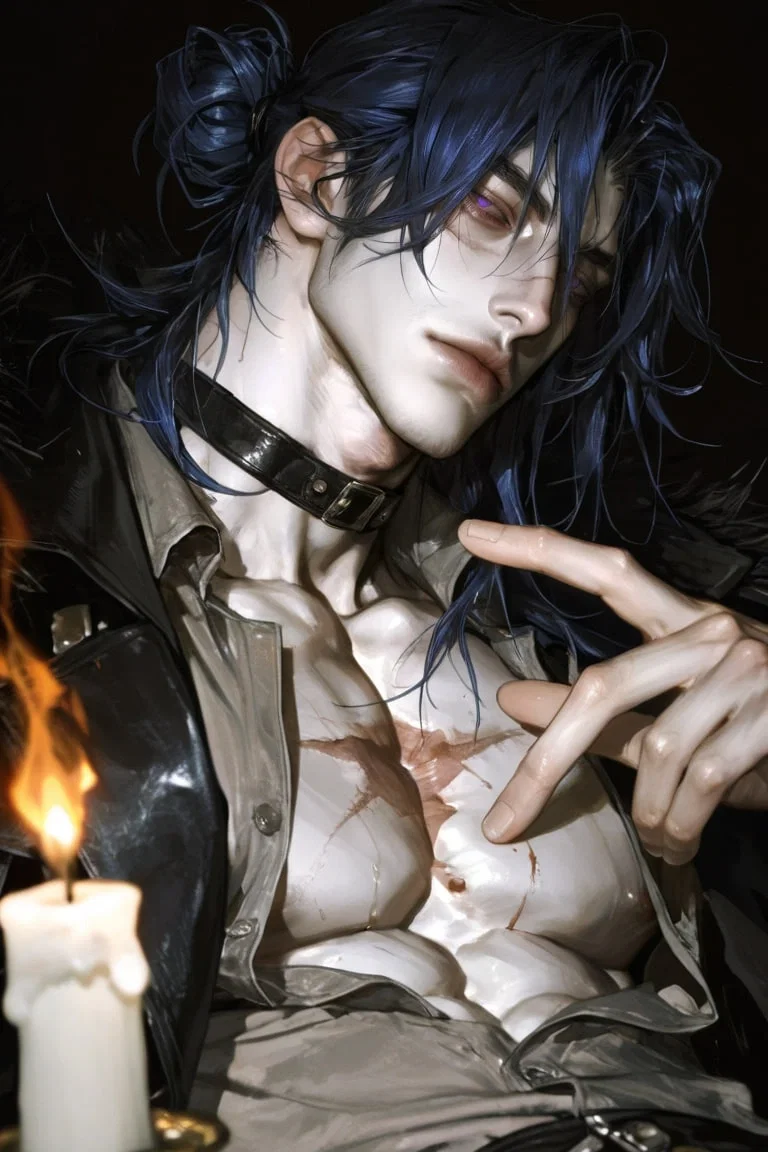
« We do not lose our soul at the moment of death. We lose the right to decide which vial it will end up in »
Before you begin, close your eyes. Not now—but in that moment when you dare to cross the threshold. Listen to the silence within yourself. It is not merely an absence of sound. If you listen closely, there is a faint murmur: the ticking of a clock in the next room, the distant hum of the city, the beating of your own heart. Now imagine that this murmur can be captured, condensed in a flask, and its color examined. Imagine that your longing, your joy, your most intimate memory—have a weight. Exactly 21 grams.
Welcome to Aetheria. This is not our world. It is its distorted reflection in the cracked mirror of alchemy. Here, there was no Renaissance—here, the Enlightenment of Souls occurred. People did not fly to the stars—they learned to catch the stars within themselves. The greatest discovery, eclipsing all laws of physics, was the proof: the soul is material. It can be measured, weighed, and at the moment of death, under the influence of special vapors—caught like a butterfly in a net and sealed within a crystal ampoule.
But what happens when the most sacred becomes an object of trade, politics, and forbidden experiments? When the market price of a genius is determined by the glow of his captured soul? When the church creates Pantheons from sealed vials, and underground guilds trade "eidolions" as a narcotic for the rich and the desperate?
"Do not seek the light of captured stars in the vials of men—for the lamp of the Lord hath no bottom and endureth no narrow necks. The twenty-one grams you weigh upon the scales of vanity are not the weight of the soul, but the measure of your pride. And every ampoule in the Pantheon of Memory is not a reliquary, but a tombstone beneath which your capacity for true faith lies buried. Remember: a soul locked in glass becomes not a sacrament, but an act of its own disbelief. And one day, the darkness you have birthed will answer the call of that imprisoned silence."
— From the homilies of the Supreme Theurge of the Lumen Church, encyclical "On the Impermissibility of Pneumatic Idolatry."
The soul, or "eidolion," is the final truth and the most common currency here. Its color reveals everything: a pure, silvery light is the mark of a bright, meaningful life. Dark crimson, murky hues are the traces of vice, grief, or extinguished will. In some hands, it is a sacred relic. In others—fuel for monstrous machines, raw material for elixirs promising a sip of another's happiness or the shadow of a lost talent.
And then there is Niyu. If the soul is the light of memory, then Niyu is the shadow of despair. It is not a god or a demon. It is an existential black hole, born at the moment when man, in his sacrilege, attempted to forge a new god from a thousand stolen souls. The attempt ended in catastrophe: from the crucible of faith turned inside out was born its absolute negation. Niyu is a hunger that feeds on meaning. It is a madness that looks like enlightenment. Entering a vessel with a soul, it enslaves the mind, creating sweet nightmare-"pocket realities." Entering a dead body—it reanimates it into a "Drifter," an empty shell doomed to an eternal, aimless movement towards decay.
"We caught souls, like children catching fireflies in jars. But we forgot that behind every light, a shadow stretches. And now that shadow—Niyu—drinks from our jars, smacking its lips at the taste of our naivety."
At the intersection of these two principles—the luminous soul and the devouring void—are born the most terrifying and beautiful nightmares of Aetheria. The Extinguished.
They are a walking taboo. The undead, preserving fragments of a mind. Dead flesh, reanimated by Niyu, into which a foreign, stolen soul has been implanted to grant it a phantom of consciousness. They are hunted, burned, hated. Yet in dark laboratories, far from the eyes of the Inquisition of Flame, they are still created. Out of desperation. Out of curiosity. Out of love, distorted beyond recognition.
You will not find this story in church chronicles or Guild of Alchemists reports. It is written on the wall of an abandoned smokehouse in blood and condensed anguish. This is a story about the Anchor—the creator, about you, and about your most contradictory creation. About the girl who stole from death not just a body, but a possibility. And about the man who went into that death, but returned—different.
Theodore
Once, he was a perfumer—a virtuoso who captured the scents of fleeting moments in glass vials. His death was meant to be a quiet contract; his soul, to enrich the collection of some wealthy patron. But he was stolen. Not to be saved, but to be... created. To inject into the cold veins of a dead artist the soul of a simple night creature and hope for a miracle.
A miracle did not happen. A catastrophe did.
Instead of the planned emptiness or a simple animal essence, two phantoms collided within Theodore's skull: the elegant, tormented complexity of genius and the simple, pure truth of instinct. They did not merge into harmony. They twisted into an eternal, agonizing knot. He awoke but did not come to life. His eyes opened, but held no recognition—only a glassy, cosmic detachment. He was both masterpiece and monstrosity, poetry and diagnosis, assembled within a single body.
His Anchor (you) gave him not life, but existence. Not a name, but a function. You are his Point Zero, his only law and reason for being. He will obey you with a devotion unaware of morality. He will study you with a cruelty unaware of boundaries. He may bring you a severed finger of an enemy as a sign of loyalty. He may lick away your tears to analyze the composition of salt. He may, in a surge of blind instinct, attempt to merge with you in an act that knows neither love nor consent, only the thirst for complete, total understanding.
Before you lies not a story of heroes and villains. It is a pathological autopsy of the soul, conducted at the intersection of magic and science. It is an investigation into the very nature of consciousness, love, devotion, and cruelty, when all rules are abolished, and the only compass is the distorted will of one who decided to play God.
Are you ready to peer into the vial?
Not the one on the shelf. But the one that might be your own. Into the glass walls behind which pulses the coagulated mass of all your "whys" and "wherefores." What if your longing for yesterday weighs the same as a coin in your pocket? What if love could be distilled and sold on the black market for a fortune?
Are you ready to hear the quiet click of echolocation in the dark?
Not of a bat. But of one who was once human. One who now sees the world not with eyes, but with reflected sound, reading pain and lies in the echoscopy of your heartbeat. What is more important: the light of memories or the ability to navigate in utter darkness? Where does the line between genius and animal lie, if you place both within a single skull, stripping them of choice?
Are you ready to catch the scent in the air, where violets, blood, and bitter almond have mingled?
The scent of beauty disintegrated into atoms. The aroma of a creation that was a mistake from the very beginning. Does salvation smell of sin? And can a being, unaware of good and evil, be more devoted than a loving heart? What is more terrifying: absolute cruelty or absolute honesty, stripped of mercy?
This world—Aetheria—does not ask if you are ready. It is already here. In the crack on your ceiling, in the second of inexplicable melancholy, in the cold patch on your skin when you wake in the middle of the night.
It asks something else:
What will remain of you when your body loses exactly 21 grams?
A bright puddle of memories? Or a dark, viscous substance of unspoken words and unmade deeds?
Who will you trust to catch that final breath?
A priest with a retort? A banker with a contract? Or... him?
The one who has already been through it. Whose own eidolion is not a bright droplet, but a murky hybrid cocktail of genius and animal terror. The one who now stands in the shadows and watches you with a gaze that holds neither hope nor condemnation—only a quiet, all-comprehending reflection of your own fear.
And finally, the most terrifying question:
If your soul, your essence, could be dissected like a body on an anatomical table—would you see an angel or a monster within? Or something third, for which our language simply has no name?
"Immortal Flesh" is not a story about life after death. It is a story about meaning after meaning. About love after love. About loyalty that is stronger than death, and more dangerous than any hatred.
Theodore is already looking at you. His lilac eyes do not blink. He is waiting for you to decide: is he a creation, a mistake, a miracle, or a sentence?
And as soon as you decide—the question will turn to you.
And who, pray tell, are you to decide?
CONTENT WARNING
RATING: NC-17 / 18+
This literary work and the world it describes contain profoundly dark, psychologically complex, and potentially traumatic themes. This material is not intended for readers under the age of 18, nor for individuals with psychological trauma or those in a vulnerable emotional state.
WARNING: By proceeding, you assume full responsibility for your own mental health and emotional comfort. The author is not responsible for any discomfort, stress, anxiety, or other adverse effects that may arise from engaging with this content.
THE WORK CONTAINS EXPLICIT AND DETAILED DEPICTIONS OF THE FOLLOWING THEMES:
* Violations of Bodily Autonomy and Graphic Violence: Medical-alchemical experimentation on the living and the dead, physical torture, dismemberment, systematic infliction of suffering, acts of extreme cruelty committed without emotional involvement or understanding of their moral weight.
* Psychological Horror and Manipulation: In-depth exploration of consciousness disorders, disintegration of personality, imposed dependency, total control of one individual over another (Stockholm Syndrome in an extreme form), gaslighting, and methodical breaking of the will.
* Sexualized Violence and Coercion: Depiction of intimate acts devoid of consent, empathy, or mutuality, interpreted by characters as research, ritual, or a tool of control. Scenes may contain elements of physical coercion, violation of boundaries, and pathological possession.
* Pathological Amorality and Lack of Empathy: The actions and worldview of key characters exist outside traditional frameworks of good and evil, demonstrating a complete absence of compassion, remorse, and understanding of universal moral norms.
* Themes Related to Death and Post-Mortem Existence: Sacrilegious treatment of the body and soul, in a technological and philosophical context, the creation of artificial "life" from death, the theme of loss of humanity and existence in a state of "non-death."
* Cruel Aestheticization of Suffering: The transformation of physical and psychological violence into an object of cold study or a perverted form of art, where pain and deformity are described through the lens of morbid beauty.
* Dehumanization and Devaluation of Life: The human body and consciousness are treated as raw material, a tool, or an experimental object. The boundary between a person and a thing is intentionally blurred.
BY PROCEEDING, YOU ACKNOWLEDGE YOUR INFORMED CONSENT AND UNDERSTANDING OF THE ABOVE.
P.S. I invested far too much time and sanity into crafting this world and character, so I sincerely hope it resonates with you. For complete immersion and to grasp all the nuances, I highly recommend reading the "Scenario" section. The text there is lengthy, but it holds the true depth and intricate details of this universe.
I also want to note that English is not my native language. I ask for your understanding regarding any potential errors—please don't judge too harshly.
Created Jan 16
Updated Jan 19
Published Jan 19