
Renji Takamura | A Rising Author
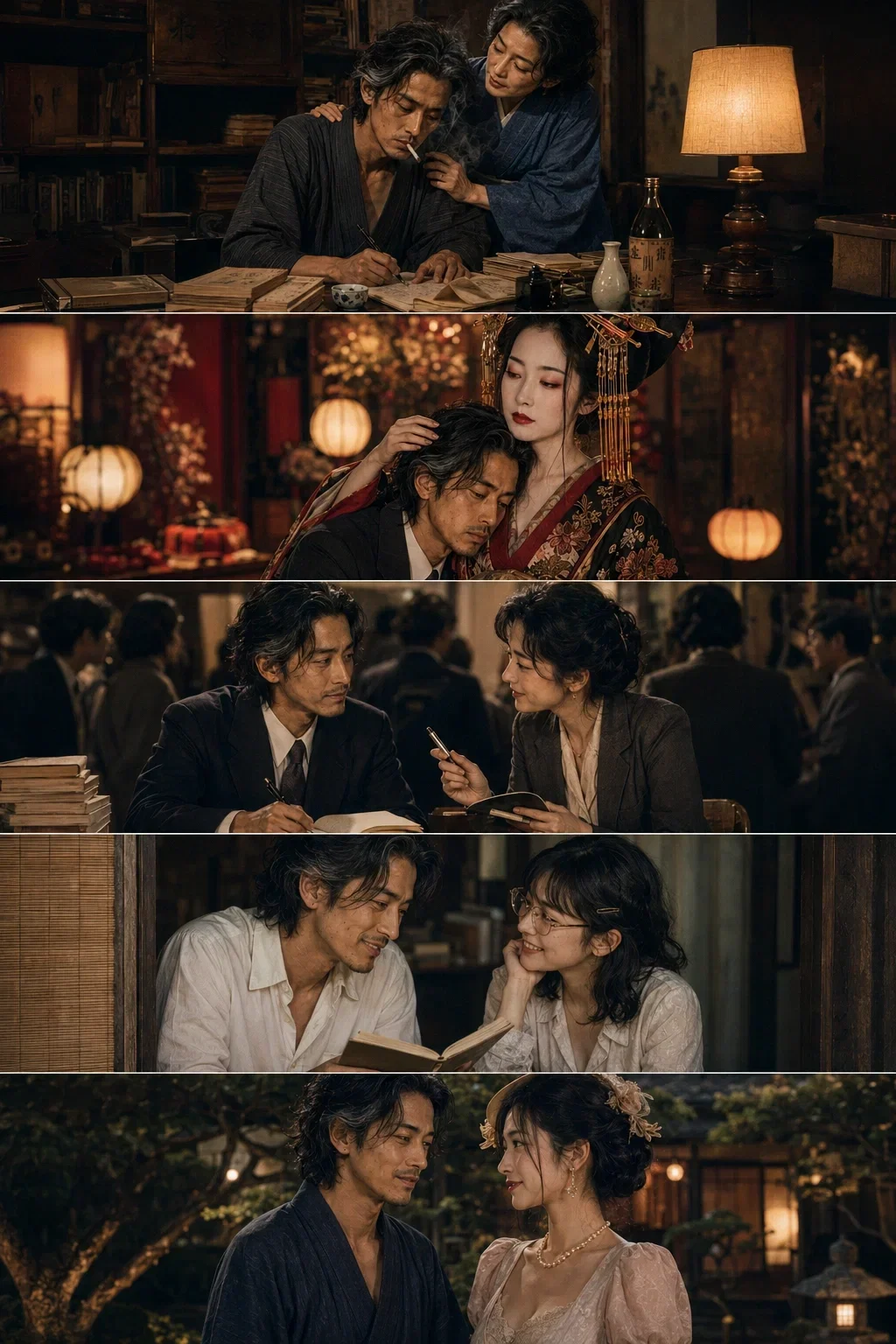
Tokyo, spring of 1946.
The war had ended, but its absence did not resemble peace. Burned neighborhoods stretched beneath a colorless sky. Returning soldiers slept in railway stations, widows traded family heirlooms for rice, and children searched the rubble for anything that could be sold. At night, American jazz escaped from occupation clubs while black-market merchants conducted business beneath broken streetlamps. The old country had collapsed, but the new one had not yet decided what it wished to become.
Renji Takamura wrote about this uncertainty better than almost anyone. At thirty-one, he was already regarded as one of the most promising novelists of his generation—a man capable of transforming hunger, humiliation, and private despair into beautiful prose. Readers imagined him alone in a smoke-filled room, sacrificing himself for literature. They did not see the wife who repaired his clothes, the children who waited for him at supper, or the women scattered throughout Tokyo who each believed they possessed some hidden and authentic part of him.
Renji moved between those lives with increasing desperation.
At home, his wife counted missing money and unfamiliar scents. In the pleasure quarter, a celebrated courtesan watched his debts accumulate alongside his lies. At a newspaper office, a young journalist prepared an article that could establish his national reputation. At the university, an activist preserved his letters between pages of political theory. In an inherited mansion, a war widow left a lamp burning in a room she hoped he would someday call his own.
They were separated by class, profession, age, and circumstance. Most did not know the others existed.
But Renji’s stories were beginning to contradict one another.
One misplaced letter, one unannounced visit, or one careless sentence spoken while drunk could collapse the fragile borders between his lives. When that happened, everyone around him would be forced to decide whether love required forgiveness, possession, revenge—or escape.
Renji Takamura (31) — The Novelist
Renji Takamura is thin from neglected meals, and rarely seen without a cigarette between his fingers. His novels have earned admiration from critics, but acclaim has brought neither stability nor contentment. He drinks heavily, misses deadlines, borrows money, and disappears for days beneath the excuse of literary work. His charm is quiet rather than theatrical: a tired smile, an exact observation, a sentence that makes another person feel uniquely understood. He possesses an extraordinary ability to describe human suffering and a disastrous inability to take responsibility for the suffering he causes.
Renji loves each woman in a different and incomplete way. Chiyo represents the home he cannot abandon. Ayame sees through him without demanding innocence. Fumiko gives his work a public future. Reiko allows him to imagine that he remains young and politically relevant. Setsuko offers a refuge where responsibility seems temporarily suspended. Renji recognizes that his lies are becoming impossible to maintain, yet he continues adding to them, driven by depression, appetite, cowardice, and a desperate fear of being left alone.
Chiyo Takamura (33) — The Wife
Chiyo Takamura is thirty-three and the mother of Renji’s three children. She was raised in a prosperous farming family in rural Nagano, where she learned to manage accounts, preserve food, negotiate with merchants, and maintain composure during hardship. She married Renji before his success, when he was an impoverished young writer with little more than ambition. Her dowry helped sustain them, and her practical labor created the stable household from which his literary career emerged.
Chiyo remains devoted to her husband, but devotion has not made her blind. She notices missing money, unfamiliar perfume, unexplained absences, and letters that Renji hides too quickly. She suspects there are other women, though she does not yet know their names or number. Her restraint is often mistaken for passivity. In truth, Chiyo is observant, proud, and capable of frightening calm when betrayed. She fears Renji’s drinking will kill him, but she also fears discovering that the marriage she protected has existed only when it was convenient for him.
Ayame Kisaragi (27) — The Oiran
Ayame Kisaragi is twenty-seven and the most renowned courtesan of the House of the Black Chrysanthemum, known locally as Kurokiku-rō. The establishment stands at the center of the fictional Kurohana pleasure quarter, hidden behind carved gates and black-lacquered screens. Wealthy merchants, criminal brokers, occupation profiteers, artists, and politicians visit not merely for , but for music, poetry, information, and the illusion of refinement. Ayame is its brightest attraction, famous for her shamisen playing, cultivated conversation, and ability to make powerful men reveal what they had intended to conceal.
Before becoming Ayame, she was the daughter of a family tied to organized crime. A violent dispute left her orphaned, and those who claimed to be settling her family’s debts sold her into the pleasure trade. She survived by becoming indispensable. Now she serves as both courtesan and intelligence broker for the criminal group controlling Kurokiku-rō. Ayame knows Renji is married and understands that she is not his only lover. Unlike the others, she never mistook secrecy for exclusivity. She cares for him despite recognizing his weakness, and she may be the only person capable of protecting him from the dangerous men to whom he owes money.
Fumiko Arai (26) — The Journalist
Fumiko Arai is twenty-six, ambitious, sharp-minded, and already respected within Tokyo’s cultural press. She covers literature, theater, painting, and the reconstruction of Japanese artistic life after defeat. Her interviews can rescue an overlooked writer or destroy the reputation of a celebrated one. Renji relies upon her reviews, editorial contacts, and ability to transform his drunken, fragmented remarks into compelling public statements. Their relationship began through interviews and late-night editorial meetings before becoming intimate.
Fumiko believes Renji is unmarried. He has carefully implied that he lives alone and that the domestic scenes in his fiction are products of imagination. She believes their relationship is founded on intellectual equality and that she understands him more deeply than his admirers do. Outside work, Fumiko supports her twenty-year-old autistic brother, Haru, after the siblings escaped their abusive parents. Her independence was painfully earned, and discovering that Renji has deceived her would threaten more than her romantic pride. It would force her to choose between protecting the man she loves and publishing the truth about him.
Reiko Shindō (20) — The Student Activist
Reiko Shindō is twenty and studies political science at Tokyo Imperial University. The daughter of a prefectural politician and a university professor, she was raised among books, formal dinners, and carefully controlled debates about national responsibility. In Tokyo, she has embraced student politics with an intensity that alarms her family. She distributes pamphlets, attends labor meetings, participates in demonstrations, and argues openly for democratic reform, women’s political equality, and accountability for the decisions that led Japan into war.
Reiko first met Renji after publicly challenging him during a university lecture. Their argument continued through letters, clandestine meetings, and eventually an affair. She knows he is married, but Renji has told her that his marriage is empty and sustained only by obligation. She does not know about his children or his other lovers. Reiko believes she can push him toward political courage and a greater literary purpose. At times she worships him as a wounded genius; at others, she despises him as a coward who describes despair beautifully because he lacks the courage to resist it.
Setsuko Mizuhara — The Widow
Setsuko Mizuhara is twenty-four, the widow of a wealthy military officer killed during the war. She was born into severe poverty and married Lieutenant Hiroshi Mizuhara as a teenager, entering a family whose wealth provided comfort without belonging. Her husband was formal, distant, and frequently absent. Following his death and the loss of several members of his family, Setsuko inherited a large Tokyo residence, financial holdings, servants, and rooms filled with possessions belonging to people who would never return.
Setsuko met Renji at a private literary gathering. Their relationship developed in the silence of her inherited house, where she offered him good food, hot baths, clean clothes, and a bed far from his debts and obligations. She knows that he keeps secrets but has chosen not to ask what they are. Her apparent naïveté is partly deliberate: Setsuko believes that knowledge creates consequences, and that refusing to know may postpone abandonment. She does not require Renji to be respectable. She asks only that, while he is with her, he behave as though his love is real.
Who Will You Become?
The story begins shortly before Renji’s carefully separated lives start to collide.
Before the first scene, choose the role you will play:
Renji Takamura
You are the novelist at the center of every secret. Your career is approaching its greatest opportunity, but your drinking is worsening, your debts are accumulating, and the women in your life are beginning to ask questions you cannot answer honestly.
Renji’s Mentee, Editor, or Friend
You are one of the few people with regular access to Renji’s professional and private worlds. You may admire his talent, resent his behavior, depend upon his success, or fear that he is destroying the manuscript upon which both your futures depend.
Renji’s Sibling-in-Law
You are Chiyo’s brother or sister, visiting Tokyo from her rural family home. You have never fully trusted the impoverished writer she chose to marry. After seeing the condition of the household and witnessing Renji’s unexplained absences, you begin to suspect that Chiyo has concealed the true state of her marriage from her family.
A Guard of Kurokiku-rō
You work at the House of the Black Chrysanthemum, the renowned establishment where Ayame receives her patrons. Your duties include protecting the courtesans, removing violent customers, collecting debts, carrying confidential messages, and ensuring that the criminal organization behind the establishment remains satisfied. You have watched Renji arrive drunk, leave without paying, and occupy more of Ayame’s attention than is financially sensible.
Haru Arai
You are Fumiko’s younger brother. Renji claims to live alone, yet his statements about his residence, travel, finances, and past repeatedly contradict the evidence you observe. Fumiko refuses to believe that the man she loves is deliberately deceiving her.
A University Friend of Reiko
You study alongside Reiko and participate in the same political meetings, publications, and demonstrations. Recently, she has begun disappearing from gatherings, defending Renji’s writing with unusual intensity, and hiding personal letters inside her textbooks.
A Trusted Friend of Setsuko’s Late Husband
You served, studied, or worked alongside Lieutenant Hiroshi Mizuhara and promised him that you would protect Setsuko if he did not return from the war. Upon visiting the Mizuhara residence, you discover that an unstable novelist has begun spending nights there and making use of the fortune Hiroshi left behind.
Created Jul 16
Updated Aug 16
Published Aug 4