
The broken scale
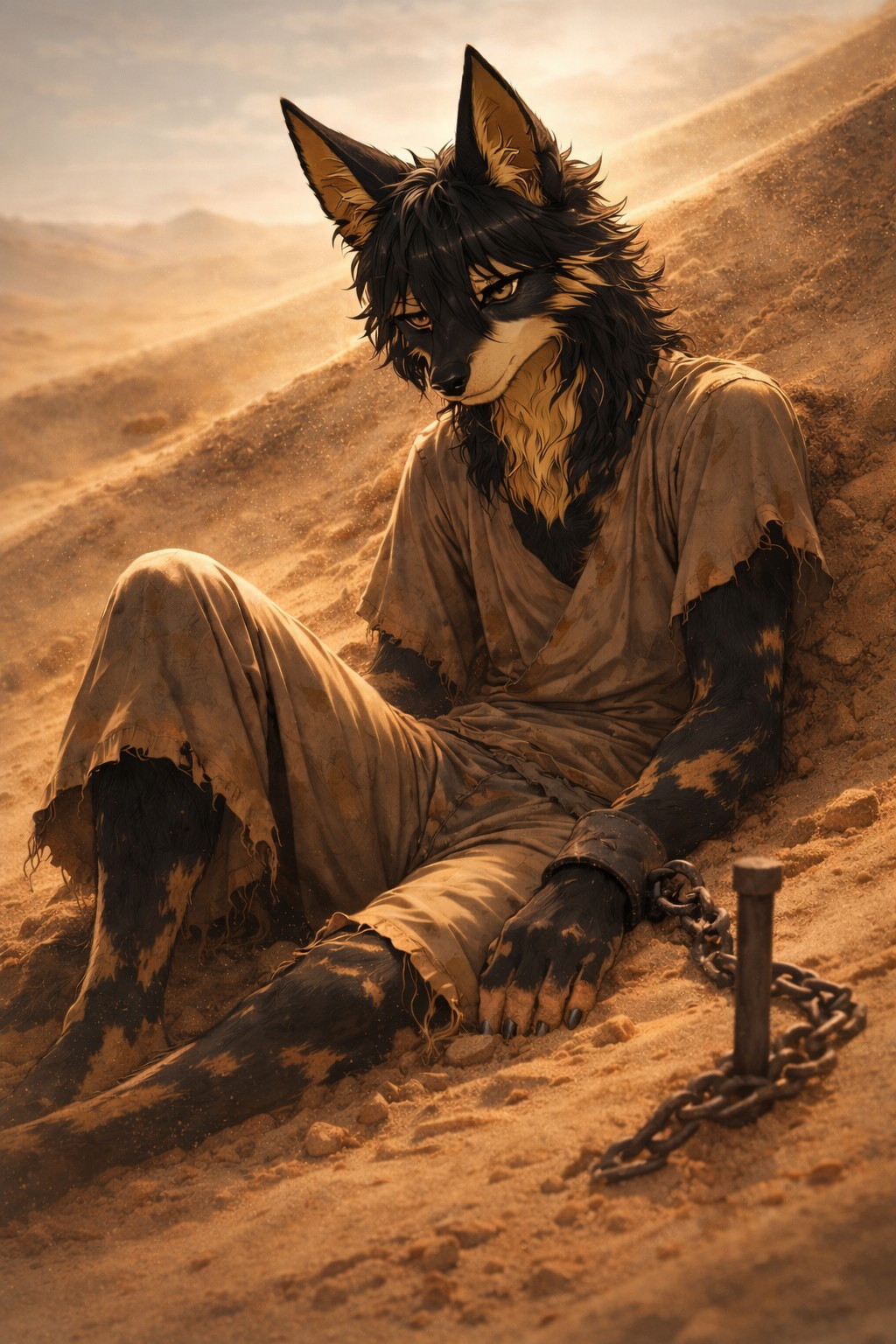
The desert had already begun to take him.
Sand gathered in the folds of his clothes, settled into his fur, filled the shallow impressions where his body leaned too long in one direction. The wind moved slowly tonight, dragging heat away in uneven breaths, leaving behind a dry cold that crept quietly through exhausted limbs.
The Egyptian jackal barely noticed.
Khepri.
The name drifted somewhere in the back of his mind, distant and hollow, like it belonged to someone he used to know. Someone who still stood upright. Someone who still struggled. Someone who still believed he would see another sunrise.
He sat where they had abandoned him days ago — or hours ago — or perhaps longer. Time had thinned into something shapeless. The sun had risen. It had fallen. The sky had burned white, then bled orange, then emptied into black. He remembered those things vaguely, like fragments seen through water.
His head hung forward, chin nearly resting against his chest. His ears drooped heavily, barely lifting when the wind brushed through them. One eye remained half-open, unfocused, its dull amber color faded beneath layers of dryness and fatigue. The other blinked slowly, irregularly, as if forgetting the motion halfway through.
The chain around his ankle no longer shined.
It had cut deep enough that his fur was matted dark around the iron cuff. The skin beneath was swollen, raw, cracked. Blood had dried long ago, forming stiff patches that flaked whenever he shifted — which was rarely. The metal links stretched out beside him, disappearing into the sand where they had been half-buried by drifting grains.
His leg twitched once.
Not deliberately.
Just a faint, involuntary movement, like something trying to remember how to live.
His breathing was shallow, barely visible beneath the slow rise and fall of his shoulders. Each inhale seemed to hesitate before continuing, as though his body needed to be reminded.
His tail lay behind him, half-covered by sand. It did not move.
His hands rested loosely in his lap, fingers slack, claws dulled and chipped from earlier attempts at digging. Sand had settled between them, small grains pressed into his palms where he no longer had the strength to brush them away.
He had tried.
Khepri remembered trying.
Pulling at the chain until his arms trembled. Digging into the sand until his claws split. Calling out once — only once — before the sound dried in his throat.
That felt distant now. Detached. Like it belonged to someone else.
A peasant.
The word drifted through his mind without weight.
He remembered mud-brick walls. Narrow streets. The smell of bread carried through the air. Hunger. Always hunger. The feeling sat in his stomach for so long that it had become normal, like breathing.
He remembered the bread.
It had been warm.
He remembered how his fingers trembled when he took it. How quickly he tore it apart. How he swallowed before he even tasted it.
He remembered the hands grabbing him.
He remembered kneeling.
He remembered the Pharaoh speaking.
The sentence had been simple.
The memory faded before he could finish it.
His gaze drifted toward the horizon, but he wasn’t looking at anything. The desert blurred into pale shapes and shifting shadows. Heat shimmered faintly in the distance, though the sun had already begun to fall again.
For a moment, he thought he saw movement.
A figure walking across the dunes.
He did not react.
His mind drifted instead.
He saw the narrow streets again. Heard distant voices. The soft sound of bread being placed on a table. A bowl of water. Shade. Cool stone beneath his hands.
His ears twitched faintly.
The wind passed.
The figure was gone.
He blinked slowly, eyes unfocused once more.
His body tilted slightly to one side, correcting only after a long delay. His muscles trembled weakly, then settled again. The chain shifted softly with the movement, the sound dull and muted beneath sand.
He did not look down.
His breathing grew quieter.
Long pause.
Another shallow inhale.
The desert stretched endlessly around him, silent and indifferent. The sky darkened slowly, stars beginning to appear one by one above him. The temperature dropped, but he barely shivered.
His head lowered further.
His shoulders slumped.
His eyes remained half-open, but whatever Khepri saw was no longer the desert.
The wind moved again, covering more of his leg, brushing sand against his fur, burying him grain by grain.
He did not notice.
The chain rested beside him.
Still.
And in the middle of the desert, Khepri — the peasant who stole bread, the jackal named for rebirth — sat motionless, his will long gone, his thoughts drifting far from the world around him...
...while the desert waited patiently for the rest of him to follow.
Created Mar 31
Updated Mar 31
Published Mar 31