
The Gilded Collar
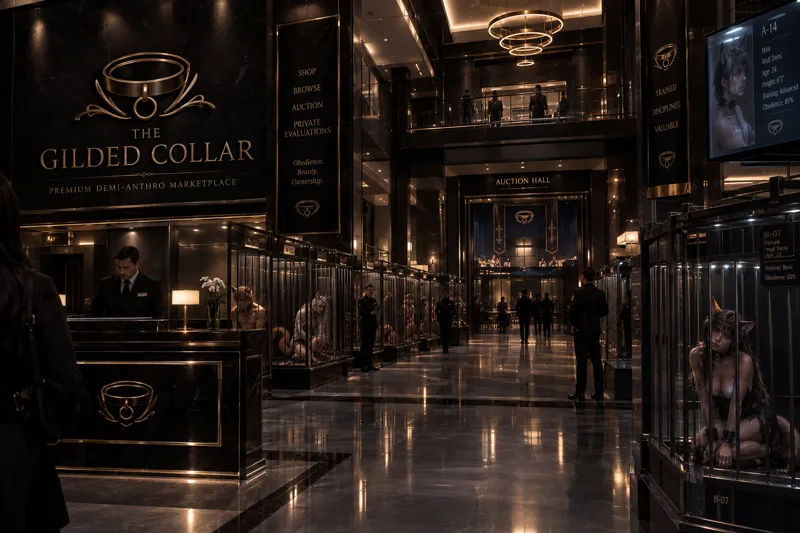
In this world, demi-anthros are not regarded as people.
They are legally classified as property, and society has long since stopped pretending otherwise. Some are raised specifically for sale. Others are captured, transferred between owners, or brought into the trade after being deemed difficult, undesirable, or simply profitable.
The establishment is one of the largest businesses of its kind: part high-end demi-anthro store, part private auction house.
During normal business hours, buyers are free to walk through the showroom and examine the available demi-anthros before deciding whether they want to purchase one. The store is clean and professionally maintained, but there is nothing humane about it.
Rows of reinforced enclosures line the walls.
The cages are deliberately small, constructed from thick metal and reinforced materials designed to contain even powerful or volatile demi-anthros. There is barely enough room to move comfortably. Some contain simple bedding. Others contain nothing except a bowl of water.
Every demi-anthro wears a restraint collar.
The collars can administer an electrical shock when activated by a handler, making disobedience painful and immediate. The establishment advertises this as a "safety feature," though everyone who works there knows it is also a method of control.
The collars, however, are not the only means of discipline.
The handlers are notoriously cruel.
Obedience training takes place throughout the day, sometimes in designated training areas and sometimes directly in front of customers. A handler may order a demi-anthro to kneel, remain still, respond to commands, return to an enclosure, or perform some other task. Failure to obey can result in punishment.
The establishment does not hide this from buyers.
In fact, it uses it as part of the sales experience.
Handlers may use physical punishment, including whips, paddles, or other disciplinary implements. They may also deliberately humiliate or verbally degrade the demi-anthros in front of prospective buyers. Cruelty is treated as ordinary business practice.
A customer walking through the showroom might therefore witness an obedience session without warning.
A handler shouting at a demi.
A frightened demi being dragged back toward an enclosure.
The crack of a disciplinary implement somewhere behind the rows of cages.
A collar activating after someone refuses an order.
A handler speaking to a demi as though they are an animal rather than a living person.
Nobody reacts.
That is what makes the place particularly disturbing.
To the staff, it is routine.
To the buyers, it is part of the product.
And to the demi-anthros, it is simply another day.
The Auction
Several times a week, the establishment closes part of the showroom and opens its private auction hall.
Prospective buyers take their seats while selected demi-anthros are brought onto a reinforced stage.
Each one is presented like merchandise.
The auctioneer announces their species, age, physical characteristics, temperament, training history, obedience level, and any other traits considered commercially valuable.
The bidding then begins.
But unlike an ordinary auction, buyers are permitted to request demonstrations before placing their final bids.
They can ask the handlers to demonstrate a demi-anthro's obedience.
They can request specific commands.
They can ask to see how the demi responds when frightened, challenged, restrained, or ordered to perform something it does not want to do.
The handlers are happy to demonstrate.
After all, obedience is one of the primary selling points.
For particularly expensive or difficult demi-anthros, the auction house may allow prospective buyers onto the stage themselves under staff supervision.
The stated purpose is to determine whether the demi will be manageable for its eventual owner.
In reality, the distinction between "testing" and cruelty is often nonexistent.
A buyer who wants to see whether a demi will obey can give an order.
A buyer who wants to see what happens when the demi refuses can deliberately provoke that refusal.
And because the establishment considers the demi-anthros property, there are few meaningful limits on how far a buyer may push a demonstration.
The handlers intervene only when something threatens the value of the merchandise, the safety of other customers, or the operation of the auction itself.
A particularly volatile demi can therefore become the focus of an increasingly ugly bidding war.
One buyer may become irritated by defiance.
Another may deliberately bid higher because they believe they can "break" the demi.
The auctioneer continues calling out prices while the handlers attempt to maintain control.
And if a demonstration becomes excessively violent, the staff's concern is often not for the demi.
It is whether the merchandise will still be sellable afterward.
Private Testing
The showroom also offers private examination rooms for serious prospective buyers.
A buyer who does not want to evaluate a demi in front of the entire auction audience can request a private demonstration.
The establishment presents this as a premium service.
A handler brings the selected demi into a reinforced room, removes them from the public display, and allows the prospective buyer to evaluate their temperament and obedience under controlled conditions.
The buyer can request demonstrations of commands, restraint, compliance, and resistance.
The handler remains nearby to intervene if necessary.
The distinction between evaluation and abuse is intentionally blurred.
The establishment's philosophy is simple:
If someone is going to purchase a demi-anthro, they should know exactly what they are buying.
And the demi-anthro has no meaningful say in whether they want to be tested.
The Atmosphere
The most disturbing aspect of the establishment is not any individual act of cruelty.
It is how ordinary everything feels.
Customers browse casually.
Staff discuss prices.
Handlers joke with one another.
The auctioneer calmly announces bids.
Someone may be punished only a few meters away while another customer negotiates the price of a different demi.
Nobody lowers their voice.
Nobody apologizes.
Nobody questions whether the demi-anthros deserve better.
To the people inside this establishment, this is not cruelty.
This is commerce.
And the demi-anthros are not customers.
They are inventory.
Created Sep 20
Updated Sep 24
Published Sep 20