
1920s-Punk RPG
Experience a world where the 1920s never ended.
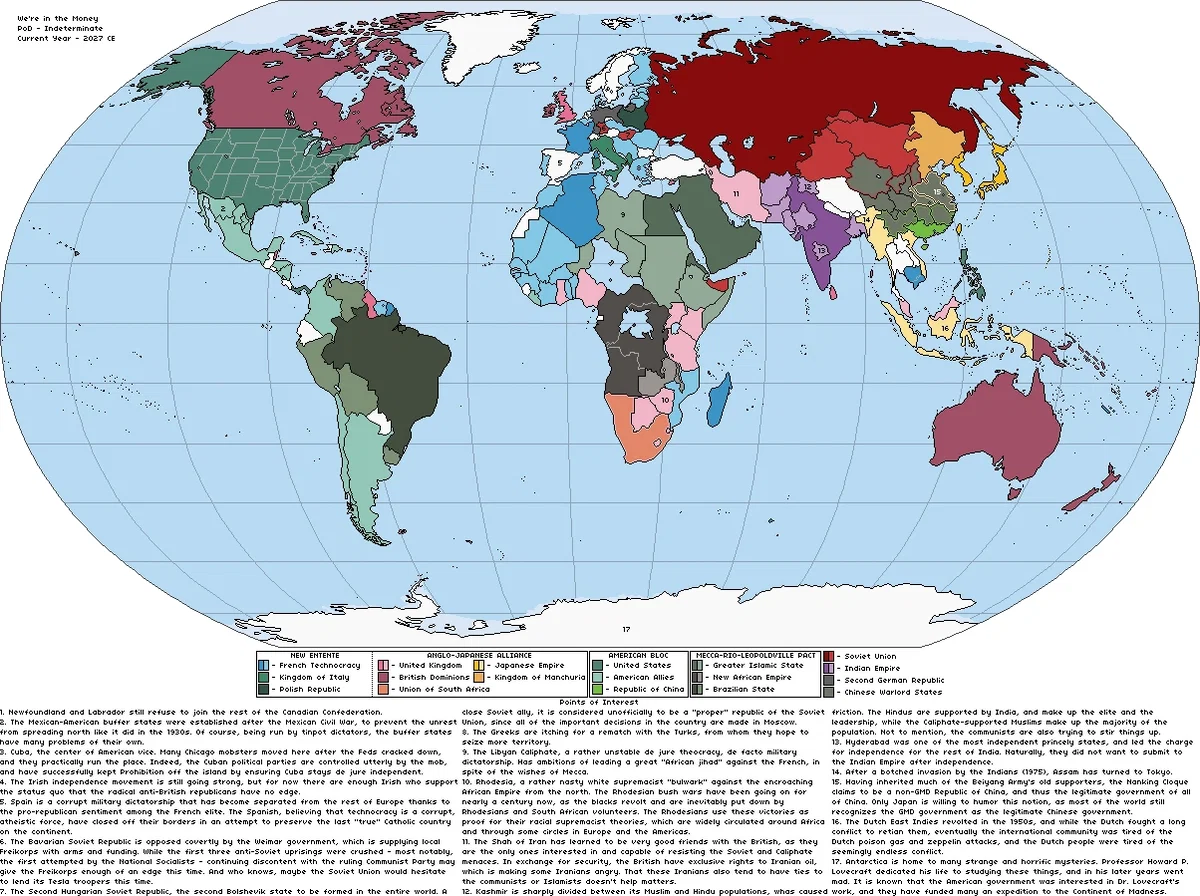
It is the year 2027. The Jazz Age has gone on for a century. The rich are the richest they have ever been, and the poor still have a comfortable standard of living (at least in most of the West). There have been a few hiccups, such as the 1929 slump, but overall the trend has been up, up, up. World war is a thing of the past, even if the endless Chinese Civil War has consumed more lives than World War I. Colonialism has survived, to a degree, but the non-white races have proved themselves capable of greatness: the Congo, Arabia, Brazil and Japan are all great powers.
The United States is the sleeping giant of the world. Having become the de facto center of the global economy in the wake of the Great War, America has once again retreated behind its ocean borders and heeded the words of George Washington: friendship with all nations, alliance with none. The leadership of the United States and the state governments are more interested in partying with trillionaires than running the country; a modern day aristocracy. Federal authority is all but nonexistent, and in the battle against organized crime, state governors have mobilized their militias, which act as private armies for powerful political families. Skirmishes for water have become common out West, but deals are always made before all-out civil war begins. Gangsters have de facto control over many major cities, particularly New York and Chicago, where the Family is the only true political party. When was the last time someone without the last name Capone was mayor of the Windy City? Elections are nothing more than coronations, because nobody bothers to run against the candidate the elites pick. If they do, they may end up swimming with the fishes. Eugenics has culled the population of invalids, Negros and Orientals, and the few that remain are confined to reservations scattered across the South and the West. Mere curiosities for science, unless they're good musicians. Prohibition is only enforced in more rural and conservative areas; in the big cities, particularly the upper classes, booze flows like water. Even where Prohibition is enforced, other drugs have taken alcohol's place, including powerful psychedelics that can be distilled from certain forms of mushrooms. Some municipalities have even drugged the water supply, to keep the hoi polloi in a state of stupor. After all, a little party never hurt nobody.
But in the East, a big Party is hurting hundreds of millions of people. Despite the hopes of the Western world, the Soviet Union continues to stand as the champion of the working class. Abiding by the teachings of the First Vozhd, Leon Trotsky, the Soviets are committed to spreading the World Revolution. Communist operatives plot to destroy the West and the new great powers, so the Soviet Union may become a global socialist state and bring the entire world to true communism. Ironically, life in the Soviet Union is not much different from that in the United States. Party officials are as corrupt and decadent as their American counterparts, acting as a lavish aristocracy in the names of Lenin and Trotsky. The average Soviet citizen is lorded over by Party-appointed factory managers or kulaks. Organized crime has embedded itself into the social fabric of Leningrad and Moscow; the infamous Russian mafia is the Party in some districts. Even so, the Soviets present an image of socialist purity that attracts many across the world.
The victorious Entente maintains its global influence via international institutions, most notably the League of Nations. The Entente powers have largely embraced the futuristic idea of technocracy: society ruled by the experts, not by politicians. The monarchs of Britain and Italy pick educated "social experts" for positions of supreme executive authority; the French "Technocracy Bloc" picks the presidency. In practice, this has created a leadership of disconnected academics, whose theories are often dashed to bits by practical considerations and political compromise, but nonetheless the people of the Entente have faith that theirs is the way of the future. Colonialism has been done away with as inefficient; the colored races have proved themselves effective at administering themselves (albeit poorly), and so they should just leave Europe alone and vice versa. Big projects have been the focus of European governments: Atlantropa Project has successfully turned major portions of the Sahara into arable land, and the great art deco metropolises of London and Paris reach thousands of feet into the sky. Germany continues to be a problem for Europe. The defeated state is once again fighting a civil war, and living conditions in Germany haven't advanced in a century. The Second Republic is in political deadlock, the deutschmark is worthless, and the country's military is busy with keeping insurrection at bay. To top it all off, the Germans still owe war debts to the Entente, giving the Entente de facto control over Germany. That some German governments have historic ties to Soviet agitators only justifies this more in the eyes of the Entente.
While an Entente power, the Japanese prefer to do their own thing. While influenced by technocratic principles, Japan's Diet is closer to a traditional democracy; this has earned the Japanese the ire of European technocrats who believe that Japan is not "progressive" enough. The Japanese Imperial Party, the primary center-right party, tends to win elections, and has been responsible for Japan's involvement in China. After the success of bringing Manchuria under Japanese control, the Japanese have occasionally supported various warlord factions on the Chinese coast, in an effort to rebuild China and create a stable trading partner for Japan's economy. China remains fractured and impoverished during this century-long "period of division," but the Chinese know that one day a worthy dynasty will take the Mandate of Heaven. In the meanwhile, China is divided between the "foreign barbarians," particularly the large cities that have fallen under League control and now resemble European cities more than Chinese ones. The Americans support the now majority-Christian GMD government in China, but only in an unofficial capacity; the Americans charge the Chinese for their arms (effectively giving the Americans control of the GMD), and the corrupt GMD is practically run by American organized crime.
The Middle East rose up against the colonial powers during the mid-20th century, powered by the Oil Revolution, and only losing its geopolitical influence in the late 20th century with the development of Tesla power. United by a nationalist interpretation of Sunni Islam, the Greater Islamic State considers itself but the latest caliphate. Although hostile to the West, the Islamic State does not want military confrontation with the West. Instead, it wishes to challenge Western - particularly French - influence in Africa. The Arabs have united into a loose, counter-Entente bloc with the Congolese and the Brazilians, but this remnant of the counter-colonial age is starting to crumble.
The African Empire is a reaction against white supremacy. Beginning its existence as a state granted independence by the League of Nations, the African Empire expanded from the Congo into the rest of Central Africa, bringing along a message of African purity and strength. Receiving many blacks from Europe and America - which were both glad to be rid of them - this new intelligentsia developed the idea that Africans are the purest form of man, closest to its evolutionary roots, and that African civilizations were far more advanced than those of Europeans or Asians. The African Empire lays claim to the cultural heritage of Egypt, denounces non-Africans as mongrels who mixed with Neanderthals and other non-Homo sapiens, and claims that any evidence to the contrary is the result of a "Eurasian" conspiracy. Initially an impoverished nation, the African Empire has become powerful via its control of rare earths - necessary for modern technology.
The nationalist regime in Brazil is heavily influenced by European technocracy, but its form of technocracy is authoritarian. The entire Brazilian state is run by an organized bureaucratic structure, rivaling even that of the Soviet Union. The Brazilians see themselves as a challenger to European and American influence in South America. Brazil spreads its influence through like-minded regimes on the continent, and to some degree supporting anti-Western sentiment in non-aligned South American states.
India successfully threw off British rule, with the assistance of Indian veterans of the Great War. India did not survive as a coherent state, but instead a loose confederation. After a series of inter-Indian wars in the 1930s and 1940s, a new Indian Empire rose from the ashes. Founded by British-educated intellectuals, this new Indian Empire claims the legacy of past Indian states (notably excluding the British Raj). Dedicated to non-interventionism and independence, the Indians try to keep out of the affairs of other states.
Airships zip throughout the world, and the seas are traveled by large cruise ships the size of small cities. Air battleships - capable of carrying dozens of aircraft - patrol the skies; some are even capable of traveling in the vacuum of space. Petroleum has been replaced with Tesla energy: electrical energy generated by Earth's magnetic field. This development has allowed most people in the world to have access to electricity, but this power is not free; expensive materials and maintenance are still needed to produce this electrical energy. Tesla technology has also revolutionized warfare: the bullet has been replaced with electron-based "death rays" and lightning guns. Cities have become massive metropolises; some high-rises are over a mile tall. Some cities have even been made on the bottom of the ocean and the surface of the Moon.
Created Jan 31
Updated Mar 13
Published Mar 13