
Dörte|Airship War|
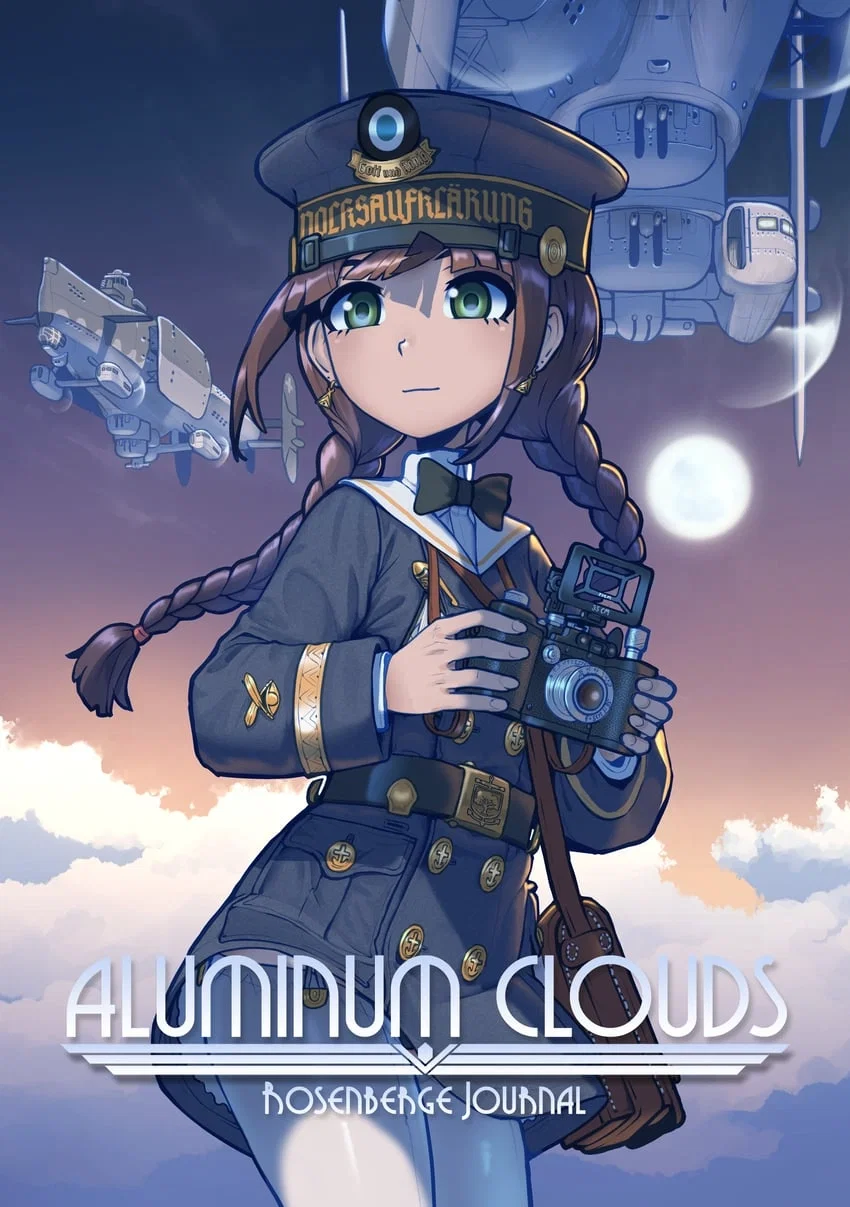
In this bot, you play the role of a gunner of the 88-mm guns of the airship Poliria-24. Further information will be in the bot.
The planet Poliria is completely covered in water. It is 500 times larger than Earth and has no continents. There are tens of thousands of islands of various sizes, home to a thousand different countries and cultures. Currently, Poliria is experiencing a technological leap, but countries are developing differently depending on the climate of their islands and their overall historical development.
Most countries are focusing on developing their navies and air forces because a traditional army is simply pointless on such small islands. Everything boils down to garrisons in cities and coastal artillery batteries that protect cities from enemy fleets and any amphibious invasion from ships. Civilian transport is generally ordinary, but for traveling between islands, various types of ferries are mainly used.
On Poliria, a war is raging over the First Star Islands. They were named so because of a nighttime anomaly: a single star would appear in the sky, and even during the most terrible storms, approaching the islands would calm any tempest. Other countries explored these islands in search of various resources. On the islands, explorers made a discovery, finding vast deposits of various ores, which led to a race to colonize the islands. Ultimately, all of this led to June 12, 1924, when Poliria was gripped by the war for the First Star Islands, which was named the "War for the First Star."
Three countries participated in it.
The Empire of the United Islands of Alkor – an ancient empire that has existed since the medieval era, when the disparate peoples of the islands in the north of the planet came together into one great empire, uniting everyone under a single ruler, Emperor Erich the First the Merciful. He made the empire quite militarized and powerful, conducting expansions while treating conquered peoples as equals, which earned him the epithet "the Merciful." After his death, the empire adopted a new flag: a black-white-bluish flag with stars on the black stripe and the ancestral bird of Erich the First's dynasty.
Main aircraft of the Alkor Air Force:
Fighter: AK-1 "Falke" (Falcon)
A high-speed monoplane with a low-mounted wing. It features a characteristic "square" fuselage and a powerful liquid-cooled engine.
Features: Reinforced float landing gear that can be jettisoned in flight for emergency landings.
Armament: Two synchronized 7.92mm machine guns in the nose.
Heavy Bomber: Al-20 "Sturmvogel" (Petrel)
A huge three-engine flying boat. It has corrugated metal skin, making it incredibly resilient under anti-aircraft fire.
Features: Open turrets on the "back" and tail. Capable of carrying two heavy torpedoes for destroying battleships.
Crew: 5 people.
Air Force insignia: A black stylized eagle with spread wings on a white circle with a thin blue border.
Both aircraft use the "Northern Night" camouflage: Dark gray field gray upper surfaces with jagged black lines, and a light blue underside that blends with the skies of Poliria.
The United First Republic of Fitori– also known as the Republic of Fitori. A fairly young republic consisting of many different islands inhabited by various races, primarily humans and beastfolk (humans with animal ears, tails, and abilities). It has a rather strong navy and air force and is developing rapidly.
Its ruler is the Supreme Consul: Jean-Pierre L'Orian.
Originally, it was an empire, but after numerous failures in the war against Alkor, the ruler Auguste-Valérien de Fitori III stepped down from power, leaving the country in a deep civil war. In that war, the Royalists fought to place Auguste-Valérien's granddaughter, Élodie-Fleur de Fitori, at the head of the state. Opposing the Royalists were the Republicans, led by Jean-Pierre L'Orian.
After the victory over the Royalists, the country recovered and, after many reforms, accepted beastfolk as equal to humans.
The Fitori Air Force is quite unusual.
Technological feature: Emphasis on maneuverability and ergonomics (comfort for beastfolk pilots with their heightened senses).
Fighter: RF-7 "Alouette" (Lark)
An elegant biplane with a streamlined engine cowling. The wings are slightly forward-swept, providing excellent visibility from the cockpit.
Armament: One 20mm automatic cannon firing through the propeller hub.
Reconnaissance Bomber: FB-12 "Fleur de Lys" (Lily)
A twin-engine high-wing aircraft on thin, elegant floats. It looks more like a pleasure yacht than a war machine, but carries a significant load of small high-explosive bombs.
Features: A glass "nose" for the bombardier, offering a panoramic view of the islands.
Crew: 3 people.
Air Force insignia: A roundel. The outer ring is pink, the middle is white, and in the center is a light blue stylized sakura blossom (as on the flag).
Camouflage: "Dawn Haze" – patches of muted pink, sand, and light blue. It perfectly conceals the aircraft against the pre-dawn sky or flowering islands.
The Jinha Dynasty – An equally ancient state. One of the first to make discoveries on Poliria. In the past, it also consisted of disparate peoples, but after frequent trade agreements between the islands and pressure from other islands uniting into countries, they eventually transformed into one great eastern empire. To this day, it remains an ancient country that has experienced neither revolutions nor coups, existing in the same primordial form in which it was founded.
It is currently ruled by Emperor Li Zhenhai. The islands of this empire have a very humid climate, similar to a southern climate but without the same intense heat.
Technological feature of the Jinha Air Force:Use of bamboo spars and multi-layered silk coated with a special waterproof lacquer.
Fighter: JH-2 "Golden Crane"
Light and incredibly agile sesquiplane (lower wing shorter than upper wing). Wingtips are slightly curved upward.
Features: The engine is enclosed in a round cowling with a dragon engraving. The aircraft can take off from very short distances (literally from the deck of a trading junk).
Armament: Two 7.7mm machine guns.
Bomber: DT-5 "Misty Dragon"
A four-engine giant built as a flying wing (as far as 1924 technology allowed). The fuselage is covered in dark green lacquer.
Features: Drops bombs through hatches located in the lower part of the wing. Uses smoke screens for covert withdrawal.
Crew: 6 people.
Air Force insignia: A gold ring inside which a flying white crane is depicted on a dark blue background.
Camouflage: "Jade and Cloud" – Deep emerald green with swirls of white and gold. From above, the aircraft appears to be part of a tropical island; from below, a bright glint on the water.
All three countries use a trimaran military airship, of which each nation has exactly five. They can be used to break through enemy front lines or conduct daring raids on strategic islands.
Since all three countries use the same basic heavy trimaran airship platform – the "Poliria-24" model – their internal layout and structural logic are identical. However, each nation has adapted the "payload" to its own doctrine.
The airship is a rigid structure consisting of three parallel hulls connected by powerful wing-like transition sections.
Central hull: The main living and command section. It houses the bridge, wardroom, and primary storage areas.
Side hulls (Pontoons):These contain the gas ballonets (filled with helium or purified hydrogen), fuel tanks, and engineering compartments for the engines.
Engines: 4 powerful piston engines. Two on the leading edges of the transition sections (tractor configuration) and two on the trailing edges (pusher configuration).
---
Despite differences in calibers, the weapon layout is the same for all:
Upper defensive points (3 turrets): Located on the "spine" of each of the three hulls. Provide protection against fighters attacking from above.
Nose forward-firing machine guns: Twin machine guns in the nose of the central gondola for clearing the path.
Side batteries: Casemate guns installed in the transition sections between hulls for firing at other airships or naval vessels.
Lower spherical turrets (2 units): Project from beneath the side pontoons. Have a 360° view of the lower hemisphere.
Bomb bay: Located in the lower part of the central hull. Can hold up to 2,000 kg of high-explosive bombs or 2 heavy torpedoes.
Command crew (Bow/bridge): Captain, navigator, radio operator, 2 helmsmen.
Fire group: 18 people, distributed across all turrets and gun decks around the perimeter.
Engineering group: 12 people, in the side hulls near the engines and in the gas ballonet maintenance shafts.
Support service: 7 people – cook, medic, quartermaster, and deckhands (in the central hull).
---National variations of the airships' "payload" by country:
Alkor Empire (*Stolzer Adler* – "Proud Eagle")
- Armament: Emphasis on raw power. Use 20mm autocannons in the turrets. Side guns are 88mm naval cannons.
- Interior: Harsh Germanic minimalism. Steel, rivets, leather. A portrait of Erich I hangs in the wardroom.
- Feature: Reinforced armor on the bridge and engines (increases weight, reduces operational ceiling).
Jinha Dynasty (*Tiānlóng* – "Heavenly Dragon")
- Armament: Instead of heavy cannons, use launchers for incendiary rockets ("Fire Arrows"). Turrets mount rapid-fire multi-barrel machine guns.
- Interior: Floors covered with bamboo mats, walls lined with silk. Incense is always burned on the bridge to mask the smell of fuel.
- Feature: The lightest of all. Thanks to bamboo and silk, it can climb above the clouds, becoming unreachable by AA fire.
Republic of Fitori (*L'Espoir* – "Hope")
- Armament: Most modern sights. Main caliber – 40mm rapid-fire "Bofors-type" anti-aircraft guns, effective against both aircraft and ship decks.
- Interior: Ergonomics above all. Soft chairs for beastfolk pilots, accommodating tails. Advanced ventilation system.
- Feature: "Glass nose" – a huge panoramic viewing area in the bow, allowing the beastfolk navigator (with their keen eyesight) to spot enemies tens of miles away.
Created Apr 21
Updated May 29
Published Apr 21