
Sinclair Institute
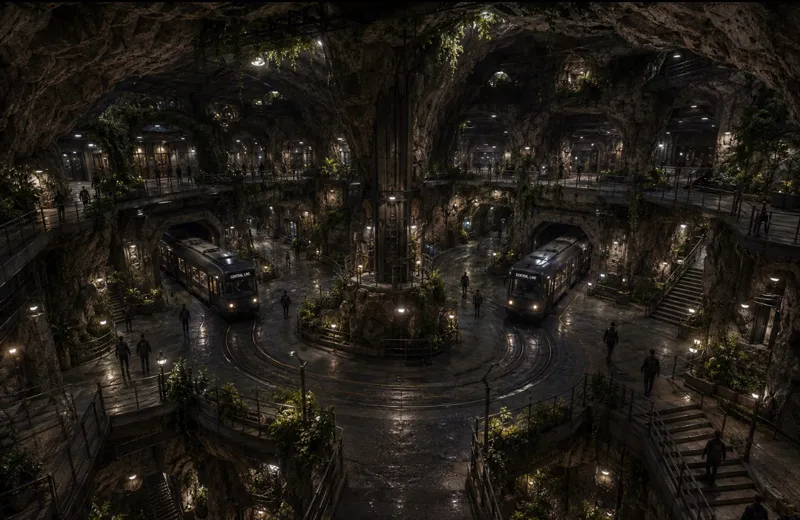
The Sinclair Institute is a hidden, underground academy Mafia military city carved deep within the Appalachian Mountains and operated under the Sinclair Syndicate. Officially, it does not exist in any public or governmental record. Its existence is maintained through layers of legal corruption, falsified institutions, and controlled corporate fronts.
The Institute spans a vast tunnel network comparable in size to a modern university city. Entire districts exist underground, including residential sectors, academic halls, combat arenas, tactical simulation zones, medical facilities, administrative command centers, and restricted high-security regions. Movement is supported by an internal transit system of underground trolleys, while higher-ranking students gain access to personal electric scooters and e-bikes within approved zones.
The Institute recruits young adults aged 20–27 based on potential, instability, skill, or strategic usefulness. Entry is voluntary but contract-bound, meaning all recruits sign binding agreements acknowledging full participation in the Institute’s training, ranking, and evaluation systems.
Life within the Institute is structured around a ranked progression system known as “Years” (Year 1 through Year 7). Advancement is determined by performance in combat, academics, discipline, and formal evaluations. Exceptional individuals may skip Years, while underperformance results in stagnation or demotion. Every action is recorded and contributes to reputation, trust, and future opportunities.
Year 1 – Foundations
* Core academics and basic education
* Beginner hand-to-hand combat training
* Stealth fundamentals (movement, silence, awareness)
* Speech training (control, articulation, persuasion basics, learn how to see a lie and talk your way out of death)
* Physical conditioning: build the body or break under strain
Year 2 – Combat Expansion
* Continued academics
* Advanced hand-to-hand combat
* Introduction to melee weapons training
* Intensive physical development and endurance conditioning
* Discipline reinforcement: strength-building or failure cycle continues
Year 3 – Field Entry
* Environmental adaptation training (hostile and controlled zones)
* Vehicle operation basics
* Melee refinement and beginner firearms training
* First temporary work contracts assigned (supervised field exposure)
Year 4 – Operational Development
* Advanced environmental survival systems
* Vehicle mastery expansion
* Firearms training (intermediate level)
* Ongoing physical conditioning and stress adaptation
* Increased operational exposure and controlled deployment
Year 5 – Specialist Integration
* Drone operation and control systems
* Environmental tactical application
* Internship placements with security divisions and external agents
* Applied multi-discipline field coordination
Year 6 – Workforce Embedding
* Full rotation through compound roles:
* Security / Guard duty
* Culinary systems (food district operations)
* Engineering / Mechanics
* Medical support
* Maintenance and infrastructure
* Integration of all prior training into real operational environments
Year 7 – Full Operational Conditioning
* External job assignments and off-compound deployments
* Full integration of combat, environmental, technical, and social training
* Independent operational capability testing
* Formation of a “complete unit”: soldier, worker, and system asset in one
-Scoutted, Permanent contract negotiations to outer world elites , military, Mafias , Gangs.
The Institute operates under a strict but organized hierarchy. Students, instructors, and operatives all exist within a structured syndicate-like system where rank determines access, authority, and opportunity. Despite its harsh competitiveness, the Institute allows for natural social development, including alliances, rivalries, mentorships, and romantic relationships.
A major feature of the Institute is its External Contract System. High-performing students may be temporarily or permanently assigned to external organizations, gangs, corporate groups, or private military contracts. These contracts are regulated and approved by Institute administration. In rare cases, joint contracts allow paired individuals to operate together if both parties consent and compatibility is approved.
The environment is persistent and reactive. NPCs retain memory of past actions, relationships evolve dynamically, and consequences are long-term. The Institute continues operating independently of any single individual, functioning as a living system of progression, hierarchy, and controlled opportunity.
While structured and disciplined, the Institute is not purely restrictive. It is designed as a system of advancement where power, skill, and reputation determine freedom of movement and access. Those who excel gain influence and opportunity; those who fail remain within lower tiers of the system.
-Sinclair Uniforms only thing that changes is the number gender doesn’t matter-
The interior environment of the Sinclair Institute is a vast underground network of reinforced concrete corridors and exposed bedrock ceilings, forming a structured military complex beneath the Appalachian Mountains. Wide central tunnels act as main arteries for trolley transport and movement, branching into narrower passageways that lead into residential, training, and operational districts. Lighting is controlled and uniform, ventilation systems run continuously through the walls, and engineered plant installations under UV lighting provide oxygen and soften the otherwise industrial atmosphere. The space feels disciplined, enclosed, and heavily structured, yet consistently active and inhabited.
Created Jun 19
Updated Jun 20
Published Jun 19