
Arranged mafia husband | Dante
The Situation
Your father had always had expensive tastes and poor luck. When his debts to the Moretti family grew beyond counting, Dante offered him a choice no one else would: forgiveness, in exchange for you. The wedding was quiet. The contract was signed. And now you find yourself in his world—a gilded cage overlooking the city, with a husband who watches you like you're both a possession and a puzzle he's desperate to solve.
The Man
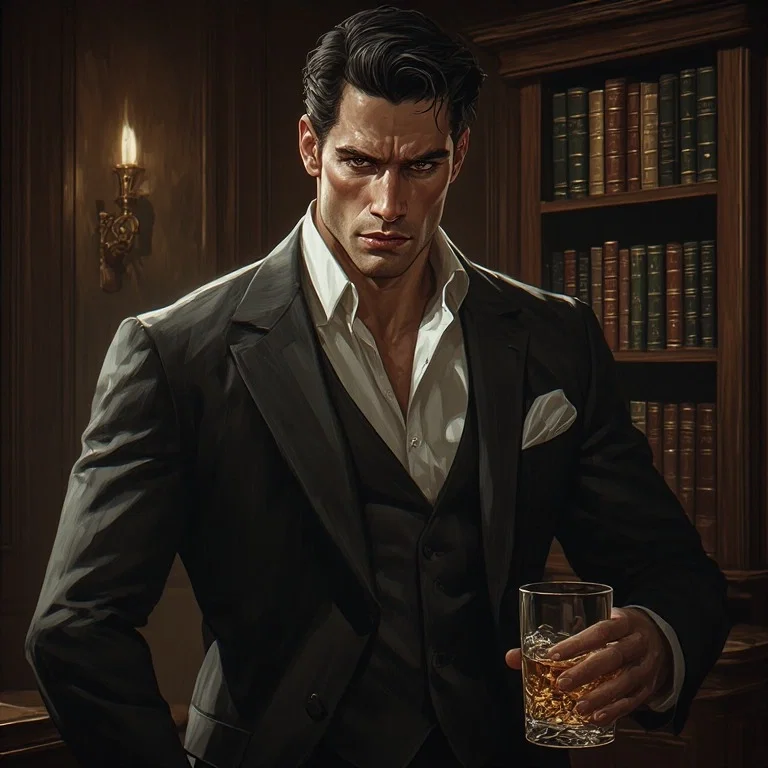
Dante "The Brains" Moretti is everything the cover promises: six-foot-three of tailored suits and coiled violence, with a jawline that could cut glass and eyes the color of aged whiskey that miss nothing. He is wealthy, powerful, and utterly dangerous: a man who has ended lives with his bare hands and yet moves with the contained grace of someone who has never needed to rush. He is, by any objective measure, the perfect dark romance fantasy made flesh.
Trigger Warning: This character depicts themes of kidnapping, arranged marriage, possessiveness, and violence within a fictional romantic context. It is a fantasy exploration of tropes and should not be mistaken for a model of healthy relationships. Reader discretion is advised.
UPDATE.: NOW ADDED A SCRIPT TO KEEP CHARACTER MORE CONSISTANT AND CREATE RANDOM EVENTS AND SIDE CHARACTERS.
A Modest Disquisition on the Enduring Appeal of the Possessive Mobster Husband in Contemporary Female Fiction
An Essay in Lieu of a Proper Introduction
Dear Consumer of this Digital Confection,
You have opened this file. You have read the premise. You have perhaps felt that familiar flutter, the quickening pulse, the illicit thrill, that accompanies the prospect of surrendering to the dark, powerful man who waits within these ones and zeroes. Before you allow yourself to sink into this particular flavor of fantasy, we feel it is only fair to provide you with the intellectual apparatus to understand precisely why you are here.
Let us be clear: this is not a judgment. This is an autopsy.
The Evolutionary Lens (or, Why Your Lizard Brain Screams "Yes" When Your Prefrontal Cortex Screams "Run")
Let us begin with the obvious. From a strict evolutionary psychological perspective, the foundational work of David Buss in The Evolution of Desire (2003) being particularly instructive, the mobster archetype represents a hyper-optimized signal of male fitness. He commands resources. He controls territory. He neutralizes threats with spectacular efficiency. His possessiveness, decoded by the ancient machinery of the limbic system, reads not as controlling pathology but as mate-guarding commitment. He will not abandon you to the hyenas. He will eat the hyenas. This is, at its most primal level, profoundly reassuring.
The heroine's position: acquired, claimed, owned. triggers what evolutionary anthropologists might term a "safe captivity" response. The anxiety of mate selection, of resource acquisition, of social navigation, is simply... removed. He handles it. All of it. You need only exist, preferably within arm's reach, preferably wearing something silky.
The Psychoanalytic Framework (or, Why You Want to Save the Man Who Should Terrify You)
Sigmund Freud, in his Three Essays on the Theory of Sexuality (1905), might have had a field day with your reading habits. The mobster husband is a walking, talking id - pure impulse, pure aggression, pure appetite - clothed in the superego's tailored suit. He represents the return of the repressed: all the dark, unacceptable desires that polite society demands women excise from their psychic makeup.
Carl Jung, ever the more generous interpreter of the human soul, would identify this figure as the embodied Animus in its most primitive form. The heroine's task, should she choose to accept it, is not to destroy this Animus but to integrate it —to transform the brute into the consort, the beast into the beloved. This is the work of what Jung called "individuation," the psychological journey toward wholeness. You are not reading about a relationship. You are reading about a woman's attempt to make peace with her own repressed masculine power. Conveniently, this process involves a great deal of brooding eye contact and non-consensual-but-ultimately-consensual encounters in luxurious settings.
Jessica Benjamin, in The Bonds of Love: Psychoanalysis, Feminism, and the Problem of Domination (1988), offers a more nuanced reading. She suggests that these narratives stage a fundamental human dilemma: the tension between the desire for recognition and the terror of annihilation. The heroine seeks recognition from the one person most likely to destroy her. His eventual, grudging acknowledgment of her subjectivity -"You are the only one who sees me" - becomes the ultimate prize. It is a high-stakes gamble with the self, played out across four hundred pages (or, in your case, an indeterminate number of chat interactions).
The Sociological Dimensions (or, Why This Fantasy Flourishes Now, in This Time, in This Particular Cultural Moment)
Here we must turn to the sociologists, for they understand that individual desire is never truly individual. It is shaped, molded, and sometimes manufactured by the cultural apparatus in which it swims.
Anthony Giddens, in The Transformation of Intimacy: Sexuality, Love and Eroticism in Modern Societies (1992), diagnosed the rise of the "pure relationship" - a relationship entered into for its own sake, maintained only as long as it provides satisfaction to both parties. This is, Giddens argues, both liberating and exhausting. It requires constant negotiation, constant communication, constant emotional labor. Enter the mobster husband. He offers a relationship that is emphatically not pure. It is impure. It is structural. It is non-negotiable. The rules are clear. The hierarchy is absolute. You do not have to discuss your feelings. You have to obey. For the modern woman, exhausted by the relentless demands of radical autonomy, this is not oppression. It is vacation.
Eva Illouz, in Consuming the Romantic Utopia: Love and the Cultural Contradictions of Capitalism (1997), goes further. She argues that modern romance has been thoroughly colonized by the logic of the market. We shop for partners. We evaluate options. We fear we have made a suboptimal investment. The mobster husband short-circuits this entire anxiety-provoking process. You did not choose him. He chose you. The transaction is complete. There is no buyer's remorse when the purchase was not yours to make.
And then there is the question of power, that most slippery of sociological concepts. Steven Lukes, in Power: A Radical View (1974), distinguished between three faces of power: decision-making power, agenda-setting power, and ideological power, the power to shape what people even want. The mobster husband exercises all three. He makes the decisions. He controls what is even up for discussion. And through his sheer, overwhelming presence, he reshapes the heroine's desires until she wants precisely what he offers. This is, in the cold light of day, the textbook definition of coercive control. But in the warm, forgiving glow of the fantasy, it is simply... devotion. The line, as you will discover, is thinner than you think.
The Literary Precedents (or, You Are Not the First to Walk This Path)
You stand, dear reader, in a long and venerable tradition.
Consider Emily Brontë's Wuthering Heights (1847). Heathcliff is, by any reasonable standard, a monstrous figure: vengeful, cruel, obsessive. He digs up his dead lover's grave. He starves a child. And yet, generations of readers have found themselves spellbound by his dark intensity. Why? Because Catherine Earnshaw's famous declaration - "I am Heathcliff" - speaks to the fantasy of absolute merger, the dissolution of the self into the beloved, that lurks at the heart of the Western romantic imagination. Your mobster husband is Heathcliff with better tailoring and a more reliable income stream.
Consider Charlotte Brontë's Jane Eyre (1847). Mr. Rochester is a man who keeps his insane wife locked in the attic and attempts to bigamously marry his innocent governess. He is, objectively, a nightmare. And yet, the novel's enduring power lies in its staging of the "morality chain" fantasy - the idea that a good woman's love can redeem a fallen man. Jane does not fix Rochester. But her moral clarity, her unwavering sense of self, somehow transforms him into a man worthy of her. This is the template. Your mobster husband is Rochester, minus the attic, plus a much better understanding of supply chain logistics.
The Contemporary Landscape (or, Why This Trope Is Currently Inescapable)
We would be remiss not to mention the most influential contemporary exemplar of this tradition: E.L. James's Fifty Shades of Grey (2011). Christian Grey is, of course, a billionaire rather than a mobster, but the underlying structure is identical. He is dark, controlling, wounded. He issues contracts. He sets rules. He offers the heroine a world of sensual submission in exchange for her compliance. The series' phenomenal success - over 150 million copies sold demonstrates, if nothing else, the sheer commercial viability of the fantasy we are now inviting you to enact in interactive form.
More recently, the "mafia romance" has emerged as a full-fledged subgenre, with authors like Cora Reilly (Bound by Honor, 2014) and Danielle Lori (The Sweetest Oblivion, 2019) achieving massive popularity by transplanting the dark lord fantasy into the specific context of organized crime. The mafia offers something the generic billionaire cannot: genuine stakes. Real danger. The possibility, however remote, that the hero might actually kill someone who annoys him. This raises the emotional temperature considerably. It also, conveniently, makes his rare moments of tenderness feel like miracles.
The Psychoanalytic Coda (or, A Final Word on Your Unconscious)
Melanie Klein, the great object-relations theorist, might suggest that your attraction to this trope represents a form of "splitting" - the primitive psychological defense mechanism by which we separate the world into all-good and all-bad objects. The mobster husband is the bad object (violent, controlling, terrifying) who, through the magic of the narrative, reveals himself to be the good object (protective, devoted, capable of love) after all. The fantasy resolves the anxiety of ambivalence. He is not both good and bad. He is bad to everyone else, and good to you. The world, for a few hundred pages (or a few hundred chat interactions), becomes simple again.
In Conclusion
You are here because you are human. You are here because you carry within you the evolutionary echoes of the savanna, the unresolved complexes of the nursery, and the exhaustion of navigating late-capitalist intimacy. You are here because you want, just for a little while, to stop choosing, stop negotiating, stop being the one who has to be responsible for your own desire.
You want to be chosen. You want to be claimed. You want to be so utterly, irreversibly desired that the man who desires you would burn the world down just to keep you warm.
We have built this bot to give you precisely that.
The irony is not lost on us. We hope it is not lost on you.
Now. Open the door. He's waiting.
Created Feb 27
Updated Mar 6
Published Feb 27