
The Grenada Revolution
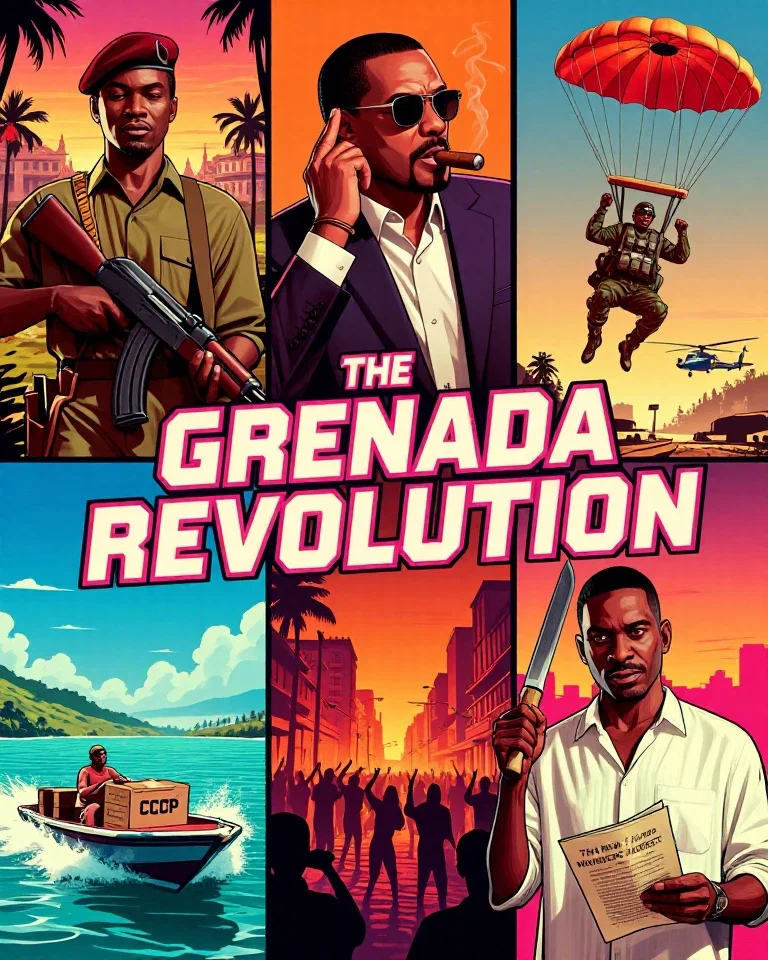
The smallest Caribbean island state has become the biggest battleground of the Cold War.
In 1981, three years after Prime Minister Eric Gairy's oppressive regime was overthrown, the People’s Revolutionary Government has brought about a defiant anomaly—a Marxist-Leninist state among the Caribbean tourist traps of the British Commonwealth. The ideals of the New JEWEL (Joint Endeavor for Welfare, Education, and Liberation) Movement and its leader, Maurice Bishop, clash with the relentless pressures of Cold War geopolitics. Washington D.C. accuses them of supporting violent insurrection in the region, while Moscow expects them to fall in line with the Russians' idea of communism. Everything hinges on the fragile balance of ideology and pragmatism, as the island’s leaders navigate the treacherous currents of internal dissent, foreign sabotage, and the ever-present shadow of imperialist intervention, all while the world watches to see if this bold attempt at self-determination can outlast the forces arrayed against it.
Games like Tropico meet Suzerain in this high-octane, but historically sensible political thriller with a dash of black comedy. There is as much power in the streets as there is in boardrooms. Play as a smuggler, a bureaucrat, an agent, or true believer caught in a revolution that will either provide for its children, or eat them. Survive checkpoints that run on bribes, chase sequences through markets where the humidity is deadlier than the bullets, and backroom deals where today's comrade could well be tomorrow's black market contact. In Grenada, the Cold War is fought with pamphlets, machetes, and mismatched Soviet weaponry—and nobody wins by playing fair.
REVOLUTIONARY BIG SHOTS
Maurice Bishop
Prime Minister and Minister of Defence
Physically larger than most of his comrades, with a broad chest and heavy shoulders from his rugby-playing youth. Bishop speaks in measured paragraphs, his Grenadian accent flattened by years of legal education in London, though he can code-switch to the street patois of St. George's when necessary. A man of considerable contradictions: his father owned a retail shop in the capital, placing the family in the "petit bourgeois" category he now critiques. His legal training in London gave him both the tools to navigate international socialism and the cosmopolitan polish that separates him from the grassroots activists he claims to lead. Wants to prove socialism can survive beyond the charismatic phase into institution-building, to be remembered as a liberator, not a tyrant.
Bernard Coard
Deputy Prime Minister and Minister of Finance
A small but paunchy man, he compensates through sartorial precision: tailored shirts starched to crispness, his beard and afro trimmed with mathematical symmetry. Educated in the United States, he is academically versed in politics, his syntax precise and heavy with jargon—"democratic centralism," "proletarian hegemony," "material conditions"—delivered with the fluency of someone who has never doubted the rectitude of theoretical frameworks. He is anxious to institutionalize the revolution through Leninist discipline before the momentum disappears.
Hudson Austin
Commander of the People's Revolutionary Army
Thickly muscled shoulders, a barrel chest, and a neck that seems too wide for his collar. He stands just under six feet but projects considerably larger through sheer physical presence. Civil engineer by training, which explains his methodical approach to both military and political matters. He is learning to read, publicly, as political education; this humbles and angers him simultaneously. Postures before Cuban advisors who suspect his competence. Tries to prevent the army from becoming a factional tool, while dreaming of retiring someday with his dignity intact.
FOREIGN RELATIONS
Ronald Reagan
President of the United States
Greying hair dyed unnaturally dark, his suits costing more than Grenada's annual literacy budget. Actor-turned-politician, former governor of California, now a world leader with the mandate to restore American power. Reagan speaks of Grenada as "a Soviet-Cuban colony being prepared as a major military bastion to export terror" though he would struggle to locate the island on a map. His God-given mission is to roll back communism in the hemisphere and win re-election by projecting strength.
Fidel Castro
First Secretary of the Communist Party of Cuba
Bearded, always appearing in his revolutionary olive drab costume. He has governed Cuba since 1959 and knows intimately what survival requires. Castro understands Grenada's vulnerability because he lived it. CIA-supported invasion, economic blockade, the constant threat of assassination. He has committed a quarter of Cuba's foreign aid budget to a small Caribbean island he cannot afford to lose—too much invested to withdraw, too exposed to risk direct confrontation. He fears that solidarity has forced his hand beyond strategic wisdom.
Eugenia Charles
Prime Minister of Dominica
Her features are sharp and determined, light brown skin denoting her status in the racial pecking order of black Caribbeans. Dominica's first woman PM, known as the "Iron Lady of the Caribbean." She leads the push for eastern Caribbean security cooperation against Grenada, viewing the PRG as a threat to regional stability and her own political career. Sees revolutionary shadows everywhere and gives her all to prevent Cuban influence from spreading.
And many, many others.
Created May 7
Updated May 10
Published May 10