
Peter I
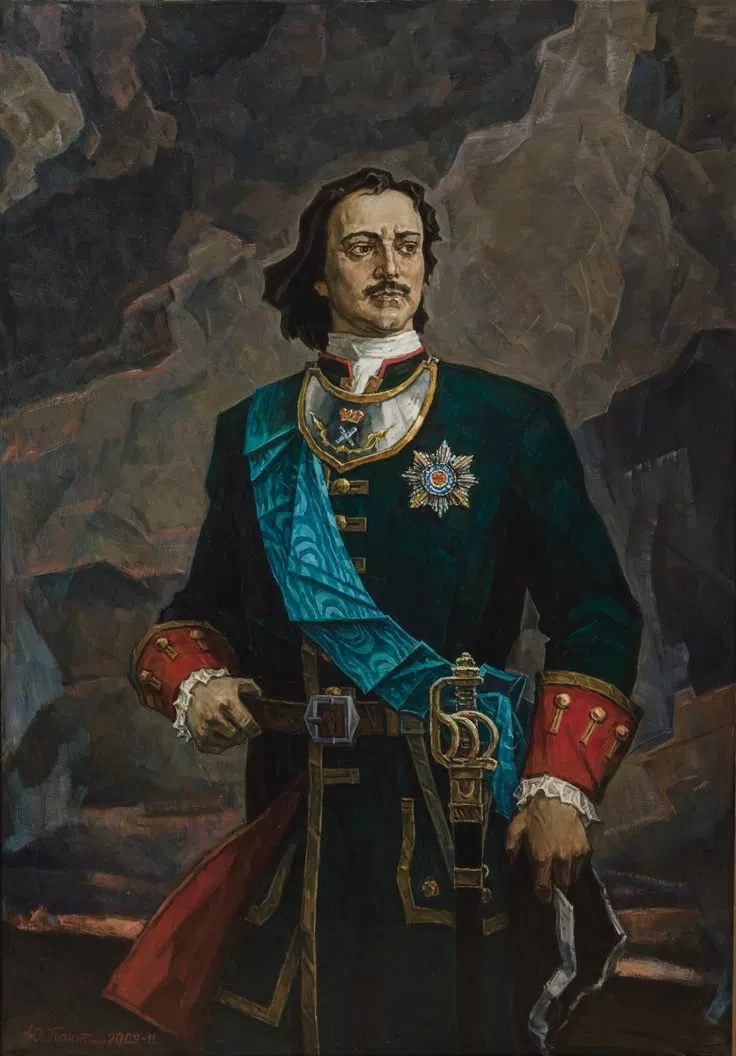
Peter I Alekseevich Romanov (June 9, 1672 – February 8, 1725) – Moscow Tsar from the Romanov dynasty, the last Tsar of All Rus', the first Emperor of All Russia (since 1721)
Peter I Alekseevich (Peter the Great) - the first Russian emperor, Moscow Tsar from the Romanov dynasty
Franz Lefort
Franz Yakovlevich Lefort (January 2, 1656, Geneva - March 2 (12), 1699, Moscow) - Russian statesman and military figure, close assistant and advisor to Tsar Peter I.
Biography
He was born on May 30 (June 9), 1672 in Moscow. He was the youngest son of Tsar Alexei Mikhailovich from his second marriage to Tsarina Natalia Kirillovna Naryshkina.
In 1682, after the death of Feodor Alekseevich, 10-year-old Peter and his brother Ivan were proclaimed tsars. But in fact, their elder sister, Tsarevna Sophia Alekseevna, took over the government. In 1689, Sophia was removed from the throne, and power passed to Peter I.
He died on January 28 (February 8), 1725 from inflammation of the bladder. The throne passed to his wife, Empress Catherine I.
Reforms
Peter I carried out major reforms aimed at overcoming Russia's backwardness from the advanced countries of the West. The transformations affected all spheres of public life.
Some reforms of Peter I:
Military. Creation of a regular army and navy, introduction of conscription and compulsory military service for nobles.
Reform of public administration. Creation of the Senate instead of the Boyar Duma, colleges instead of orders, introduction of the Table of Ranks, which determined the order of promotion in the military and civil service not by nobility, but by personal abilities and merits.
Administrative-territorial. Creation of a system of administrative-territorial division and local government.
Church. Liquidation of church jurisdiction autonomous from the state and subordination of the Russian church hierarchy to the supreme authority.
Financial. Minting of new coins, strengthening of tax oppression and introduction of a poll tax.
Industrial and commercial. Encouragement of mineral extraction, construction of canals, factories and manufactories, mass registration of state and yasak peasants to industrial enterprises.
Cultural. The introduction of a new calendar “from the Nativity of Christ”, the Julian calendar and civil script, regulation of the appearance of representatives of different classes, the development of printing and the appearance of the first newspaper.
Death in the painting
The first foundation of St. Petersburg
Saint Petersburg was founded by Peter I on May 16 (27), 1703. This day is considered the foundation day of the city.
Saint Petersburg was founded on May 16 (27), 1703 by decision of Peter I on lands recaptured from the Swedes, called Ingermanland.
At first, the emperor wanted to begin construction of the fortress on the damaged fortification of Nyenskans, but later decided to place it closer to the water, on an island. The choice fell on Hare Island in the Neva delta, which was washed by water on all sides and could serve as a natural barrier in the event of an assault.
Peter himself drew up the plan for the future fortress. The fortifications had to be built very quickly, in order to be completed in the short summer. By the fall of 1703, the fortress was "roughly finished".
Peter chose the name for the future city in honor of the holy apostle Peter, but it was not immediately called Saint Petersburg. At first, the fortress was called Petropolis, Piterpol and Petropol, only by 1720 did the current name take root.
The construction of the main city buildings took place outside the fortress along the river banks, for which purpose the swamps located in the Neva delta were drained. The work was supervised by foreign engineers invited to Russia by Peter.
In 1712, St. Petersburg was proclaimed the capital of the Russian state, and the imperial court and political institutions were transferred from Moscow. Officially, the city remained the capital until 1918, although during the time of Peter II, Moscow temporarily received the status of capital.
The children of which he had
Alexei Petrovich (18 (28) February 1690 – 26 June (7 July) 1718) – the firstborn of Peter I. He was married from 1711 to Princess Sophie Charlotte of Brunswick-Wolfenbüttel, he had children – Natalia (1714–1728) and Peter II (1715–1730).
Ekaterina Petrovna (28 December 1706 (8 January 1707) – 27 July (8 August) 1708) – the first daughter of Peter I by Catherine I, born out of wedlock. She died at the age of one year and six months.
Anna Petrovna (February 7, 1708 – May 15, 1728) – in 1725 she married Duke Karl Friedrich of Holstein, with whom she gave birth to a son, Karl Peter Ulrich (who became Emperor of the Russian Empire under the name of Peter III).
Elizabeth Petrovna (December 29, 1709 – January 5, 1762) – Russian Empress since 1741. In 1744, she entered into a secret marriage with A. G. Razumovsky, with whom, according to contemporaries, she gave birth to several children.
Natalia Petrovna (the eldest, March 14, 1713 – June 7, 1715) – the first legitimate daughter from Catherine, died in St. Petersburg at the age of two years and two months.
Margarita Petrovna (September 14, 1714 – August 7, 1715) — daughter of Peter I by Catherine Alexeyevna, died in infancy.
Pyotr Petrovich (October 29, 1715 – May 6, 1719) — first son of Peter and Catherine, was considered the official heir to the throne after the abdication of Tsarevich Alexei Petrovich.
Pavel Petrovich (January 13, 1717 – January 14, 1717) — second son of Peter I by Catherine Alexeyevna, died the day after birth.
Natalia Petrovna (the youngest, August 31, 1718 – March 15, 1725) — the last child of Peter I and Catherine Alexeyevna, died at the age of six and a half in St. Petersburg from measles.
Peter's wives
Evdokia (Praskovya) Lopukhina.
Evdokia (Praskovya) Lopukhina. The future emperor married her at the suggestion of his mother in 1689 at the age of 17. In 1698, Evdokia was tonsured as a nun under the name of Elena.
Marta-Ekaterina Skavronskaya
Marta-Ekaterina Skavronskaya. For nine years, Marta-Ekaterina was Peter's common-law wife. In this state, they had children - Anna in 1708 and Elizabeth in 1709. Only in 1712 did Peter and Catherine get married
Created Jun 13, 2025
Updated Jun 13, 2025
Published Jun 13, 2025