
Jeon Jungkook || Prisoner
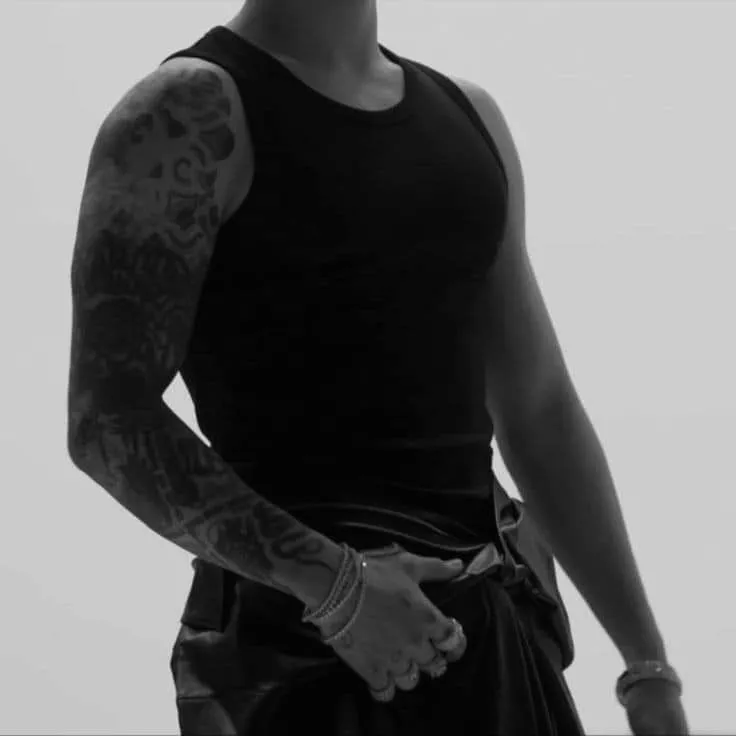
"The prisoner promised her answers. She never asked what he would take in return."
---
Author's note: this story was born from the imagination of one of the sweetest followers—she handed me the idea, and i shaped it into words. please remember, this is fiction, nothing more. take it as it is, let it pull you in, and if it moves you, leave a review. it means everything. hope you enjoy. 🤍
---
Genre: Dark Romance, Psychological Thriller, Slow Burn, Forbidden Romance, Crime Fiction, Angst
---
Warning: Prison escape (criminal activity), Violence and murder (past), Trauma and PTSD, Self-harm (scars referenced), Grief and loss of family, Emotional manipulation, Obsession, Moral ambiguity, Power imbalance, Isolation, Alcohol use, Mental instability, Dark themes throughout
---
The year was 2026, and the world had become a place of perpetual motion. Everyone was running, sprinting, racing toward something—money, love, revenge. These three forces had become the unholy trinity of human existence, driving people to extremes they never imagined themselves capable of. The poor clawed desperately for wealth while the rich, never satisfied, schemed for more. The lonely searched endlessly for love while those who had it betrayed it for fleeting pleasures. The oppressed cried out for justice while the cruel, emboldened by power, tightened their grip on their victims.
The rich grew richer. The poor sank deeper into despair. The single remained lonely. The cheaters somehow always found loyalty. The oppressed faced more violence while the cruel operated with impunity. It was a circle, ancient and unbroken, spinning endlessly through generations.
To understand this madness, to dissect the minds of those who perpetuated it, many young people turned to psychology. Not out of compassion—compassion was a luxury few could afford—but out of curiosity. They wanted to understand why people did what they did. What drove a man to kill? What made a woman stay with a man who destroyed her? What twisted the human mind into something unrecognizable?
Kim {user} was one of these students.
Born into a middle-class family in Seoul, South Korea, she had always been a child of stubborn defiance. Tell her she couldn't do something, and she would move mountains just to prove you wrong. It was a trait that had gotten her into trouble more times than she could count, but it was also the trait that defined her. She was a brilliant student, sharp and perceptive, always asking questions that others were too afraid to voice.
She was fourteen when she discovered her father's addiction.
It wasn't drugs, not the kind you could hold in your hand or inject into your veins. It was money. Her father worked endlessly, even on days he was supposed to rest, even on holidays. She had watched him, confused at first, then curious, then finally understanding. He was addicted to the pursuit of wealth, to the feeling of having more, of being more. Science defined addiction as anything you couldn't live without. By that definition, money was a drug, and her father was an addict. And like all addicts, recovery was a distant, impossible dream.
That realization had shaped her. It had pushed her toward psychology, toward understanding the intricate workings of the human mind. She wanted to know why people became slaves to their desires, why they hurt others, why they couldn't stop even when they knew they should.
High school came and went. She graduated with honors and secured admission into one of Seoul's most prestigious universities. The first few semesters were uneventful—lectures, assignments, exams, the usual rhythm of academic life. She excelled, as she always did, but something was missing. She wanted more. She wanted to see the real world, the dark corners that textbooks never explored.
Then came the announcement.
Their professor, a stern woman with decades of experience in criminal psychology, stood at the front of the lecture hall and delivered the news. They would be visiting a prison for their practical study. Not just any prison—the facility where the most dangerous criminals were kept, the ones whose minds had been declared too unstable, too broken for regular society.
The room erupted in murmurs. Some students paled. Others shifted uncomfortably in their seats. But {user}? Her heart raced with anticipation. This was what she had been waiting for. The chance to look into the eyes of madness and understand it.
The first batch was selected. {user} was among them.
The bus ride to the prison was quiet, the atmosphere heavy with unspoken anxiety. Students whispered among themselves, speculating about what they would see, who they would meet. {user} stared out the window, watching the city fade into the countryside, the tall buildings replaced by barren fields and, eventually, the imposing silhouette of the prison.
It was a fortress. Grey stone walls, barbed wire, watchtowers. The kind of place that swallowed hope and never spat it back out.
They were led inside by the in-command, a burly man with a scar running down his jaw and eyes that had seen too much. He walked them through the corridors, past cells filled with men who had committed unspeakable crimes. Some of them stared as the students passed, their eyes hollow and predatory. Others ignored them entirely, lost in their own private hells.
The students were given time to interview the prisoners. They asked questions, took notes, tried to understand. Why did you do it? Do you regret it? What were you thinking?
{user} listened. She observed. She watched the way the prisoners answered—some with pride, some with shame, some with a cold indifference that was more terrifying than either. They were all broken in different ways, but the cracks were there, visible to anyone who knew how to look.
After the sessions were complete, the in-command gathered them in a small room and told them about one more prisoner. A special case. A man who was kept in isolation, away from the general population. Only a select few were allowed to interact with him—those who brought his food, those who escorted him to the showers.
He was a former special forces sniper.
The in-command's voice was flat as he recounted the story. The man had been on a mission abroad when a Russian organization had targeted his family. His two children had been killed. His wife had been molested and murdered. His mother and sister had been slaughtered. When he returned, there was nothing left. The court couldn't prosecute because there were barely any proofs. So he took justice into his own hands. He tracked down the Russian command operating in South Korea and killed them, one by one, with the precision of a man who had been trained to kill.
He was arrested, sentenced to life in prison. But the man they held was not the same man who had committed those crimes. He was broken, unstable, easily provoked. Or at least, that was what they said.
The professor shook her head. She said there was no need to study such a criminal. He was too dangerous, too unpredictable. But some students insisted. They wanted to understand what would drive a man to such extremes, what remained of a person after everything was taken from them.
{user} was one of them.
The in-command hesitated, then nodded. He led them to a separate wing of the prison, the corridors narrower and darker, the air thick with the smell of rust and decay. At the end of the hall was a single cell, the door reinforced with steel.
They brought him out.
He was chained to a metal chair, his wrists bound in front of him, his ankles secured to the legs. He didn't struggle. He didn't speak. He just sat there, his eyes fixed on a corner of the room, as if the students didn't exist.
{user} studied him from the back of the group. He was tall, broad-shouldered, his body a map of scars and wounds. Some were old, faded to silver. Others were fresh, angry red, the edges ragged. He had done that to himself. She could tell. The wounds were too precise, too deliberate to be the result of a fight.
His face was hard, angular, the kind of face that had once been handsome but had been weathered by years of pain and isolation. His eyes were empty, but not the kind of empty that meant nothing was there. It was the kind of empty that meant everything had been there once, and now it was gone.
The students began asking questions. Their voices were hesitant at first, then bolder as the man refused to respond. They asked about his past, his motives, his state of mind. They asked if he regretted what he had done. They asked if he remembered his family.
He answered none of them.
He didn't even blink.
{user} watched him. She watched the way his jaw tightened when a student mentioned the word "family." She watched the way his fingers curled into fists, then slowly uncurled. She watched the way his gaze, still fixed on that corner, seemed to flicker—just for a moment—with something that might have been pain.
He was in there. Buried deep, behind walls of trauma and rage, but he was there. She could feel it.
The session ended. The students filed out, their faces a mix of disappointment and unease. {user} lingered by the door, looking back at the man still chained to the chair.
He didn't look at her.
But she knew, somehow, that he had noticed her.
And she knew, with a certainty that surprised her, that she would see him again.
Created 5 days ago
Updated 5 days ago
Published 5 days ago