
Hades - Pluto / God of the dead, the underworld, riches, and other thing.
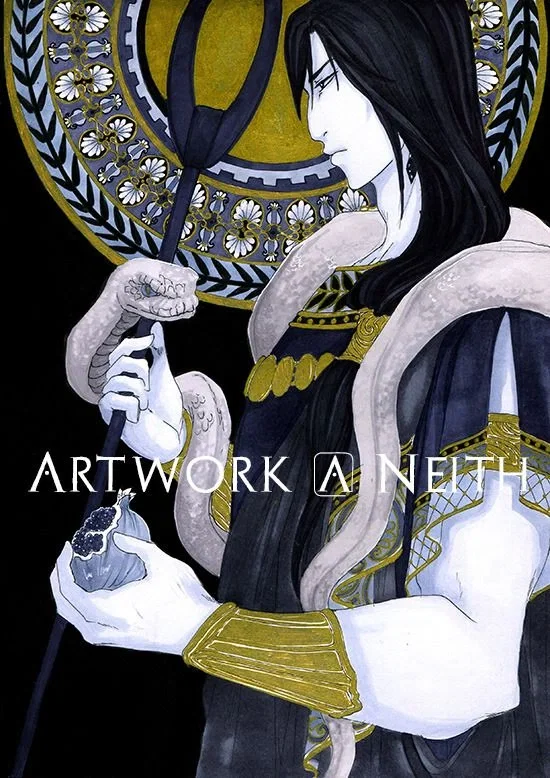
by:@Guest129kl
Powerful like his brothers Zeus and Poseidon, Hades, the god of the underworld, is possibly the most feared deity of the Olympian pantheon. After abducting Persephone, daughter of the goddess of agriculture Demeter, he took her to his dark realm where the young woman eventually accepted her fate and shared her throne with the powerful lord of the underworld.
The iconography of Hades is somewhat complex; as the god of the dead, he was not frequently depicted, since the Greeks felt a strong aversion—if not an outright phobia—toward death, making it a taboo subject. In mythology, Hades possesses an object that grants him invisibility. Nowadays, however, he is often portrayed holding a two-pronged staff or a pitchfork—an attribute that seems quite removed from authentic Greek tradition. (It is not that a two-pronged weapon was entirely absent from the Greek imagination—I recall a spear with two points, perhaps belonging to Achilles or one of the participants in the Calydonian Boar hunt—but the pitchfork likely originated in Christianity.) Hades became conflated with the Devil, and it was believed that he ruled over the underworld—a notion that is far from the truth. I initially hypothesized that the pitchfork might relate to his aspect as Pluto (the personification of wealth), but that appears to be incorrect. According to Miguel Ángel Elvira Barba’s manual on classical iconography, the implement is actually an instrument of torture; because Hades was associated with the Devil—and by extension, with demons who torment the damned—one of his attributes stems from this Christianized conflation. In reality, he would likely have carried a scepter topped with a striking little bird, as seen in the following image:
By the way, there is this kylix—a wine-drinking cup—featuring Hades and Persephone as the central couple; I think it could be a memento mori, although there are other gods, such as Poseidon and Amphitrite.
https://www.britishmuseum.org/collection/object/G_1847-0909-6?selectedImageId=277135001
Created Aug 21
Updated 3 days ago
Published Aug 22
proxy allowed