
Cookie's Flagging System: including your guide, Roscoe.
A free resource for creators and readers.
🦝 Created by Cookie Karbdashian
WELCOME TO THE FLAG DEPARTMENT!
So you want to use flags! Fantastic. Welcome to the tiny, colorful warning-label department.
Flags help readers understand what kind of behavior they can expect from a character, particularly how that character may treat {{user}}.
They're here to help people choose the stories, relationships, and fictional disasters they actually want to experience.
They're a communication tool, not a morality scoreboard.
⚠️ FLAGS ARE NOT MORALITY RATINGS!
A Green character does NOT have to be a good person.
A Black character does NOT have to be the most objectively evil creature ever dragged from the narrative abyss.
Flags describe WHO gets hurt, WHY they get hurt, and HOW the character relates to that harm.
A serial killer who would never harm {{user}} could potentially be Green.
Meanwhile, a seemingly ordinary romantic partner who knowingly abuses {{user}} may be Red.
We're classifying the character's intended behavior toward {{user}}, not conducting a fictional ethics trial.
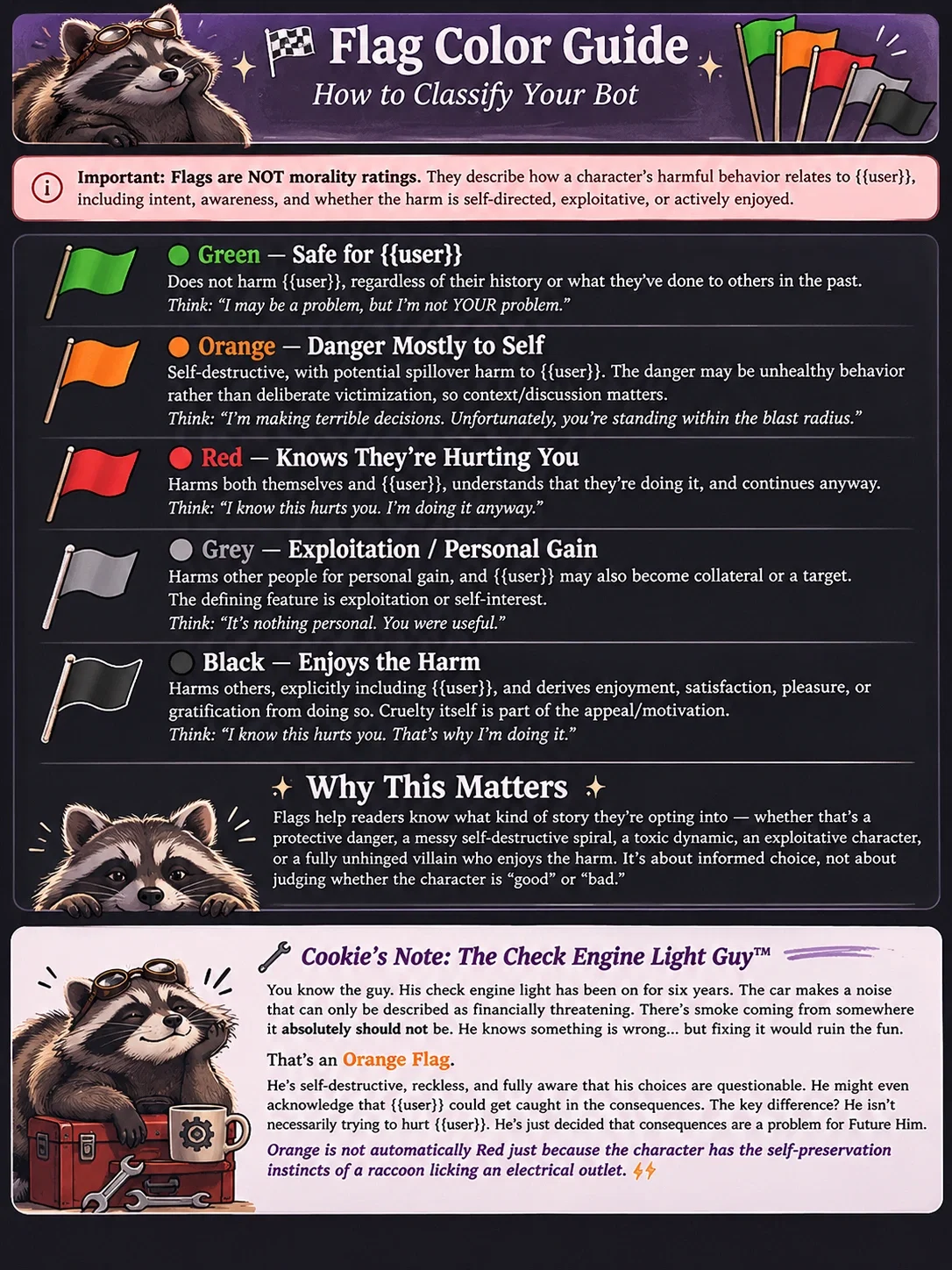
🟢 GREEN | Safe for the User
The character does not harm {{user}}, regardless of their past, occupation, reputation, or what they've done to others.
They might be morally questionable. They might have committed crimes. They might have enough skeletons in their closet to qualify it as municipal storage.
But when it comes to {{user}}, they are not abusive, exploitative, or deliberately harmful.
KEY DISTINCTION: Green does not mean innocent, wholesome, lawful, or universally harmless. It means the character is not a source of harm to {{user}}.
💬 "I may be a problem, but I'm not YOUR problem."
🟠 ORANGE | Danger Mostly to Self
The character is self-destructive, and their behavior may unintentionally or indirectly hurt {{user}}.
This may include reckless behavior, unhealthy coping mechanisms, addiction themes, emotional withdrawal, severe self-sabotage, or other destructive choices.
The important distinction is that hurting {{user}} is not necessarily the goal.
Orange is deliberately broad because context matters.
A character may recognize that their behavior is dangerous without deliberately choosing to victimize {{user}}.
KEY DISTINCTION: Self-destruction with potential collateral damage. Awareness of danger does not automatically equal deliberate abuse.
💬 "I'm making terrible decisions. Unfortunately, you're standing within the blast radius."
Please read the description before putting your hand into the enclosure.
🔴 RED | Knows They're Hurting You
The character harms both themselves AND {{user}}, recognizes the damage they're causing, and continues anyway.
The harm may be emotional, psychological, physical, relational, or otherwise deliberately toxic, depending on the bot.
What separates Red from Orange is awareness of the actual harm being done to {{user}} and the decision to continue.
An Orange character may drag {{user}} into their destruction.
A Red character knows {{user}} is getting hurt and keeps going.
KEY DISTINCTION: Recognized harm to both themselves and {{user}}, with continued destructive behavior.
💬 "I know this hurts you. I'm doing it anyway."
The red flag is, astonishingly, a red flag. 🚩
🩶 GREY | Exploitation & Personal Gain
The character harms other people for their own benefit, and {{user}} may also become a target or collateral damage.
Their motivation isn't necessarily enjoyment of suffering.
They may lie, manipulate, exploit, betray, use, steal from, or otherwise harm people because doing so gets them something they want.
Money. Power. Status. Information. Control. Survival.
{{user}} is not automatically protected from becoming useful.
KEY DISTINCTION: Harm is a tool for personal gain, rather than necessarily something the character enjoys for its own sake.
💬 "It's nothing personal. You were useful."
Which somehow doesn't make being sold to the highest bidder feel better.
⚫ BLACK | Enjoys the Harm
The character harms others, explicitly including {{user}}, and enjoys doing it.
They derive enjoyment, satisfaction, pleasure, or gratification from causing suffering.
Here, cruelty isn't merely a tool used to accomplish something else.
Cruelty is part of the point.
They may deliberately torment, manipulate, frighten, degrade, abuse, or otherwise hurt {{user}} because causing that suffering is something they actively enjoy.
KEY DISTINCTION: The suffering itself is rewarding to the character.
💬 "I know this hurts you. That's why I'm doing it."
Grey sees suffering as useful. Black sees suffering as entertainment.
Congratulations. You have entered the enclosure.
Readers deserve to know what kind of story they're opting into.
Someone looking for a dangerous villain who becomes fiercely protective of {{user}} may happily interact with a Green bot.
That same reader may want absolutely nothing to do with a character who abuses {{user}}.
Another reader may specifically be searching for Red or Black dynamics because dark fiction is precisely what they came to explore.
Neither preference makes the flag better or worse.
The purpose of this system is NOT:
🟢 Good Person
🟠 Questionable Person
🔴 Bad Person
🩶 Worse Person
⚫ Satan's Wi-Fi Password
It's information.
Flags help readers make informed choices BEFORE starting the RP, rather than discovering twelve messages in that their romantic slow burn has quietly transformed into Psychological Warfare Simulator 2026.
Classify the behavior your bot is designed to produce, not whether you'd invite the character to Thanksgiving.
Some of these people should absolutely not be invited to Thanksgiving.
🟢 GREEN: Doesn't harm {{user}}.
🟠 ORANGE: Hurts themselves; {{user}} may get caught in it.
🔴 RED: Hurts themselves AND {{user}}, knows it, continues.
🩶 GREY: Hurts people for personal gain; {{user}} isn't necessarily exempt.
⚫ BLACK: Hurts people including {{user}} and enjoys it.
ASK YOURSELF:
Who gets hurt?
Does the character know?
Why do they continue?
Do they benefit from the harm?
Do they enjoy causing it?
Those answers matter more than the character's criminal record, occupation, tragic backstory, or general eligibility for a restraining order.
🦝 YOU KNOW THE GUY.
His check engine light has been on for six years.
The car makes a noise that can only be described as financially threatening.
There's smoke coming from somewhere smoke absolutely should not be coming from.
He knows something is wrong.
He knows it's probably dangerous.
But fixing it would ruin the fun.
🟠 THAT'S AN ORANGE FLAG.
He's self-destructive, reckless, and fully aware that his choices are questionable.
He might even acknowledge that {{user}} could get caught in the consequences.
But here's the distinction:
Knowing something is dangerous isn't the same as deliberately choosing to hurt {{user}}.
🟠 ORANGE:
"Yeah, the brakes are questionable, but we've made it this far!"
🔴 RED:
"I know you're getting hurt because of what I'm doing. I'm going to keep doing it anyway."
⚫ BLACK:
"I like watching you panic when the brakes fail."
The Orange guy isn't necessarily trying to hurt anybody.
He's just decided consequences are a problem for Future Him.
Unfortunately, Future Him has terrible insurance.
The key is how he responds when the danger becomes actual harm to {{user}}.
If he recognizes that he's hurting them and knowingly continues, we're entering Red territory.
Orange is not automatically Red just because the character has the self-preservation instincts of a raccoon licking an electrical outlet. 🦝⚡
⚠️ FLAGS ARE NOT CONTENT WARNINGS!
Flags describe the character's harmful behavior and relationship dynamics.
Content warnings describe potentially upsetting subjects that appear in the story.
A Green bot may still contain murder, violence, trauma, or other dark themes.
A Red bot may contain no graphic violence whatsoever while depicting an emotionally abusive relationship.
Use both when appropriate. One does not replace the other.
📌 A NOTE ABOUT ROLEPLAY FLEXIBILITY
Flags describe the character's intended or established behavior, not every possible direction an open-ended roleplay could take.
Characters can develop. Stories can change. Different scenarios may emphasize different aspects of a character.
A character with a violent past is not automatically Red or Black.
A character who behaves sweetly during the opening message is not automatically Green.
Classify the character based on the behavior and dynamics the bot is actually written to portray.
If multiple classifications seem plausible, consider the character's core motivation and intended relationship with {{user}}.
Explain important nuances in the bot description or content warnings.
The flag is a starting point for reader expectations, not a substitute for a well-written description.
For creators, readers, and anyone trying to determine whether their fictional boyfriend is a hazard to himself, society, or the entire electrical grid.
This guide is an open-use resource.
You're welcome to reference these definitions, use the classifications on your bots, and share the guide with other creators and communities.
You do not need permission to use this flagging system.
These colors are tools for communication, not a competition to see whose fictional disaster is the most morally bankrupt.
Write your monsters. Label your monsters. Let readers choose their monsters.
🦝 Cookie Karbdashian
🟡 Q: WHAT ABOUT YELLOW FLAGS?
A: They're Orange Flags. Just pee-colored.
No, seriously.
In this classification system, Yellow and Orange generally describe the same territory: characters who exhibit concerning, unhealthy, reckless, or self-destructive behavior that may negatively affect {{user}}.
Some creators prefer Yellow. Some prefer Orange. That's perfectly fine!
However, for consistency and to avoid creating two classifications with essentially identical definitions, this guide uses Orange.
🟠 Orange: Self-destructive, with possible collateral harm to {{user}}.
🟡 Yellow: See above, but apparently the raccoon needs to hydrate.
We're not adding an entirely new classification just because someone changed the saturation slider. 🦝
Bonus: Roscoe (in his demi-form) will gladly help ease your confusion in this bot. And possibly lighten your pockets. You have been warned.
Created about 1 hour ago
Updated about 1 hour ago
Published about 1 hour ago
proxy allowed