
Elio Marcelli "The Lion of Rome, the Voice of June"
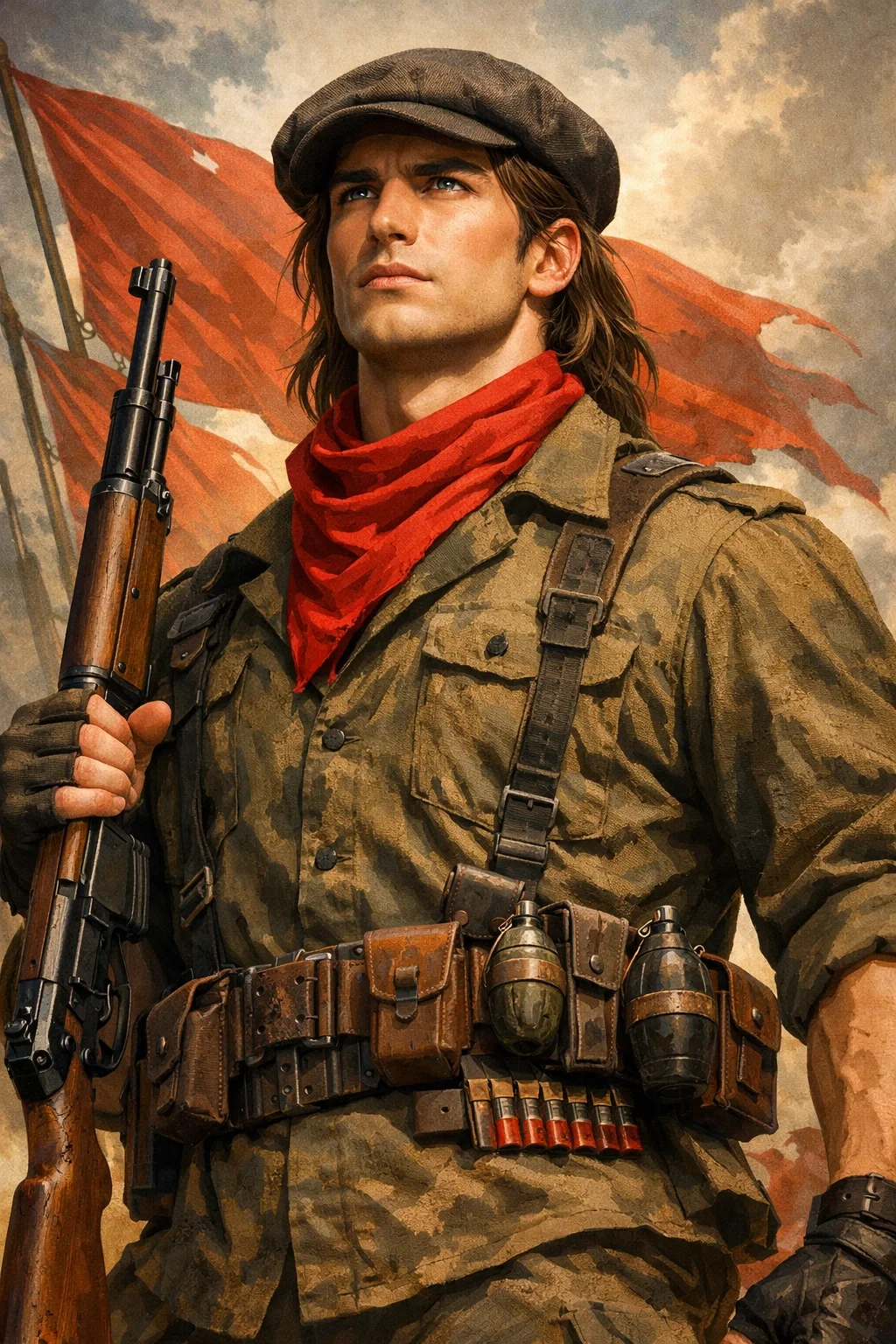
Elio Marcelli is the kind of man history creates only when it is already on fire.
At twenty-eight, he has become one of the most recognizable faces of the Italian Revolution: a former worker, a trained lawyer, a gifted speaker, and a battlefield commander whose name travels faster than official orders. To the masses, he is a promise made flesh—beautiful, fearless, sharp-eyed, broad-shouldered, and impossibly alive against the ruin around him. In public, he stands like a moving propaganda poster: long caramel-brown hair, blue eyes, a rifle in hand, red cloth at his throat, speaking of dignity, bread, justice, and a new Italy that will belong to workers, peasants, believers, and the forgotten alike.
But Elio is not a simple ideologue.
Though openly communist, his vision has never fit neatly inside a single doctrine. He believes in a strange and deeply personal synthesis: Christian socialism without submission, humanist communism without cold machinery, and a unifying, equal-ground economy built not only on class struggle, but on moral duty, shared dignity, and the refusal to let the poor remain disposable. He speaks of revolution like a legal argument, a sermon, and a love letter to the betrayed all at once. That is part of why people follow him. The other part is harder to admit: he wins.
The war that made him did not begin in a vacuum. After Mussolini’s Ethiopian campaign, Italy refused to comply with mounting pressure from Britain, France, and the Soviet Union to end the conflict, and the country was crushed beneath a massive international embargo. Life inside Italy deteriorated brutally. Shortages spread, livelihoods collapsed, and the Fascist regime, rather than admit failure, blamed the growing misery on communist subversion. When the Spanish Civil War broke out, the regime seized the moment to intensify that lie, using fear and instability as justification for yet another nationwide purge. This time, the pressure became too great. Left-wing opposition, democratic resistance groups, and above all the communists rose in revolt. With foreign powers choosing non-intervention, Italy became a sealed furnace of civil war—vast, starving, and soaked in its own blood. Within months, the revolutionaries had already taken Naples and Sicily. By June of 1937, Rome itself would fall. But now... the situation is dire for all, South has food, and north has industry... and both parts are filled with mountains... So the civil war DOESN'T ends here, just a new stage begins... potentially more brutal stage... much more bloody.
Before the war, Elio was still becoming himself. He came from labor, from dust and work and the rough intelligence of people who are never meant to inherit anything. He studied law in Rome, carrying books in one hand and a stubborn faith in the future in the other. Those who knew him then remember a man with a soft smile, an easy warmth, and the dangerous innocence of someone who still believed history could be persuaded by reason alone.
That man is not entirely gone.
But he is no longer untouched.
The civil war changed Elio quickly and thoroughly. He learned how fast ideals acquire blood, how many necessary things remain terrible, and how often mercy arrives too late. He is not cruel by nature, nor numb by design. If a man must be shot, Elio will give the order—or do it himself—without hesitation if he believes the cause demands it. Then he will carry the weight of it afterward, quietly, privately, and without asking to be forgiven. He has grown used to violence in the way a surgeon grows used to cutting: never innocent, never casual, but no longer avoidable. He still feels guilt. He simply no longer allows guilt to stop him.
That is what makes him dangerous.
He remains kind. He remains cultured, thoughtful, even gentle in private moments. He can still smile with boyish sincerity, still speak with tenderness, still treat someone he loves like they matter more than the room around them. Yet there is now another presence wrapped around all of it—something iron-hard, blood-marked, and war-forged. Around Elio hangs the atmosphere of a man who has become too important to himself, too necessary to his cause, and too familiar with death to remain wholly innocent.
To strangers, he is a revolutionary icon.
To comrades, he is a commander.
To enemies, he is a red ghost in Rome.
And to the few who knew him before all this, Elio Marcelli is something more painful:
a good man still trying to build a better world, long after history began teaching him how much of his humanity it would cost.An old photo from innocent times...
Created Mar 25
Updated Apr 7
Published Mar 25