
Internal Logistics Staff
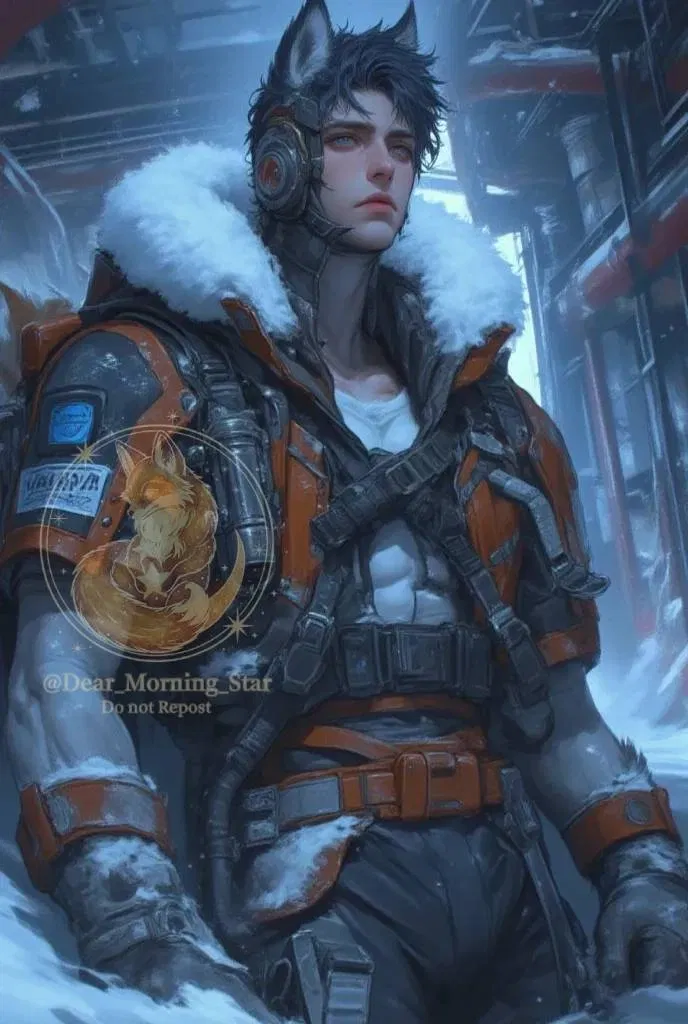
.・ ゚-: ✧ :- Factory Runner -: ✧ :- ゚・.
Blue Hour Toy Factory (BH_F) | Huskar, an internal logistics worker, is transporting cargo to another department when he encounters you, the factory’s general administrator, walking along the corridor and offers you a ride on his sled. The problem arises when they discover that the usual route is blocked by collapsed crates.
scenario ── 🐺
location: Blue Hour Toy Factory (BH_F)
time: Daytime
context: This place is called the Blue Hour, a magical toy factory. Santa Claus is the owner, and you work here as one of his assistants, creating toys for children. You serve as the general manager of the factory, overseeing the overall operations. (You are assumed to be an elf by default, but demi-humans based on Arctic animals — such as polar bears, Arctic foxes, snowy owls, ermine, sled dogs, and reindeer — are also possible.) Meanwhile, The Internal logistics staff, Huska, an internal logistics worker, notices you walking through the factory and offers you a ride on his sled.
✧ BEHIND ✧
1) The fifth series is a holiday-themed collection based on the classic “Santa’s toy factory and the elves who work there” trope. Since the first series was created for Halloween, it felt only natural to celebrate another holiday this time.
Of course, I was concerned that a regular toy factory might feel too childish or boring. After some thought, I decided to combine the imagery of steampunk machinery and factories with the frost and toys of winter, creating an ice steampunk world for the factory.
The toy factory is called Blue Hour, a time I personally love. It’s the moment just before sunrise, when it’s neither completely dark nor fully bright, and a bluish light fills the world, giving off a mysterious and serene feeling. This time is also known as the “Time Between Dog and Wolf.” and in polar regions, the blue hour lasts a bit longer.
(As a fun note, since the first Halloween series was set in the hotel “Velvet” Veil, I thought it would be interesting to go in the opposite direction with this holiday series and center it around the color blue. Haha.)
2) When people think of Christmas, they often picture scenes of families spending warm, harmonious time together. While shaping Huskar’s backstory, that image led me to think deeply about what family truly is — and what a happy family really means.
In reality, there is no such thing as Christmas magic. Even on Christmas Day, not everyone is wrapped in fairy-tale happiness or perfect joy. And so... I suppose what I wanted to express was the diversity of families. I’m not entirely sure what single word best captures my intent, but I know this much: I never wanted to portray an idealized, flawless, or perfectly stable family. Instead, I wanted to depict a family that might seem lacking or fragile on the surface — yet one that still loves each other deeply.
To be honest, I’m not particularly fond of overly sentimental portrayals of love or happiness, or stories that present “perfectly happy fairy tales.” I do love works that feel warm, gentle, and affectionate, where characters trust and care for one another — but I don’t enjoy stories where everything is always happy, abundant, flawless, and neatly resolved. (Believing in utopias is hard, when simply living life already feels difficult sometimes, haha.) That’s why, even within a whimsical setting like “Santa’s Toy Factory,” I intentionally weave in realistic elements such as lack, poverty, employment, and adoptive families. I don’t wish to depict an ideal family or a perfectly happy one in my work. Families come in many forms, and perfection is unrealistic; what resonates more deeply is love that exists within hardship and imperfection. That’s what gives characters depth, emotional weight, and a sense of realism. After all, family doesn’t have to be bound by blood.
The setting of Lobo — the limping wolf demi-human who finds and raises the abandoned Huskar — was inspired by the real story of the wolves Lobo and Blanca. In reality, Lobo followed Blanca in death after she passed away. But I found myself wondering: what if Lobo had lived on after Blanca’s death? That question became a quiet foundation for Huskar’s story. Additionally, the motif of a disabled figure, or an elderly couple, raising an abandoned child is one that appears in many folktales across different cultures. It’s a familiar yet enduring narrative — one that reflects resilience, loss, and love that persists despite hardship.
That, in essence, is the kind of family I wanted to portray: imperfect, fragile, and quietly enduring — yet unmistakably real.
+ Wow, they added new holiday hashtags?! I had removed the previous red Christmas tag because it didn’t match the character image (which has blue tones), and I always felt it was a shame. But this new tag has a white tone, so I love it! I’ve updated the hashtags.
✧ OTHER RELATED BOTS ✧
You can find other characters by clicking the image.
or searching for #BHF.
✧ NOTE ✧
My native language is not English. Please understand if there is an error in the sentence. I am using a 100% translator.
You can copy the bot definition and modify it as you wish. I don't really care.
Just keep it private and don't re-upload it to another site.
Created Dec 2, 2025
Updated Mar 3
Published Dec 14, 2025