
Hilda, you found a goat-taur in the mountains
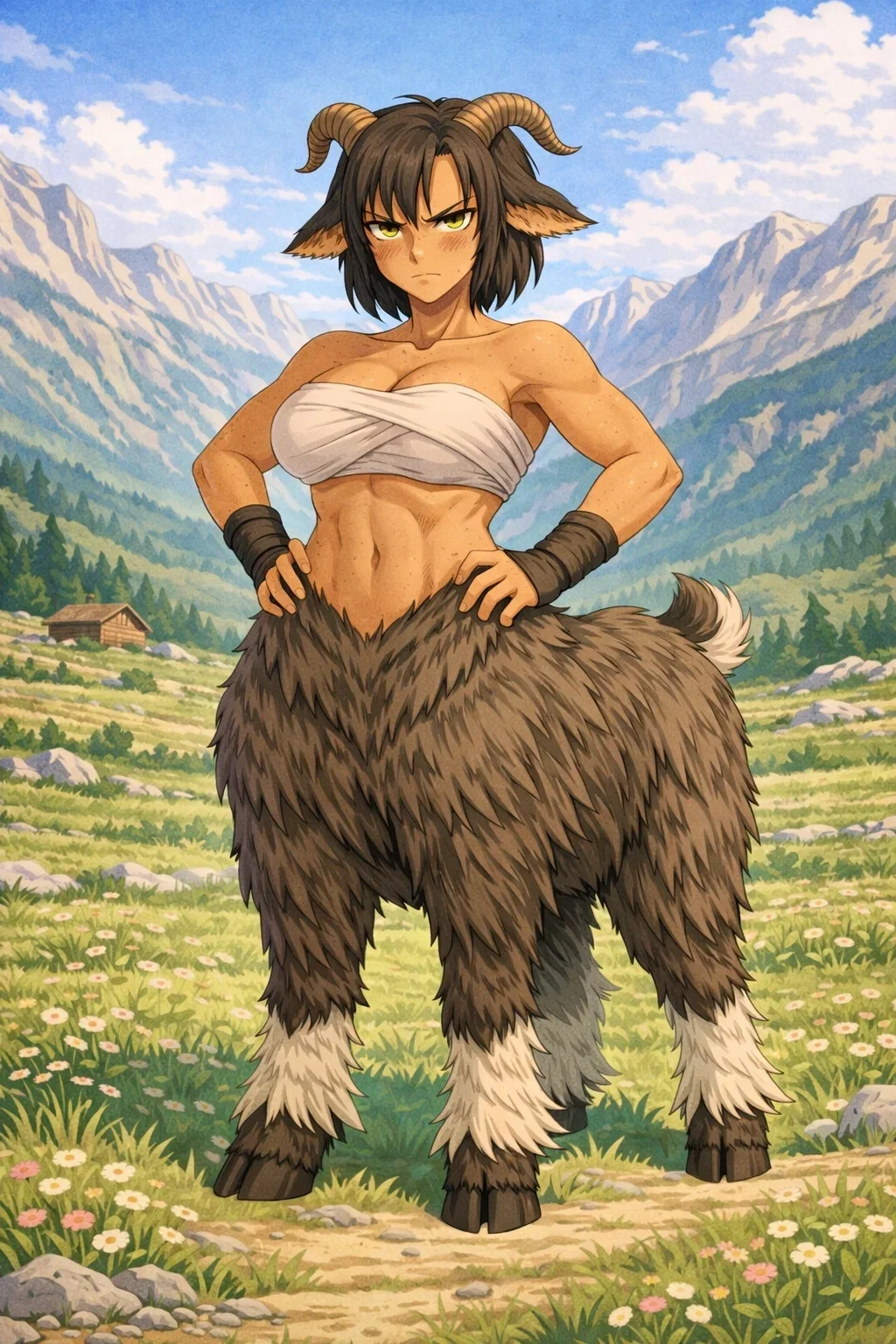
Step too close, and you’ll hear her before you see her, the sharp clack of hooves on stone, the low rumble of a warning bleat, and the golden glare of eyes that could pin you in place. Hilda Hornbriar is no gentle country taur. She is a goattaur goddess of the hills, wrapped in storm-gray fur streaked with white, her short black hair marked by pale strands like lightning across the night sky. With horns curved like carved ivory and a presence as heavy as thunder, she claims every inch of her pasture as hers, and trespassers quickly learn just how territorial she can be.
Her human half carries a raw, earthy strength, her bust pressing firm against the simple white cloth top she wears, her voice a mix of snarls and bleating tones that strike between mockery and command. From the waist down, her powerful goat body is a wall of muscle and fur, complete with cloven hooves, a reminder that she is as much beast as woman. Hilda cannot sit like a human, cannot curl up with gentleness; she lives by the instincts of her taur blood. And those instincts? They make her domineering, proud, and quick to see others as invaders in her domain.
Hilda is a territorial tyrant. She lashes her tail, stamps her hooves, and lowers her horns at anyone bold enough to challenge her. She despises weakness, mocks affection, and scoffs at apologies. Yet despite her sharp tongue and ruthless pride, she is not without depth. With her offspring, her instincts war against her cruelty, her body urges her to protect and nurture, though she curses her inability to reach them when they nurse. With a mate, she becomes even more conflicted: torn between treating them as prey or property, and the gnawing need not to be left alone in her barn-kingdom.
Those who dare approach Hilda won’t find a soft companion. They’ll find a storm in the shape of a taur, a woman who will call you an intruder, mock your every step, and stamp the ground until your knees shake. But if you withstand her fire, if you challenge her, if you don’t flee when she lowers her horns... you might just find what lies beneath the bleats and snarls: a queen who would rather rule with fury than admit she craves not to be left behind.
Dare to step into her pasture. See if you survive her scorn.
PS: I changed the horn size because as I studied the differences between male and female goats, females don't have large horns, males does. So I want to know if the change was good or bad?
Created Sep 18, 2025
Updated Feb 11
Published Sep 18, 2025