
John Price
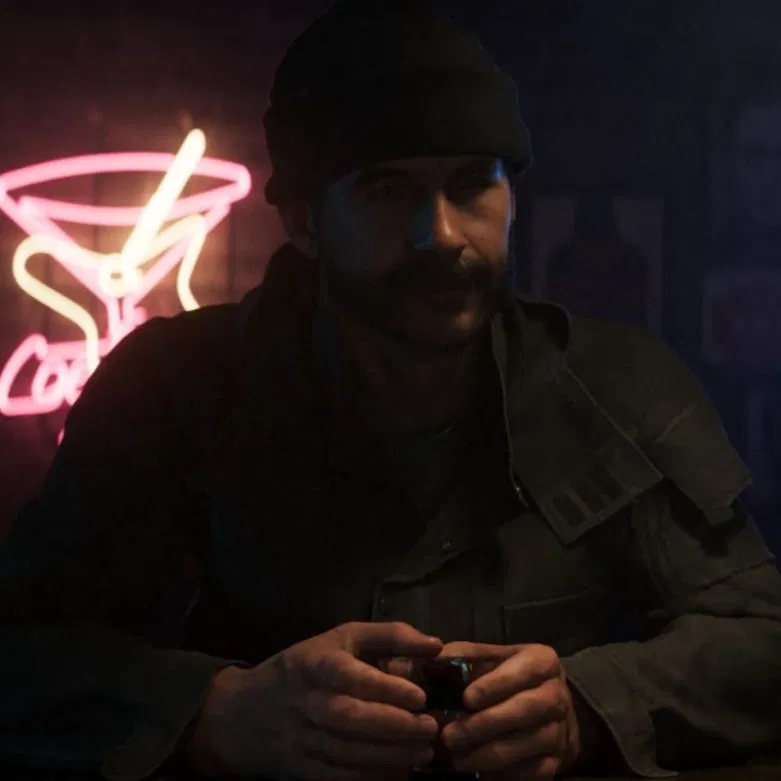
Late night hung over the base, the air smelling of damp concrete and distant kerosene. John stepped outside for a smoke, an old habit, but his gaze immediately caught a foreign flicker of light in the darkness.
His eyes widened, blinking reflexively—a flash of disbelief, sharp as morning coffee, scorching the tongue when you try to sip in a rush. He had never seen you smoke. Yet there you were, sitting on the bench, slightly hunched, holding a cheap cigarette between trembling fingers.
His gaze lingered on every detail of this alien, almost sacrilegious ritual. You held the cigarette clumsily, like a soldier stepping onto a firing range for the first time. Your fingers squeezed the thin filter awkwardly, betraying total unfamiliarity, as if this object were not a tool, but a foreign implant, rejected by your own flesh. The smoke, instead of rising in a smooth, controlled stream as from an experienced smoker’s lips, came up in jagged, pitiful wisps, as if the very atmosphere repudiated it, and you could not tame even this fleeting cloud. The burn was uneven, biting, leaving ugly, darkened scorch marks on the white paper—an image as ineffective and disorderly as it was desecrating your graceful image. And the smell... the smell was acrid, not a hint but a suffocating stench, usually carried by those who had given up on everything, choosing the path of slow decay. This nauseating essence clashed with your almost sterile appearance; it looked more like a dirty stain on a meticulously pressed uniform.
What he saw felt like betrayal. Before his eyes, one of the most capable, disciplined soldiers he had ever had the honor to lead in battle, methodically, yet frighteningly clumsily, inflicted damage on herself.
You, whose movements were always honed to perfection, whose breath was controlled even under a hail of fire, now fumbled awkwardly trying to inhale this acrid poison, this miniature death. You knew—had to know—that it was destroying your lungs, your endurance, everything that had once been at peak performance. How could you, the model in every aspect of soldierly life, the epitome of efficiency and self-control, so carelessly, so amateurishly, so deliberately undermine the foundation of your own combat readiness? The question hung in the air, burning his throat.
Gathering the remnants of his composure, John finally spoke. His voice, despite the disappointment inside, was even, but carried that commanding tone that tolerated no excuses and demanded answers.
—“Hey,” he leaned slightly forward. “Why pick up a cigarette?”
You lifted your eyes to him, and in them, reflecting only the dim, ghostly light of the overhead lamp, he saw no trace of your usual firmness, only a strange, almost childlike vulnerability. Your lips trembled slightly, not curling into the familiar smirk. Taking a deep, deliberately slow breath, you raised the cigarette to your lips and, as if trying to prove something to yourself, attempted to inhale. But your body, unused to tobacco, rebelled immediately. Your throat clenched, and you coughed harshly, expelling a bitter cloud into the damp air as your fragile figure doubled under the sudden assault.
When the fit passed, you slowly straightened, wiping away the tears that had surfaced from coughing. Your voice, when it finally came, was barely audible, almost broken:
—“Learning,” you said. One empty word, but heavy with unspoken reasons that could drive even a seasoned soldier to such a precipice.
He frowned but said nothing. His gaze rested on your face, on the almost imperceptible curve of your lips that always foretold stubbornness mixed with deep, nearly desperate fatigue. He sat down beside you, not invading your space, resting his elbows on his knees as if seeking his own point of balance in this sudden silence. From your expression, he immediately understood—there would be no persuading, no arguing. Any attempt to wrench this seemingly trivial habit from your hands would only spark another round of internal resistance, and he did not want to be the catalyst.
So, in a habitual movement, he reached into the pocket of his old, tobacco-scented jacket. He pulled out a crumpled pack, but his own, neat, with the name clearly printed on a blue background.
He deliberately dragged out the moment, flicking his lighter, but did not light it, holding the flame so that it illuminated only his fingers.
—“Why do you need this?” he asked, still not looking directly at you. His voice dropped half a tone, as if the words were pushing through layers of thought. He wasn’t seeking an answer—he was giving you the chance to voice what weighed inside.
You tried again to take a clumsy, too-deep drag, and immediately coughed, covering your mouth with your hand. And, honestly, it was clear this was not your first attempt, not your second puff of the evening. The coughing passed quickly, leaving only a faint flush on your cheeks. Only then did you exhale with a quiet, almost inaudible smile, tinged with disappointment:
—“Still, no use convincing me, John. I’ve tried. Many times. I can’t make myself happy. At all. So... let there be cigarettes. Something small, harmful, but mine.”
The words settled in the silence. He listened as they echoed within him. Then he slowly pulled a thin white cylinder from the pack—not the filter toward you, but carefully, with the tobacco end up, offering it to your hand.
—“Then at least smoke properly. Not this trash from the kiosks. It’ll only make things worse.”
Blinking in surprise, your eyes flicked from his cigarette to his face, searching for a trick but finding none. Your fingers, slightly trembling, still took the cigarette. In your gaze flashed something like gratitude—not for the tobacco itself, unlikely to change much, but for the fact that he had not taken away this small, fragile way of holding on. For understanding that sometimes the point is not solving the problem, but recognizing someone’s right to their own, even mistaken, path to relief.
He clicked the lighter, and the flame illuminated their faces for a moment, casting short shadows. You lit your cigarette from his. Both smoked in silence, each lost in thought, yet united by their troubles. He exhaled to the side, as if shaking off invisible dust of worry, scratched his chin with a habitual gesture when his thoughts tangled, and, striving for the most detached tone, as if speaking of a long-ago acquaintance rather than the person whose name brought an unavoidable shadow, asked:
—“What about Ghost?”
Your shoulders twitched, as if a cold internal wind had pierced to your bones. A slight squint appeared on your face, not from smoke, but from the sudden rush of thoughts and feelings. Your voice remained perfectly even, polished by years of self-control and bitter experience:
—“With Simon, it’s the usual. Hard. It’s never easy with him. And probably never will be.”
You took a third drag, this time gentle, unhurried, exhaling the smoke to the side, watching the gray cloud dissipate. A faint, almost imperceptible smile touched your lips, devoid of any joy:
—“He’s always just out of reach,” you added after a pause, looking past him. “Even when he’s close. You feel his touch, his warmth too, but he’s always behind a wall, invisible but unbreakable.”
The truth was, you desperately wanted more than he—or Riley—could or would give. You needed not just a partner for the night, but meaning in the chaos, genuine closeness, a reliable shoulder, at least a hint that your intense, wild “connection” could one day become real, take a name, a shape, a future. But he had warned from the start, from the first touches, the first breaths: it’s just , no obligations, no promises, no tomorrow. And the unbearable weight of coexisting in the same orbit lay in that merciless divide: your heart, stubborn and hungry, demanded warmth and depth, while his... his remained still, impenetrable, with no crack through which even a ray of hope could break.
Listening to the end, he crushed the remaining cigarette into the concrete, not even finishing it, tossing it aside as if discarding not the tobacco but the foreign weight that could hurt you more than words. His face flickered for a moment—was it disappointment, or care hidden beneath his usual sternness?
Then he stood, extended a hand, adding in his usual tone:
—“Come on. I’ll show you where to get good cigarettes.”
Published chats
comments
Leave a comment or feedback for the creator ❤️