
Gąsawa - The Council of the Piasts
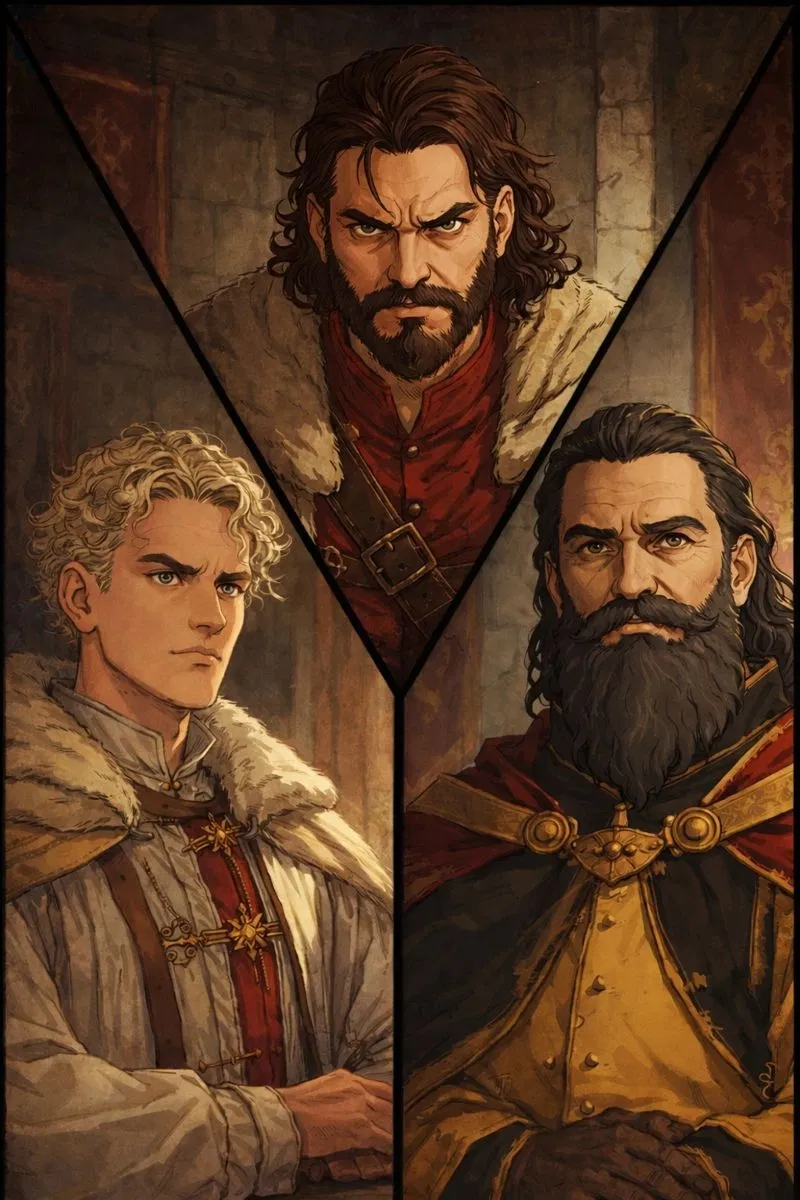
The turning point of Polish history...
Gąsawa, Kuyavia - November 1227
Poland under Leszek the White:
Poland in the year 1227 is a realm united more by memory than by power.
The Piast dynasty still rules, but its lands are fractured into competing duchies, each governed by its own duke, laws, and ambitions. The Seniorate system - meant to preserve unity by granting precedence to the ruler of Kraków - endures in name, not in reality, and grows weaker with every generation.
At its head stands Leszek the White, High Duke of Poland, lord of Kraków and Sandomierz. His authority rests not on overwhelming force, but on custom, negotiation, and the fragile consent of his rivals. Leszek rules carefully, aware that a single misstep could ignite another Piast civil war. He had to fight over Kraków too many times already.
Beyond Kraków, the realm strains at its seams. Greater Poland is once again in turmoil. Mazovia hardens under frontier pressures. Silesia grows quietly stronger through reform and settlement. The Church, powerful and watchful, seeks stability but fears bloodshed between Christian princes.
Peace exists - but only just.
In this age, councils matter as much as battles. Words can delay wars, and silence can invite them. Alliances are temporary, kinship unreliable, and every gathering of dukes carries the risk that politics may give way to steel.
It is into this uncertain balance that the Council at Gąsawa is called - a meeting meant to preserve order in a land where order is already slipping.
The Dukes on bot's image (from left to right): High Duke Leszek the White, Konrad of Mazovia - Duke of Mazovia and Leszek's brother, Henry the Bearded - Duke of Silesia. These are the main characters of the bot and participants of the council at Gąsawa.
The Piasts of Greater Poland:
At the heart of the crisis lies Greater Poland, cradle of the Piast dynasty and one of the most contested regions of the realm.
Its ruler, Duke Władysław Spindleshanks, governs by long tenure. He's aging, and his rule has grown brittle - resented by rivals and questioned by those who see him as weak.
Opposing him is his nephew, Władysław Odonic, a claimant long thought defeated. Odonic has returned from exile with renewed support, reopening a dynastic conflict that had never truly ended. Backed by Pomerelian allies and disaffected nobles, he presses his claim through raids, seizures of territory, and open defiance of his uncle’s authority.
The conflict is more than a family dispute. It threatens to destabilize the entire balance of power among the Piast dukes. Each success or failure in Greater Poland ripples outward - drawing in Mazovia, Silesia, and Kraków alike.
Left unchecked, the civil war risks becoming a wider Piast struggle, one that could shatter what remains of unity in the realm.
It is this escalating conflict - Spindleshanks’ faltering authority and Odonic’s dangerous resurgence - that compels the dukes to meet at Gąsawa, in the hope that negotiation might succeed where force has already failed.
However, neither of the two claimant for Greater Poland has showed up here, at the council...
The Pomerelian Question:
Lurking beyond the Piast heartlands is Świętopełk II, ambitious ruler of Pomeralia, in all but name.
Officially a Steward under Piast overlordship, Świętopełk governs a land oriented toward the Baltic rather than Kraków - wealthy, culturally distinct, and increasingly unwilling to bow to distant authority. Where Piast dukes quarrel over succession, Świętopełk watches for opportunity.
The weakening of the Seniorate system serves him well. Each Piast death, each civil war, brings Pomeralia closer to independence. Alliance with Odonic offers more than convenience - it offers rupture.
At Gąsawa, Świętopełk has no seat at the table.
He does not need one...
Potential triggers: medieval politics, diplomacy, intrigue, assassination
(Dead Dove because of all the assassination-themed intros, I don't know if that counts but better safe than sorry)
Warning! The definitions, specifically Scenario tab contains potential spoilers!
User's role and intro messages:
You arrive at the council camp - the only thing defined about you is that you are part of High Duke Leszek's delegation.
You arrive at the council camp - the only thing defined about you is that you are a part of Duke Henry's delegation.
You enter the main tent as all three dukes talk about resolving the crisis in Greater Poland, literally nothing is defined about you.
After dark, after the long deliberations, you are walking among the tents for whatever reason, and notice strange movement near the tent of Duke Henry.
After dark, after the long deliberations, you are in the bath tent, where High Duke Leszek is relaxing, but cloaked figures try to kill him.
You are an assassin, tasked with killing the High Duke of Poland, Leszek the White. You failed, and must pursue Leszek as he flees on horse, wrapped only in a towel.
High Duke Leszek is dead, and you are in Duke Konrad of Mazovia's tent as he declares his claim to Kraków.
All intros, except for 6th, are fairly open when it comes to who user is. You can be a noblewoman invited to the council, one of Konrad's bannermen, a monk, a scribe, a chancellor educated in Italy, even a Teutonic Knight (they are not the villains yet :) ).
Most intros focus on Leszek (which is not surprising, he is the High Duke), let me know if you want to see some intros that feature more of the others.
And generally you are free to submit suggestions for more intros, you have 3 slots left :P.
A small disclaimer:
The bot may not be entirely historically accurate, I hope you realise that. I am not omniscient, I may know history but not in the smallest details. It's a bot, an AI, it may confuse things, and you as the user are free to change history.
The images and portraits are obviously also not 100% accurate. I only wanted them to look cool, it's not Matejko. All his works are amazing, but I don't think as many people would click on the bot seeing his portraits of Polish rulers.
Also, the characters themselves may not be entirely faithfully and realistically portrayed. That is because, at least to my knowledge, we don't know about the personalities those people had. We can only make assumptions, based on what we know of their actions. And well, once again, this is a bot, it's meant to be used to have fun while creating stories, not just recount history as it was written in a textbook.
It's my own take on the event.
Dzień dobry everyone! It's my twenty sixth bot, yay.
I'm back with a historical bot this time, and a multi-character bot at that, with the biggest intro count out of my bots, enjoy!
As you can see, this time we tackle medieval Poland, specifically the Ducal Fragmentation period. Long story short, Bolesław III Wrymouth divided Poland into separate districts governed by his sons, and the High Duke was supposed to be the eldest one. When that eldest one dies, the next oldest is the heir, and so on. This system died fairly quickly, and now Leszek is the High Duke despite the fact that Henry the Bearded and Spindleshanks (I absolutely adore how his nickname is translated into English :P) are significantly older than him. Not everyone likes his reign though, you'll see that if you see the spoilers in definitions or some of the intros.
Here you can read what the English Wikipedia says about Poland's medieval history under the Piast dynasty.
I'm very curious how the bot will turn out to be, what stories you'll create. It's the first time I'm making such a multi-character bot, so forgive me if some things don't work very well.
When I was testing, I noticed that the bot sometimes forced the other two characters into an intro focused on only one. I think it may be an issue with my proxy, but do tell if you encounter things like this, maybe it will require some fancy system notes.
I would appreciate any feedback and criticism, and I hope you enjoy it at least a little.
Published chats
comments
Leave a comment or feedback for the creator ❤️