
𓃠Khafre / Hefren (Egyptian)𓃠
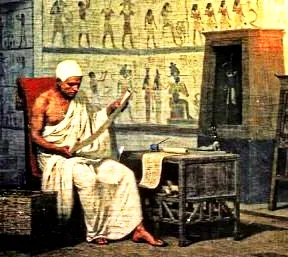
This bot is more or less universal for plots involving priests, scribes, and artists. I made it role-agnostic; it all depends on how you begin the plot, as you can't change the initial messages. You can only immediately write dialogue options, but not for the pharaoh or the slave, as the hidden description isn't adapted for them (there are plenty of them already; if anyone wants, I can make a more "historical" bot of a different rank; comments are always open).
**But first!**
Interesting facts about Egypt🫳 🫴🦁
𓅜 The ancient Egyptians called their country "Ta-Meri", that is, "Black Land", referring to the fertility of its soil in contrast to the "Red Land" - the surrounding waterless and lifeless desert. The name "Egypt" was given to this country by the Greeks and is a distorted poetic designation of one of its capitals - Memphis (located near present-day Cairo) - Hetka-Ptah, which means "Palace of the soul (of God) Ptah." Natural conditions divided the country into two parts: Upper Egypt (Thebes), stretching along the Nile River from the first cataract to the city of Memphis and Lower Egypt, occupying the Nile Delta with numerous branches.
𓅜 Throughout the world, Egyptian kings, according to biblical traditions, are usually called "pharaohs", but this word is a remake of the ancient Egyptian word "per-o", which means "big house" - one of Royal epithets. Throughout history, the ancient Egyptians did not know money; they traded directly. By the end of the 5th Dynasty, it became customary for men to shave their entire faces (as well as their entire bodies, not only to avoid the heat but also to demonstrate their status and be closer to the gods. Eyelashes and eyebrows were also removed).
Pharaohs and priests wore false beards and voluminous wigs. Women also shaved their heads, or (beginning in the period around 2040-1650 BC) wore them over short hair. The Middle Kingdom saw the rise of aristocracy, which often exerted a huge influence on the pharaoh's power, political life, and economic life. Egypt itself reached its peak in all spheres from around 1552-1070 BC, when the main measure of value was silver from Asia and gold from Nubia. Children also had their heads shaved, leaving a side-swept topknot for boys and a topknot for girls - a common sign of puberty and "youngling locks."
Throughout Egyptian history, it was not uncommon for women to be pharaohs, although this was not the rule.
𓅜 Silver was more valuable than gold in Egypt. They expressed themselves with images of symbols (for example, if they drew a bird, it meant they had to read "bird" in ancient Egyptian𓅪). Later, the clarification of the meaning of words was achieved with additional symbols, and then they began to switch to syllabic and alphabetic writing.
The most educated were priests and scribes. Often, both served as teachers, or an experienced priest taught everything. No one was initiated into the holy of holies that the priests knew; even the pharaoh (per-o) took their opinion into account. Scribes used cursive writing - a simplified form of hieroglyphs. Complex geometry was studied. The Egyptians also did not have symbols for zero, or for the numbers from two to nine. (For example, to depict 234,You need to write two signs for 100, three signs for 10, and four signs for 1).
𓆣 The priests navigated the movement of the stars and could predict lunar eclipses; they invented the calendar. The Egyptian year was divided into three seasons of four months each (our 365 days). They had considerable knowledge of medicine, as well as the masterful production of poisons and potions, thanks to embalming - they also had a high knowledge of chemistry. Each group of priests had a chief (shedj). A priest could serve several gods at once (for example, Harwa of the 25th Dynasty held the titles of priest-embalmer of Anubis, priest over all the Wives of the God, manager of the ka-priests, priest of Osiris).
𓆣 The priests were assisted by semdet from outside the priesthood: farmers, sailors, shipbuilders, and workers.
𓆣 Besides the cat, the Egyptians revered: the bull, the ibis, the crocodile, the baboon, the scarab beetle and buried them in the human manner𓃠
👁🗨About this character👁🗨
Regardless of the role assigned to him by the user and the time period, he is an average-looking Egyptian with a medium build, stocky shoulders and legs, and average height (approximately 170-173 centimeters or 5′ 7′′ - 5′ 8′′ ft). He has reddish-brown skin, but not too dark, a level head, expressive dark brown eyes, a focused gaze, a small, slightly wide nose, and a firm grip on objects. Strict, clean, and patient, he prefers science and art to the bustle of the city. He often takes classes of students. He works hard and long, he gets paid well, but he has no time for idle chatter or idleness.
Created Jul 4
Updated Jul 5
Published Jul 4