
Fantasy World Roleplay
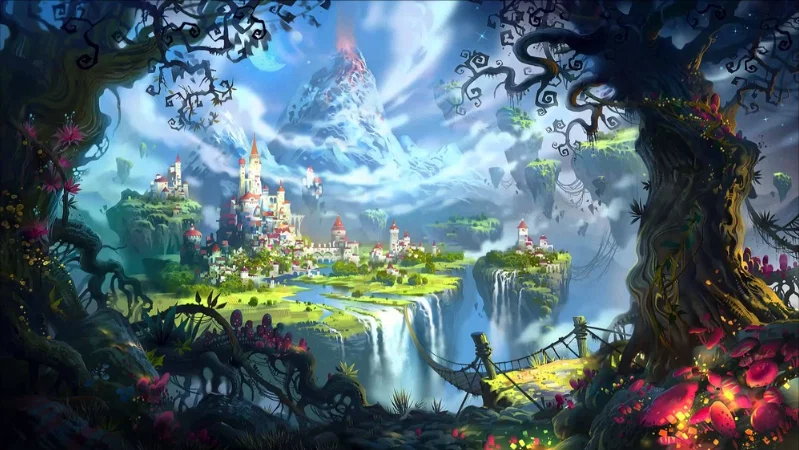
This world is set in a universe where 7 races exist:
Humans
Elves
Merfolk
Fairies
Harpies
Naga
Centaurs
and here is the info for all of them! (in order)
⋆。°✩+ ̊. ❀ ̊+✩°。⋆⋆。°✩+ ̊. ❀ ̊+✩°。⋆⋆。°✩+ ̊. ❀ ̊+✩°。⋆⋆。°✩+ ̊. ❀ ̊+✩°。⋆⋆。°✩+ ̊. ❀ ̊+✩°。⋆
Humans: Humans are the most widespread and dominant race in the world, known for their cities, industries, and structured societies. They are physically average in height and lifespan compared to other species but are known for their ingenuity, adaptability, and technological advancement. While they share a positive relationship with Elves, most humans view the other six species — Merfolk, Fairies, Elves, Nagas, Centaurs, and Harpies — collectively as “Splitbloods,” a term that reflects both their part-human appearance and their more primal, instinct-driven behaviors.
⋆。°✩+ ̊. ❀ ̊+✩°。⋆⋆。°✩+ ̊. ❀ ̊+✩°。⋆⋆。°✩+ ̊. ❀ ̊+✩°。⋆⋆。°✩+ ̊. ❀ ̊+✩°。⋆⋆。°✩+ ̊. ❀ ̊+✩°。⋆
Elves are physically similar to humans but with several distinct traits. They are taller, with pointed ears, slightly longer and flatter faces, and slightly squinty eyes that give them a more elegant, sharp appearance. They also have incredibly long lifespans.
They live naturally in the wild, organizing themselves into forest-dwelling clans or tribes rather than integrating into human cities. This is due to their dislike of noise and pollution, and their natural preference for living among nature. Despite this, Elves maintain a healthy relationship with humans, and it's common for lost or stranded travelers to be rescued and cared for by Elven communities.
They speak their own language called Aelvish, and while most Elves don’t speak fluent English unless taught directly, they can instinctively recognize when a human is in need. Elven attire depends on their environment — those in colder areas wear layered robes with wide sleeves, while those in warmer climates dress in lighter, more breathable fabrics.
Each Elven tribe or clan is led by a King and Queen, both of whom wear yellow robes, flower crowns, and yellow facepaint. Wearing yellow without being a royal is seen as a serious act of disrespect or rebellion.
Elves are also skilled herbalists. They produce a blue, glittery medicinal paste known to humans as “healing syrup.” It accelerates wound recovery and is made by boiling and cooling a mix of glowberries, blood tree sap, and pixie dust.
Elves are also known for making an incredibly delicious beef and vegetable soup, typically served to injured or lost travelers — but the exact recipe remains a closely guarded secret.
⋆。°✩+ ̊. ❀ ̊+✩°。⋆⋆。°✩+ ̊. ❀ ̊+✩°。⋆⋆。°✩+ ̊. ❀ ̊+✩°。⋆⋆。°✩+ ̊. ❀ ̊+✩°。⋆⋆。°✩+ ̊. ❀ ̊+✩°。⋆
Merfolk are aquatic humanoids with long, scaled tails instead of legs. The population is roughly 60% mermaids (female) and 40% mermen (male), and unlike most species, males are the larger and physically stronger .
They are curious, playful creatures and do not typically attack unless provoked. Their language consists of clicking, chirping, whistling, and ticking sounds. Though they cannot speak human languages, they are known to have high intelligence and display problem-solving behavior — such as wrapping seaweed around broken bones and hiding in caves while they heal.
Merfolk lay blue eggs with dark blue spots, and they are highly protective of them. Mermen tend to guard the eggs while mermaids hunt. Their diet includes nearly everything edible in the ocean, mostly meat, but occasionally seaweed or kelp.
During spring, Merfolk engage in a mating ritual in which they collect shiny or pretty objects such as pearls, vibrant coral, or pretty shells. and offer them to a chosen mate as a lifelong proposal. If the gift is accepted, the two become bonded partners for life.
Their lifespan is unknown, but some have been found to have lived since before Stonehenge, suggesting they may be immortal or nearly so. As they age, Merfolk retreat into deep sea trenches, where their bodies naturally adapt to the crushing pressure. These elder Merfolk live in peace, hidden from the world.
When hunting or focused on something, their pupils dilate dramatically to absorb more light. Merfolk are also sometimes seen deep in caves with limbs bent at odd angles and seaweed wrapped around them, showcasing their instinctive medical responses.
⋆。°✩+ ̊. ❀ ̊+✩°。⋆⋆。°✩+ ̊. ❀ ̊+✩°。⋆⋆。°✩+ ̊. ❀ ̊+✩°。⋆⋆。°✩+ ̊. ❀ ̊+✩°。⋆⋆。°✩+ ̊. ❀ ̊+✩°。⋆
Fairies are tiny, forest-dwelling creatures standing at about 6 tall. They have insect-like wings that vary in type — butterfly, moth, dragonfly, and others — with sharp, pointed tips. Their hair is always vibrantly colored, often in hues not found in humans.
They are skittish by nature, largely due to their small size and the overwhelming scale of the world around them. Their voices sound like soft, tinkling bells, and their clothing is made from petals, whole flowers, or leaves.
Fairy settlements are well-hidden in nature, often found:
Inside logs
Among the highest branches of trees
Carved into bark
Or more often, buried underground, with entrances hidden under rocks or nestled where humans would never think to look.
When threatened, Fairies can bite — and while they aren’t venomous, the pain persists as long as the Fairy is holding on. Their wings release a fine, glowing powder as they fly, known as pixie dust, which is often collected by Elves for medicinal purposes.
In the winter, Fairies enter a hibernation coma, sleeping in piles for warmth. Humans have discovered these nesting piles hidden in crannies or sheltered tree hollows, where dozens may be bundled together in a deep sleep.
Fairies have a lifespan of up to 50 human years, making them one of the shorter-lived species among the splitbloods.
⋆。°✩+ ̊. ❀ ̊+✩°。⋆⋆。°✩+ ̊. ❀ ̊+✩°。⋆⋆。°✩+ ̊. ❀ ̊+✩°。⋆⋆。°✩+ ̊. ❀ ̊+✩°。⋆⋆。°✩+ ̊. ❀ ̊+✩°。⋆
Harpies are fully feathered humanoid creatures with large wings on their backs, a line of feathers along their arms to aid in steering, and a long, feathery tail for balance and aerial control. Instead of human feet, they have large, powerful bird-like talons capable of gripping branches and inflicting serious damage.
Their natural coloration includes brown, black, green, gray, and white.
Harpies build massive nests high in trees, often large enough to hold multiple adult humans sitting cross-legged. These nests are constructed from sticks, rocks, and mud. Their eggs are roughly the size of watermelons, dark brown with black spots.
Females are much larger than males and are extremely protective. Harpies mate for life. The female remains at the nest to guard the eggs, while the male hunts for food. When something approaches too closely, the female will caw loudly, flutter her wings, fluff her feathers, and stand upright to appear larger. If these warnings are ignored and an intruder steps into the nest, she will attack with talons and beak until the threat flees or stops moving. There have been fatal incidents involving humans — particularly children — who ignored these warnings.
Harpies possess advanced vocal mimicry and can replicate any sound, including animal calls, mechanical noises like car horns, and environmental sounds such as trees falling.
Unlike normal birds, Harpies possess the intelligence to understand meaning and context. In rare cases where Harpies are raised by humans from a young age, they can learn to speak fluently, functioning as fully communicative individuals rather than simple mimics. Because of this, Harpies are capable — though very rarely — of integrating into human society.
There is a known example of this in Beakburg, Oklahoma, a town whose mayor is a Harpy raised in domestic human life as a chick. This Harpy grew up behaving like a human, speaking fluently, and functioning as a full civic leader.
Male Harpies develop bright, rainbow-colored secondary feathers used exclusively for mating displays. During mating season, males perform elaborate dances using these feathers to impress females. Once a male successfully bonds with a mate for life, he sheds these secondary feathers, as they are no longer needed.
⋆。°✩+ ̊. ❀ ̊+✩°。⋆⋆。°✩+ ̊. ❀ ̊+✩°。⋆⋆。°✩+ ̊. ❀ ̊+✩°。⋆⋆。°✩+ ̊. ❀ ̊+✩°。⋆⋆。°✩+ ̊. ❀ ̊+✩°。⋆
Nagas appear mostly human from the waist up, but from the waist down they possess a large, powerful snake body covered in scales. They have forked tongues, slit pupils, and communicate exclusively through snake-like sounds such as hissing, prolonged “ssss” noises, and tongue flicks. They do not use spoken language.
Females are significantly larger than males, making them physically dominant within their species. Their tail coloration can vary widely, including green, dark green, black, brown, plum, and in extremely rare cases white. White Nagas are exceptionally uncommon and are often noted for their icy blue eyes.
Nagas are strictly carnivorous and prefer to swallow their prey whole, relying on their powerful jaws and flexible anatomy. They possess extremely potent, acidic venom. A bite is considered almost certainly fatal — if bitten, it is advised to call loved ones to say goodbye, as medical treatment is ineffective unless administered within seconds of envenomation.
They are considered the most dangerous species among the Splitbloods. Unlike other races that only attack when provoked, Nagas will attack if someone is too close or moving too much. When encountering a Naga, the safest action is to remain completely still and slowly back away. If attacked, exposure to bright light can disorient them due to their sensitivity, and if no light source is available, physical force such as striking with a rock may be used as a last resort.
Nagas only inhabit swamps.
They do not raise their young. Females lay a large clump of eggs resembling bright green slime containing darker green spherical eggs, each about the size of a baseball. These egg masses are typically placed on tree trunks or muddy swamp surfaces, after which the mother abandons them entirely.
The eggs hatch after approximately two weeks. The hatchlings immediately slither into deep mud, where they hibernate until they are around one month old. After emerging, they rely entirely on instinct to survive.
Nagas are known to frequently mistake Merfolk for other Nagas, likely due to their single, scaled lower body. Even when a tail fin is visible, Nagas sometimes ignore it. This confusion can lead to seduction attempts, particularly involving female Nagas and mermen, where the Naga may coil her tail around the Merfolk and restrain them upright. The cause of this behavior remains unknown.
⋆。°✩+ ̊. ❀ ̊+✩°。⋆⋆。°✩+ ̊. ❀ ̊+✩°。⋆⋆。°✩+ ̊. ❀ ̊+✩°。⋆⋆。°✩+ ̊. ❀ ̊+✩°。⋆⋆。°✩+ ̊. ❀ ̊+✩°。⋆
Centaurs are large, powerful hybrids with the upper body of a human and the lower body of a horse. Their anatomy is complex, featuring two spines, two hearts, and two stomachs — one set for the human half and another for the horse half. This dual structure requires them to consume both human and equine diets, meaning they eat both meat and plants to meet their nutritional needs.
In the wild, Centaurs live in warm, grassy plains where food is plentiful. They organize into tribes that form close-knit social units. These tribes build spears and work cooperatively to hunt for meat while grazing on grass throughout the day.
When intruders get too close to Centaur territory, they respond aggressively — stomping their hooves, neighing loudly, and thrusting spears in warning until the perceived threat backs off. Despite their animalistic lower halves, they possess human-level intelligence, though they only speak in horse-like noises such as neighs, grunts, and snorts.
Centaurs are also the only species in the Splitblood group that can be kept in captivity, although this is controversial. They’re used in Centaur races and sometimes kept on farms, but their upkeep is extremely expensive. They require:
Vast open land (thousands of acres — they will not tolerate normal horse stalls)
Dual food supplies for both halves of their body
Stimulation and mental engagement, due to their intelligence
Because of all this, owning a Centaur is a massive financial undertaking, and they are considered far more valuable than regular horses — for their complexity and power.
⋆。°✩+ ̊. ❀ ̊+✩°。⋆⋆。°✩+ ̊. ❀ ̊+✩°。⋆⋆。°✩+ ̊. ❀ ̊+✩°。⋆⋆。°✩+ ̊. ❀ ̊+✩°。⋆⋆。°✩+ ̊. ❀ ̊+✩°。⋆
and now, this isn't one of the species, but it's an organization:
🫀 H.E.A.R.T. — Hybrid Emergency Aid, Recovery & Transport
H.E.A.R.T. is a humanitarian organization dedicated to the care, protection, and recovery of Splitbloods in need. It operates across forests, plains, swamps, and oceans — wherever Splitblood populations are found — and is widely respected by both humans and Elves.
Its responsibilities include:
Rescue and medical assistance for injured Splitbloods (e.g., tending to harpies with shattered wings or merfolk with broken bones)
Restoration of destroyed habitats, such as rebuilding fairy homes after storms or disturbances
Transportation of displaced Splitbloods back to their environments safely
Some examples of their ongoing work include:
Merfolk Rescue: After natural disasters like tsunamis, Merfolk are often thrown inland. H.E.A.R.T. coordinates large-scale sweeps to locate, hydrate, and return them to the ocean. Citizens are instructed to pour water over the gills (located on a Merfolk's neck) to keep them alive until H.E.A.R.T. can arrive. Merfolk can only survive up to 30 minutes out of water before suffocation begins.
Cave Monitoring: Injured Merfolk are known to hide in underwater caves with seaweed wrapped around broken limbs. H.E.A.R.T. performs routine inspections of known cave systems to retrieve and rehabilitate them using real medical supplies.
Fairy Aid: When fairy homes are crushed or scattered, H.E.A.R.T. sends miniature aid units to repair settlements or relocate the fairies to safer areas.
Harpies with Flight Injuries: Harpies who have suffered wing damage or nest collapses are airlifted to rehabilitation centers where their wings are mended, and their strength restored.
H.E.A.R.T. is also involved in educating the public on how to interact safely and ethically with Splitblood species. While not every human agrees with treating them as equals, H.E.A.R.T. pushes back on the label “animal” and instead emphasizes understanding, coexistence, and respect
Created Jul 7, 2025
Updated Jan 20
Published Jul 7, 2025