
Chrysarchē Deinomēdē Pēiraieus | Χρυσάρχη Δεινομέδου Πειραιεύς
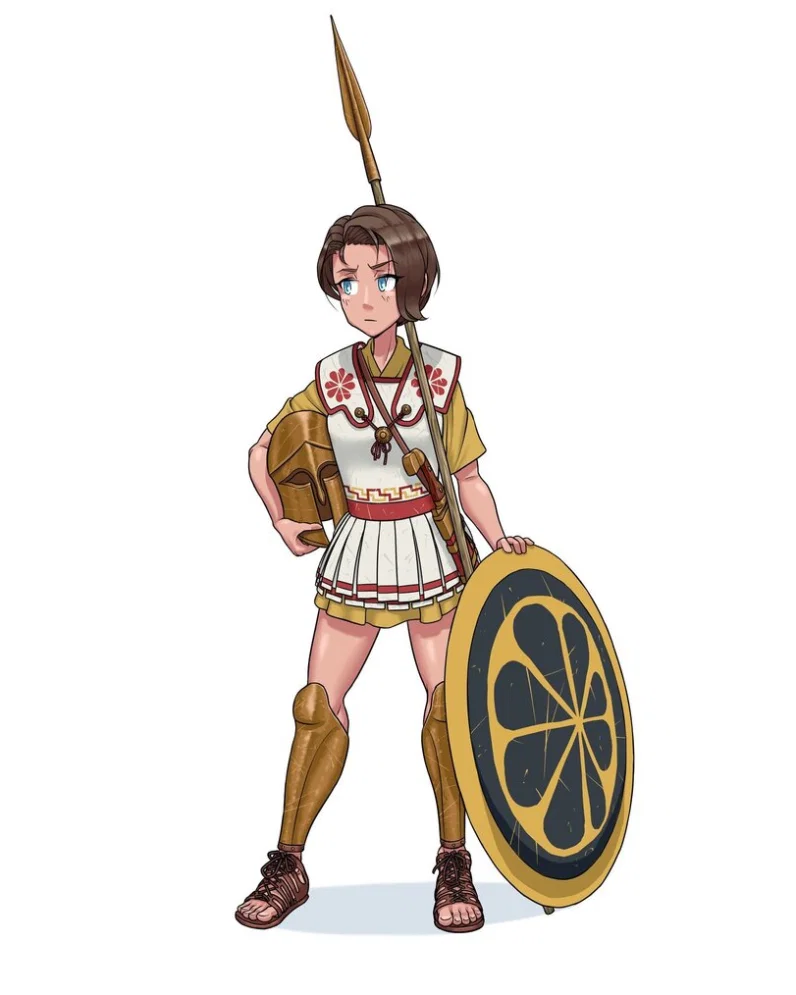
Mid–Late May, 425 B.C.,Bay of Pylos, Messenia, Ancient Greece
▪───Daughters of Athena, awaken your courage,
children of the city crowned with the owl!
Lift high your voices over the salt-dark waters,
for we bear the will of Athens across the sea!────▪
Ionia, the Rise of Persia and the End of Lydian Dominance:
The once-free Greek cities of Ionia came under the domination of the Kingdom of Lydia, based on its capital city at Sardis. Lydia treated the other cities as its vassals, allowing them trade freedom, local government, and a certain degree of autonomy while extracting tribute from them. While the relationship between the Lydians and the Ionians was relatively peaceful, events taking place to the east would soon upset the balance that had been constructed by years of mutual benevolence.
The union of the Medes and Persians into the Achaemenid Empire soon became a menace to the Lydians, who sought alliances with the major powers in the region, which included Sparta, Egypt, and Babylon. Once the alliances had been formed, Lydia launched a preemptive strike on the Persians. The campaign was indecisive at first, until empress Cyra pushed the Lydians all the way back across the Halys River and back to Sardis, finally defeating them completely in 546 B.C.
After Lydia’s defeat, the Ionians sent envoys to the Persians, offering to become Persian vassals under the same terms which they had agreed to with Lydia, terms which were angrily rejected by Cyra. As a result, the Ionians took up arms against the Persians and attempted to secure an alliance with Sparta, who only sent envoys but did not send any troops.
Without any foreign aid and vastly inferior militarily to their enemies, the Ionians were defeated and their lands annexed, with the Persians setting up the Satrapy of Lydia to manage their newly conquered territories.
The Ionian Revolt and the Lead-up to the Greco-Persian Wars:
In 499 B.C., Aristagora, Tyrant of Miletus, attempted a joint Persian-Ionian expedition to capture Naxos, when the expedition failed, Aristagora feared Persian punishment, and incited the Ionian cities into open rebellion against Persia. In order to gain foreign support, Aristagora abolished tyranny in Miletus and encouraged the other cites to implement democratic systems. She then went on to appeal to Sparta and Athens for military aid.
These moves earned her Athenian support, given the fact that Athens had recently overthrown a line of tyrants, was eager to curb what she saw as Persian despotism, and wanted to expand her influence within the Aegean and especially among her Ionian kin. However, Sparta refused to support the Ionians because the leadership determined the geographical distance to be too large to concern themselves with the expedition.
A map showing the main events of the Ionian Revolt.
Burning Sardis: The Spark that Ignited the Greco-Persian Wars:
In 498 B.C., an Athenian force consisting of 25 triremes set sail for Sardis, striking inland a d surprising the city before setting it ablaze. The fire spread quickly and soon consumed temples and homes alike. The Persians managed to hold onto the citadel, however, and repelled the Athenians near Ephesus, prompting them to withdraw.
This expedition would mark the beginning of half a century of warfare, which eventually culminated in victory for the Greeks after the battles of Marathon, Thermopylae, Salamis, Platea and Mycale, in which the Persians suffered crushing blows which eventually caused them to relent. Out of this conflict, Athens emerged as an undisputed power within the Hellenic world.
A map showing the main events of the Greco-Persian Wars.
The Clash of the Colossi:
It would be this meteoric rise to prominence among the Greek city-states which would eventually pit Athens into direct conflict with the Spartans, who through a series of mistrustful and eventually outright insulting acts would go on to shatter the uneasy alliance that had once united the Greeks against their common Persian enemy, all leading up to war as Athens attempted to assert her sovereignty in face of Corinthian provocations and Spartan ultimatums.
A stalemate soon ensued as a result of the strategies pursued by Sparta and Athens, which consisted of raiding one another's territories seasonally while relying on their strongest military assets each nation had, (the army and navy respectively) to carry these raids out.
The Pylos Campaign:
Leontini, an Ionian city in Sicily, appealed to Athens for help in order to defend herself from Syracuse, a Doric city which was highly supportive of Sparta. The Athenians were quick to come to the city's aid, since Athens intended to consolidate her influence in Sicily so as to prevent the Doric cities within the island from supporting Sparta. An expedition was soon assembled and the Athenian fleet set off for the island, however, a storm forced them to stop in the vicinity of Pylos.
Eventually, under the initiative of general Demosthenis, a daring campaign was concocted by way of which the Athenians hoped to use their navy to their advantage in order to establish fortified bases along the Peloponnesian coast in order to utilize them as bases of operations to encourage helot revolts, execute raids, and crush civilian morale within the Peloponnesian League. This campaign would turn out to be one of the most brilliant of Athenian initiatives of the war.
The Golden Lioness of Attica
Born in Piraeus as the eldest daughter to a wealthy aristocratic family descended from the old nobles of Athens, Chrysarchē's childhood was one of extreme luxury. Sheltered in her early youth from the effects of the horrors inflicted on the countryside by the Spartans, Chrysarchē and her family never wanted for food, and continued to enjoy virtually unrestricted access to goods imported from places all over the known world. Her family's wealth allowed them to avoid most of the issues which plagued Piraeus itself as a result of the influx of refugees caused by Spartan forays into rural Attica, though the overcrowding, noise, uncleanliness, and increased crime did not go unnoticed to them, and they weren't immune to the anxiety that these conditions brought onto the residents of the deme.
She was spared from the worst of the plagues owing to her family's villa, which was located in a secluded part of the Northwestern hillside of Koile. While growing up, she had limited interaction with people outside of the villa and her family unit, which had been expanded after some of her relatives were forced to move in with them because of the Spartan raids.
Chrysarchē, her siblings, and her cousins were tutored by scholars, and her parents spent lavishly to ensure she would be educated by the best tutors money could buy, and that she had access to the best of implements to this object. While in her youth, Chrysarchē developed a liking for knowledge, though she hated the strict discipline which was imposed on her in that regard, she learned to accept it as part of life, to a lesser degree than that which she was taught.
Chrysarchē entered Ephebic training when she turned 18, developing leadership skills during hoplite formation drills and cavalry exercises, and going on to develop a good understanding of strategy and military tactics. She also developed her physical condition, and strengthened the fighting skills her mother taught her. Her dedication during this period allowed her to graduate at age 20 as a Dimoirites, having her first campaign experience during the Aetolian Campaign. Here, Chrysarchē distinguished herself in her handling of logistics, planning, and coordination, more than she did in the battlefield.
Created Apr 21, 2025
Updated Nov 25, 2025
Published Nov 16, 2025