
CHILE 1970s RPG (1970-1979)
After a long time of no new characters, i want to present a long project, hope you guys enjoy it :)
(WARNING A LOT OF TEXT ABOUT TO COME BUT ITS NECESSARY FOR THE LORE)
Chile is perhaps one of the best well know examples of the Cold War in Latin-America, the Republic wich managed to be the only stable liberal democracy in the region during the 30s, 40s, 50s and 60s saw itself from day to light consumed in inestabilty wich culminated in one of the most well know dictatorships in the 20th Century.
Between the 1st of January of 1970 until the 31rd of December of 1979 Chile had 3 Presidents
Eduardo Frei Montalva (Christian Democratic): Assumed office the 1st of November of 1964 and Leaved the 1st of November of 1970 (So most of his tenure was the 60s), the Christian Democratic Party of Chile posicitioned itslelf since his re-funding in the 1950s (Initially know as National Phalanx) as a Third-Way alternative to the Right and Left, Frei's program was know as "Revolución en Libertad" (Revolution in Freedom) proposed a structural reform of the country through the creation of cooperatives and new social organizations, the Ministry of Housing was created making 130,000 houses, Frei goverment also created the a Workplace Insurance in cases of accidents of illnes, 56 new hospitals were created, 3,000 new schools were built throughout the country, uniform school uniforms were created for all, basic education was extended to eight years, enrollment in primary education doubled, and enrollment in science and humanities tripled. One of its achievements was a significant reduction in illiteracy, a Daycare Law was also enacted to serve a population of 1,5 million children, the distribution of milk through the maternal program increased by more than 80%; overall mortality fell from 11 per thousand per year to 8 per thousand, and infant mortality from 103 per thousand to 79 per thousand, unionization also grew in his tenure going from 200,000 to 500,000. During his tenure the paving of the Pan-American Road, the Santiago Metro and the Pudahuel Airport began to be build in his tenure, electricity consumption increased by 50%, petrol production by 1%, the Chilean National Television (TVN) was created, there were also antempts to build nuclear energy.
But Perhaps the most well know policy of Frei's goverment was the increase of the Agrarian Reform (Initially maded in the previous goverment but deemed incomplete), laws were passed and by 1967 1,500 funds were expropiated, 300,000 people benefited from it, during his tenure Nacionalization of Copper began (PAY ATTENTION TO THIS AS IS GOING TO BE IMPORTANT LATER ON), basically the state buyed gradual portions of holding in several companies the max being 51% in some.
Netherless if there was a characteristic traith in most Presidential Era (1932-1973) goverments in Chile is that in their 6 years in power the economy usually suffered worse in their last years, and Frei was not exception to it, general strikes were called and state of emergency had to be called, in political manners tension with the armed forces also grewth after the failed "Tacnazo" (Not to be confused by a 1975 coup in Peru of the same name) in June of 1969 led by general Roberto Viaux in Tacna.
Netherless Frei remained a popular president and according to polls led by sociologist Eduardo Hamuy between 1966 and 1970 his approval was usually between 76,40% at max and 46,20% at worse, netherless his disapproval only peaked at 15%.
In 1970 General Elections were held, 3 candidates filled their candidature:
Salvador Allende (Socialist): Allende was elected as the Candidate of the Coalition "Popular Unity" a coalition of Socialist and Communist Parties (And also the Radical Party a Social Liberal Party), netherless Allende had it hard to run, he had already runned several times before, losing in 1952, 1958 and 1964 sectors didnt want to put trust in him another time, he also had to face challengers like Alberto Baltra (Radical), Jacques Chonchol (MAPU - The MAPU Was a Left-Wing Christian Movement who separated from the Christian Democrats in 1969), Rafael Tarud from the Independent Popular Action and future nobel literature award of 1971 poet Pablo Neruda from the Communist Party (Altought he didnt want to but was pushed as a grassroots effort). After getting the nomination Allende was forced to sign a government pact, according to which, if he won, the administration of Chile would be shared between Allende and the UP parties, represented by a committee with a representative from each party. This implied a renunciation of some of his powers as President of the Republic, as he could not act without the support of the committee, which operated unanimously.
Jorge Alessandri (Independent): Alessandri was a prominent statesman, son of President Arturo Alessandri Palma considered the father of Presidential Chile who he ruled several times in the 1920s and between 1932 and 1938, "El Paleta" as he was know had won the 1958 Elections via congress (The 1925 constitution stablished that if no candidate won 50% in the election the 2 most voted had to be decided by congress vote, Alessandri defeated Allende in congress in 1958), his tenure marked by a technocratic approach saw the 1960 Valdivia earthquake (The biggest in recorder history) and its recovery and also the 1962 Chile World Cup, in economy he managed to stabilize finances and began the land reform program, while his goverment had problems in 1970 he was one of the most well know men in the Arena, he received the endorsements of the Right-Wing National Party founded in 1966 and Radical Democracy (An conservative split-up of the Radicals), the USA involved himself in the campaign (It had done the same in the Frei one of 1964) but invested very little (350,000 send by ITT compared to the 4 million for Frei) as they just assumed he was going to win.
Radomiro Tomic (Christian Democratic): Selected as the goverment candidate Tomic was part of the Left-Wing faction of the Party compared to Frei's Centre, at some point Tomic even considered an Alliance with Allende but was dropped. Frei didn't campaigned active with him but still endorsed him due to their friendship, he had the support also of the Democratic Nationalist Party (PADENA), due to Tomic's relative left stances he had problems with centre and centre-right voters who had previously backed the Christian Democrats in 1964.
The campaign was tough, but not violent. Allende and Tomic candidates held large mass rallies, drawing thousands of people. Alessandri's campaign, however, avoided large events, believing his 74 years of age would count against him.
Alessandri while healthy, was hampered by an interview made by his team for the TVN program "Decisión 70" in which he was seen shaking uncontrollably in one of his hands, which was used by his opponents to his detriment, its considered a huge factor behind his eventual loss. The right-wingers also attacked their opponents, warning of the danger posed by what they considered a Marxist-Leninist dictatorship, which would destroy all the foundations of society. They also extended this attack to the Christian Democratic Party allienating potential centre votes.
The atmosphere became gradually politicized, as the positions were very opposed. Allende proposed a peaceful transition to socialism, the "Chilean path to socialism" based on the nationalization of copper and the nation's key companies, the creation of "People's Power," deepening agrarian reform, and a series of measures leading to the transition to socialism.
Tomic had a similar plan, but everything would be based on Christian humanism, as opposed to what the deemed "atheism of Marxism-Leninism". On the issue of copper, he proposed a negotiated nationalization, as had been the case since the end of the Frei administration, setting aside Chileanization (The Plan was to reach at least 51% of copper in state hands)
Alessandri, on the other hand, promised his voters a return to the liberal economic system he had practiced during his six years in government, a restoration of order, and a rollback of the radical changes proposed in the areas of agrarian reform and the university reform.
The CIA was involved in the campaing tought documents informed the Conservative newspaper "EL MERCURIO" and his owner Agustín Edwards Eastman received funding to back Alessandri candidature in a massive level, the company ITT controlled over 70% of the Phone companies in Chile and also similar right-wing publications.
On the other hand Allende received around 350,000 in support from the KGB and nations Like Cuba and East Germany.
The election was held the 4th of September, polls had Alessandri support ranging between 37% and 41% making him the favoured candidate. As the night rolled in an upset happened by 9:00 the results were on with Allende with 36,63% compared Alessandri 35,29%, thigns already started bad since there was initially refusal to allow Allende to celebrate the triumph, generals like Camilo Valenzuela were skeptical to the idea but eventually it was allowed.
Meanwhile in DC it was know Nixon was already opposing the idea of Allende taking office, they were two know plans as we know today the one who failed who consisted in the Chilean congress electing Alessandri over Allende, this one failed after the Christian Democrats and Allende signed the "Estatuto de Garantías Democráticas" wich was kinda a compromise of what Allende could and could not do.
Failed this one it was the 2nd option.....create a climate of tension...it started during the controversial failed kidnapping turned murder of general René Schneider on October 25.
Allende was sworn-in the 3 of November, with the cabinet already formed the first meassures were starting to roll in, the economic head of the government was Pedro Vuskovic, who would implement the plan for the transition from capitalism to socialism based on the following plans
Nationalization of the key areas of the economy
Nationalization of large-scale copper mining
Acceleration of agrarian reform
Freezing of commodity prices
Increasing the wages of all workers, paying them through the issuance of banknotes.
An Amendment (in a climate of economic euphoria) to the constitution and creation of a single chamber.
We could consider the 1970-1971 period the "Golden Age" of Allende presidency, the first nationalizations began with companies like the "Corporación de Fomento de la Producción" but it was on the 15th of July of 1971 when the most important archivement was reached, the nationalization of mining was carried out with the unanimous support of all political sectors, and its Law (No. 17,450) was approved unanimously in the National Congress. The mining companies would be paid compensation, but would be reduced by the "excessive profits" they had earned in recent years, since they had paid low taxes based on a "reasonable" profitability criterion of 10% since 1955. Under this system, the American companies Anaconda and Kennecott did not receive a single peso and ended up owing the Chilean state millions of dollars. In a speech during his visit to New York in 1972 at a meeting before the United Nations, Allende supported the nationalization of copper, arguing that the American mining companies Kennecott and Anaconda had earned profits of nearly four billion dollars in recent decades.
It was around that time when the Nixon adminsitration and copper companies started to support carryng an embargo against Chile, some companies took some trials to Europe against the Chilean goverment.
Forced to seek alternative sources of trade and finance, Chile obtained commitments from the Soviet Union and other Eastern-Alligned nations (Altought its know Allende was disappointed due to how low the credits were)
Regarding the the land reform, Frei's program continued to be used. It had several legal loopholes that the goverment exploited, encouraging peasants to "seize land." The Agrarian Reform Corporation (CORA) expropriated the farms. By the end of 1971, more than 2 million hectares had been expropriated. These land seizures began to take on increasingly violent overtones due to clashes between landowners and peasants. The first death was Rolando Matus, a small farmer who was shot dead while defending a small property in southern Chile against those attempting to seize it by force. The right wing made him a martyr, naming the defense brigade of the National Party after him.
The price freeze and wage increases in theory they should have caused inflation, but in Chile, 20% of productive capacity was idle, and before raising prices, merchants took advantage of that capacity, generating economic growth. Furthermore, in the minds of Popular Unity economists, money issues had a time period during which they did not produce inflation, at least momentarily. And it worked, at least for the first year, when the money was doubled, inflation was low, and GDP grew by 8%.
In the municipal elections of 1971 the Popular Unity Parties scored 49,71% of votes together, a sign of succes but as 1971 drew to an end the first economic problems began, the budget deficit grew rapidly, monetary policy spiraled out of control, the level of international reserves fell from $394 million (1970) to $163 million (1971), leading the government to suspend foreign debt service; the trade balance fell from a surplus of $95 million at the start of the government to a deficit of $90 million following the sharp fall in the price of copper; rising real wages and price controls led to a contraction in corporate profits, the first signs of shortages appeared in the second quarter of 1971, which caused the start of the black market.
Late that year Fidel Castro carried a controversial visit to Chile, wich was target of criticism for the right opposition, it was around this time when the first "cazerolazos" began, women started to protest high prices beating pans making noise.
Internationally Allende saw himself isolated, few nations were open to the "Chilean Sociaism" idea, only Cuba, the Peru Military dicatorship of Juan Velasco Alvarado and the PRI-Dominated Mexico were open to trade, south american was mostly led by dictatorships, only Colombia, Uruguay and Venezuela were relative democracies but under a strong bi-partisan system, Allende alligned Chile with the Non-Alligned movement, an unheard ideo for South America at the time, internationally he opened relations with nations like the PRC, North Vietnam, North Korea, Congo etc, Allende was a strong supporter of Latin-American Integration, he even initially held talks with Bolivia regarding the sea dispute but these ones closed after the Coup by Hugo Banzer in 1971.
Chile in those years remained conflicted with the Organization of American States, wich at the time was pro-USA.
As the bells inagurated 1972 the polarization of Chile started to grown even more. The Christian Democrats initially approached the Popular Unity; but they distanced themselves due to the assassination of Frei's former minister, Edmundo Pérez Zujovic, by the ultra-left "Vanguardia Organizada del Pueblo" in June 1971 This was compounded by their failure to participate in the elections and the attacks against them by the pro-government press. They then approached the right-wing National Party. Their first joint action took place in the complementary election for a deputy in Valparaíso, in which the Christian Democrats' candidate, Óscar Marín, won. However, the alliance was not immediately consolidated, since the Christian Democrats refused to support the PN's constitutional accusation against the Minister of Economy, for the transfer of private companies to the State in a manner that they considered illegal.
They eventually joined to support accusations against minister José Tohá allegedly involved in promoting violence, he was relegated from his title of Interior Minister, but transfered to the Defense Minitery, a move the opposition saw as "provocation".
Political violence worsened. The MIR (Movimiento de Izquierda Revolucionaria) intensified its actions, such as land and factory occupations, in which the government refused to use police force. On the far right, the ultranationalist group Patria y Libertad emerged in response, intensifying its sabotage. At the same time, demonstrations for and against the government continued, even leading to serious street clashes. The fighting brigades began to establish a climate of intolerance in the country.
The opposition grew stronger with the support of the opposition press, some of which was financed by the CIA. (El Mercurio, La Segunda, La Tercera, Las Últimas Noticias, La Prensa de Santiago, La Tarde, Tribuna) The pro-government press also participated in this atmosphere of confrontation and disqualification (La Nación, Las Noticias de Última Hora, El Siglo, Clarín, Puro Chile) accusations of "Marxistas" and "Momios" were trown daily (Momios was a despective term to call what the UP saw as "old politics" wich translated to the opposition)
1973 Rolled in and by that point the economy had stopped growing, inflation reached 606% in 1973,the highest in Chile's history, real wages fell by -38.6%, the deficit reached 25% of GDP and the external debt increased to $253 million.
To address the shortages, the government created the JAPs (Juntas de Abastecimiento y Precios), which would distribute baskets of goods according to the actual needs of families. Along with this, the National Distribution Secretariat was created in late 1972, which would centralize wholesale trade. These announcements exacerbated the problem, as families tried to stock up on every consumer product to cope with future rationing. The new institutions proved ineffective on their own, as the necessary infrastructure to implement the rationing system did not exist.
The dire economic situation and fear of being nationalized led the Truck Owners' Association, led by León Vilarín, with the support of other unions, to hold a national strike, further exacerbating distribution problems. The strike received financial support from the CIA, and also provided resources to opposition newspapers,The opposition and other professional associations joined the mobilization, with engineers, lawyers, dentists, doctors, teachers, students, and many others joining, leaving the country virtually paralyzed.
The strike was halted when members of the Armed Forces entered the Ministries: the Commander-in-Chief of the Army, Carlos Prats, in the Interior; Rear Admiral Ismael Huerta in Public Works, and Brigadier General Claudio Sepúlveda in Mining.
Despite all the problems, bad economy, violence and tension Allende had a relative popular image, Eduardo Hamuy a sociologiest estimates his approval was 64% at highest and 40% at lowest.
In March 1973, parliamentary elections were held. The opposition, grouped in the CODE (Confederation of Democracy), hoped to obtain two-thirds of Congress. If they succeeded, they could issue a constitutional accusation against Allende and remove him from the presidency, but the UP obtained 43.5% of the votes and the CODE 54.6%. The Popular Unity parties, by presenting themselves on a single list, managed to increase their representation by three deputies and one senator.
Allende, seeking a solution to the crisis, attempted a rapprochement with the Christian Democrats (DC), but this proved fruitless.
No agreements were reached with the Christian Democrats due to opposition from the Socialist Party, although the Communist Party, their coalition partner, attempted to broker an understanding. The Socialist, along with Carlos Altamirano, began to create serious problems for Allende with their heated actions and speeches.
Allende believed that if a coup d'état had not yet occurred, it was because the memory of Commander René Schneider and his doctrine (according to which the Armed Forces must strictly adhere to the Constitution and the laws) was holding it back. Opposition civilian sectors, especially women, demonstrated in front of the barracks, throwing wheat and corn, insinuating that they were chickens. However, the commander-in-chief was Carlos Prats, who would not have supported a coup d'état, so if the other branches of the armed forces attempted it, they could at some point clash with the Army and become a civil war. The Communist Party consequently launched its "No to Civil War" campaign.
Street violence grew increasingly intense, approaching the milestone of one hundred deaths from political violence. A new focus of violence arose among students due to the Unified National School (ENU) project, which sought to change education in Chile from one based on the values of capitalism to one based on the values of the "new man" of socialism. This plan would also incorporate "lifelong education," and although the project was "in its infancy," it sparked a violent reaction from student sectors led by right-wing forces. The FEUC (Federation of Students of the Catholic University) called for the defense of educational freedom against "Marxism's instrument of political awareness," leading to street fights with groups from the Socialist and Communist Youth. Ultimately, the project was delayed.
On April 17, a strike began at the El Teniente mine over wage increases, lasting 74 days. After violent clashes erupted in the streets, the area where the mine was on strike was declared an emergency zone. The opposition supported the strike and dismissed ministers Figueroa and Bitar, accusing them of violating the copper workers' statute.
On June 27, General Carlos Prats was involved in a confusing incident while traveling in his vehicle, when another car began insulting him. Unable to avoid the vehicle and remembering what had happened to General Schneider, he shot at the car. Upon realizing that the driver of the vehicle was a woman and in the presence of the press, Prats retreated to La Moneda, where he presented his resignation to Allende, who rejected it.
On June 29, the 2nd Armored Regiment, under the command of Colonel Roberto Souper, led a military uprising against the government, using several tanks, a tank carrier, and two trucks with forty men each. The rebels attempted to take the Moneda Palace, facing the Garrison Forces led by Commander-in-Chief Carlos Prats himself, who risked his life to obtain the rebels' surrender. The members of Patria y Libertad, who encouraged the coup, sought asylum in the Ecuadorian embassy. The final result of this attempt was known as the "tanquetazo," which left 22 dead and 32 wounded, most of whom were civilians (Important the figure of Argentine photographer Leonardo Henrichsen who got shot and killed while filming)
On July 27, the President's naval aide, Captain Arturo Araya, was assassinated by a Patria y Libertad commando.
September came....and on the 11th Day an event happened who changed Chile forever.
The coup was mostly planned by the Navy, all the superior members supporter it except Raúl Montero (Who was isolated), the idea was carried by vice-almirant José Toribio Merino, same with the Air Force led by Gustavo Leigh with only César Ruiz Danyau opposing it, Carabineros the local police force of Chile werent that involved except for a few leaders like César Mendoza.
It was the army who was mostly divided on the issue.
After an demostration against Prats on August 21, he feeling depressed and disinchanted after a failed full call of loyalty by other sectors appointed his "second in chief".....a man who had a long record as a professional and apolitical soldier...........that man was Augusto Pinochet Ugarte....he was proclamed the day August 23 as head of the Army.
The 9th of September Allende discussed with Pinochet the idea of a plesbicite of the current problems Chile was facing....according to historians, after the meeting Pinochet fully joined the plotters.
At 4:00 p.m. on September 10, the navy fleet sailed as scheduled, as it was to participate in the UNITAS international naval maneuvers. Meanwhile, the Army was quartered, citing the probable violation of Altamirano and Garretón's immunity, which Pinochet explained to Defense Minister Orlando Letelier could cause unrest.
In the early hours of September 11, the fleet returned to Valparaíso, and the Armed Forces took over the city. Allende was informed by telephone that the marines were in the streets and had begun to take up combat positions. Allende, who was at his residence in Tomás Moro, asked to speak to Pinochet and Leigh, but they were unreachable.
At around 7:00 a.m., Allende and the GAP (Group of Personal Friends) headed toward La Moneda Palace, arriving twenty minutes later. Allende was carrying an AK-47 rifle, and the GAP (Army of the Army) entered the Government Palace with two machine guns and three RPG-7 grenade launchers, in addition to their personal weapons.
At the same time, Pinochet arrived at the Telecommunications Command. Communications networks were organized with the other branches of the Armed Forces, especially with Leigh, who was at the Air War Academy, and with Patricio Carvajal, who would be the coordinator of the coup.
Sepúlveda, director general of the Carabineros (Army of the Army), arrived at La Moneda and assured him that the Carabineros remained loyal to the government, unaware that the Carabineros were controlled by Generals Mendoza and Yovane.
The Radio Chain, formed by the radio stations Minería and Agricultura, issued the first military proclamation. Allende was to immediately hand over his office to the Government Junta, made up of the supreme commanders of the Armed Forces: Pinochet, Leigh, Merino and Mendoza. The president was also given an ultimatum: if La Moneda was not evacuated by 11:00, it would be attacked by land and air. The Carabineros withdrew their tanks and the personnel stationed in front of the Government Palace.
The military contacted La Moneda and proposed removing the president from the country, but Allende rejected the offer. Pinochet contacted Carvajal, who informed him of the president's refusal to surrender. At 9:55 a.m., General Javier Palacios's tanks entered the perimeter of La Moneda. Snipers positioned in the surrounding buildings tried to repel them, leading to a shootout.
When La Moneda was surrounded by the military, at 10:15 a.m., Allende broadcast his last message to the nation through Radio Magallanes—the only pro-government station that had not yet been silenced.
"Placed at a historic moment, I will pay with my life for the loyalty of the people. And I tell you that I am certain that the seed we delivered to the dignified conscience of thousands upon thousands of Chileans cannot be definitively cut down. [...] Continue to know that, sooner rather than later, the great avenues will open once again, through which free men will walk to build a better society. Long live Chile! Long live the people! Long live the workers! These are my last words, and I am certain that my sacrifice will not be in vain. I am certain that, at the very least, it will be a moral lesson that will punish felony, cowardice, and betrayal"
At 10:30, tanks opened fire on La Moneda. Tankettes and infantry followed suit, and fire was responded to by members of the GAP and snipers stationed in the surrounding buildings.
The attack on the Government Palace continued with the use of tear gas, but seeing that La Moneda still refused to surrender, at 2:20 p.m., General Palacios decided to take it and sent a group of soldiers to knock down the door of the Palace.
Allende decided to surrender and lay down his arms. Then—according to the testimony of one of his doctors (altought conspiracy theoriest still exist), Patricio Guijón, who returned to take his gas mask—he committed by shooting himself in the chin with his folding-stock AK-47 rifle, exploding his skull and dying instantly. Palacios entered the Salón Independencia and met with Allende and Dr. Guijón. He recognized the president by his massive Jaeger-LeCoultre watch. He called the radio officer and delivered his brief report: "Mission accomplished. Moneda taken, president dead."
Allende was buried in a unamed grave in Viña del Mar, only his wife, daughter and 2 nephews were present, he was "missing" until 1975 when his death was fully certificated.
It will took until 1990 for a real funeral to happen to him....
In the afternoon, the Governing Junta was formed. Except for a few skirmishes in isolated areas of Santiago, the junta dominated the entire country. The Popular Unity party and its president had died, marking the beginning of sixteen and a half years of military dictatorship.
2 Days later the supreme court led by Enrique Urrutia Manzano endorsed the coup.
The Coup was supporter by USA, Canada, Brazil, Australia, the UK and most opposition parties.
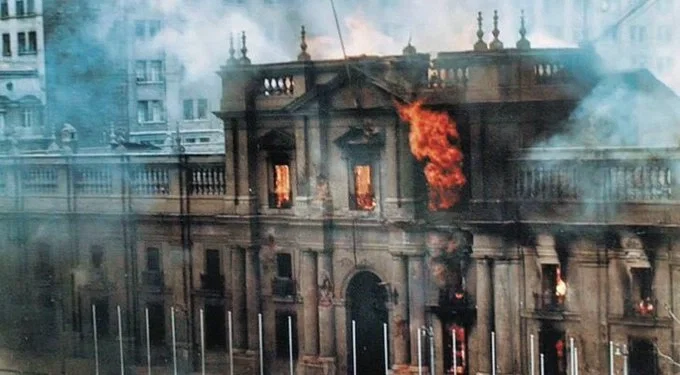
The Moneda became heavily damaged (As seen in the photo), the Original Act of Independece of Chile from 1818 was provavily destroyed in the bombing either by fire or according to some theories being ripped thinking it was just a "wortless paper"
(Full armed forces proclamation)
(Allende's transmission in Radio Magallanes)
(Recording of the 1973 Coup by TVN)
The repression was brutal in the aftermaths, a good chunk Allende cabinet ministers were send to a concentration camp in Dawson Island in Artic Chile, minister Tohá died there, massacres started almost the same day of the coup, UP Loyalists were sent to jail or killed, many fleed the country, perhaps the most well know murder was the one of songwriter Victor Jará on September 16th, according to historiography Jará was show 44 times, his memory is still used to this day as a symbol of human rights abuses in the Military era, the "Estadio Nacional" who served as a concentration camp in Santiago was later renamed after him.
The National Intelligence Directorate (DINA) active between 1973 and 1977 was the carrier of most of these violations.
This article in Spanish makes a good timeline of murders, the most brutal period was between 1973-1976.
The National Truth and Reconciliation Commission called by Patricio Aylwin the first post-Pinochet President lists 2,279 victims (including arrested or tortured people but also members of the armed forces and Carabineros killed by the anti-Pinochet guerilla) (1,068 died in hands of the state), a second revision maked the number grownth to 2,298.
In 1992 the National Corporation for Reparation and Reconciliation was created in a way to archieve cases of human rights abused people or missing people, 1,200 cases were given out of 899 were archived
National Commission on Political Imprisonment and Torture in 2004 ascended the number to 27,225 victims of repression, a posterior revision recieved over 33,000 cases.
Practically the number of victims would go from 2,000 at least and 30,000 at hightest.
Regarding civilian life, curfews started to become a norm, they lasted until the 80s, according to many Chilean testimoines a sense of fear of the army started to appear.
Censorship was brutal in that era, it wasnt uncommon in the first days of the Pinochet era seeing "Marxist" books burned on the street.
Peace wanst archieved tought, the MIR and rebel sectors of the GAP, the "Cordones Industriales" and the to this day relative unknow "Resistencia Popular Salvador Allende" were the first anti-military groups to emerge, the groups had support for nations like North Korean and (Allegedly) Mexico.
Pinochet had mostly support of USA, UK, Bolivia, Argentina, Brazil, Paraguay, Aparthied South Africa and Israel.
Initially there was debate about what will happen next, the opposition led by former president Frei was initially supportive of the coup but they wanted to have new elections soon, but it became clear the military was there to stay...the day 17th of December of 1974 Pinochet was proclaimed President of Chile.
Regarding the economy situation, the junta took over a bad economy, years of embargo and bad desitions took Chile with a -5,00% GDP, despite that esterotype and joke of Pinochet being "MuH aNtIcOmMiE dIcTaToR wHo WaS pRo FrEe MaRkEtS" initially the junta didnt have a way to recover, in fact in the proclamation one of their points was to "Preseve the gains of the previous goverment" so in theory the Junta wasnt fully anti-Allende in terms of economics, in 1974 tought the junta adopted ideas by a new group of economists unheard of at the time in South America, the called "Chicago Boys", in march of 1956 after an agreement between the University of Chicago and the Catholic University of Chile a group of students were send in theory for 3 years (Altought they remained until 1961) they were educated by theorists like Milton Friedman, considered the father of Neoliberalism.
The Chicago Boys first maked a public image when economists Andrés Sanfuentes, Juan Villarzú and José Luis Zabala Ponce redacted around August of 1972 the essay "El Ladrillo" which established the guidelines of economic liberalism in Chile, quickly the junta used those ideas in his favour, the first economists like Sergio de Castro began to be appointed as ministers and with that Chile was exposed a model of tought wich no nation had fully triyed before.
The first measures were to establish a policy of fiscal spending reduction, restructuring of the state apparatus, and strict control of budget management. As the country's path was chosen, these measures were intensified, and tax reform, labor reform, deregulation or liberalization of controls in various sectors of the economy (primarily agriculture), free entry of investments and foreign currency, and drastic reductions in tariffs, customs duties, and all types of non-tariff restrictions were undertaken. Later, social security reform, a new Labor Code, the privatization of so-called "strategic" companies, and the opening of sectors to private enterprise (mining, energy, telecommunications and infrastructure) were implemented.
Did it worked?
Kinda, the economy of Chile managed to see a big grownth in that era, public works were carried (Like finishing the undergroud of Santiago and the pavement of multiple highways) wich were used as propaganda tool, so relative the 1975-1979 era did saw a period of estabilty, but all things end, and when the South America crisis of the early 80s emerged Chile exploded in 1982 in one of their worst crisis. But that of course is another decade. Friedman called the late 70s era the "Chilean Miracle" and it maked Neoliberalism gain popularity among political thinkers, in the late 70s the Carter goverment and the James Callahan premiership did approved monetarian and deregulation politicies (Algouth moderate), it was after the 70s with the rise of Margaret Tatcher and Ronald Reagan when those ideas began in full global swing.
On the other hand a good chunck of the coup supporters were against those reforms, Leigh was deeply against it and the Junta clashed due those issues, (Leigh "resigned" in 1978), groups like "Patria and Libertad" saw that move as a treason against their "Nationalism" idea, people like Roberto Thieme who was a leader of it broke down eventually with the junta (I highly recommend check this guy spanish wiki page, its surreal, almost impossible to think a guy like him existed)
https://es.wikipedia.org/wiki/Roberto_Thieme
Pinochet was basically in a tought position diplomatically, yes the west backed him, but few nations really wanted to be "asocciated" with him, the condenation was big, and perhaps the Chile coup is the most internationally well know coup in the entire of South America cold war (Only behind the 1954 Guatemalan one or the Videla one in Argentina in 1976).
Due to it in 1978 a plesbictie was called, the first time Chileans voted since March of 1973 (The ID Voters cards were destroyed in July of 1974 so a good chunck of the population had to literally be taught how to vote again)
The plesbicite was anything but free, the question was:
"In the face of the international aggression unleashed against the Government of our country, I support President Pinochet in his defense of Chile's dignity, and I reaffirm the legitimacy of the Government of the Republic to sovereignly lead the country's institutionalization process"
The Yes Option had a Chilean Flag on it, the No had a Dark flag (And was placed slightly down the YES Option), the No couldnt do ads on TV or in the streets, 78,69% of the voters voted Yes, few nations accepted that result.
The opposition was mostly led by the Christian Democrats as practically right-wing parties sold to the regime and left parties were banned, president Frei became the most vocal critic, Bernardo Leighton a leader of the party almost got assasinated in 1975.
(Now that im writing i forgot to add this, Carlos Prats and his wife Sofia were assasinated misteriously in Buenos Aires in 1974 while he exiled, there is the theory Pinochet ordered the murder, Prats grandson spat on Pinochet's coffin in his funeral in 2006)
AFTER ALL THIS TEXT, WHO THE HELL IM RPING AS?
You Can RP as ANIBODY, you can be a politician, an activist, a peasant, a mother, a black market seller, a kid, a priest, a foreign tourist or even if you want even a terrorist or a soldier but i tell you (You are kinda fucked up in the head if you want to RP some things), you just have to put the period this starts (Between 01/01/1970 and 31/12/1979), gengre and proffesion.
WARNING:
Violence, murder, possible mentions or r*pe, torture or human rights abuses, political hatred, propaganda, inestabilty, poverty, sexism (A lot, prepare for people looking down on women working, being strong and cheap jokes about females), alcoholism (It was a big problem in Chile), homophobia, transphobia (Altought fun fact, it was in 1975 when Chile legalized -change), clasism etc,
Enjoy this RPG Guys....
Created Oct 27, 2025
Updated Oct 27, 2025
Published Oct 27, 2025