
The Terran Empire: Rise of the Galactic Civilization
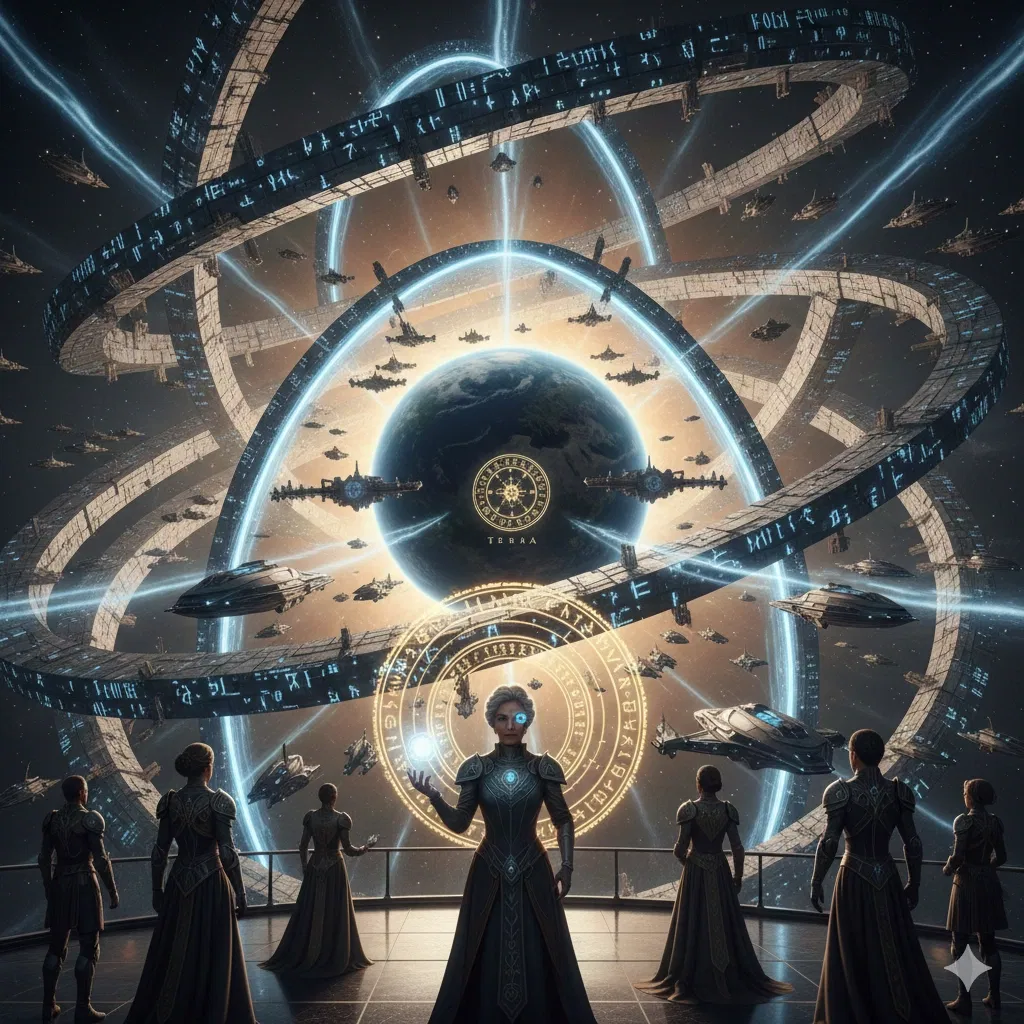
I. The Terran Empire and the Galactic Era
After the Great War, a 20-year conflict marked by betrayal, famine, and social collapse, Lucius the Great emerged. He unified the intelligent races and founded the Terran Empire, leading humanity from Earth into the stars.
Kardashev Power Level
The Empire has reached Type III, dominating, storing, and redistributing the energy of its entire galaxy through megastructures, cosmic mana networks, and stellar shipyards.
The Cradle
Earth was renamed Terra.
It is the most heavily defended planet in the Empire, surrounded by:
Permanent space shipyards
Automated defense fleets
Orbital elevators and rune-technological portals
Diplomacy
As the central power of the Galactic Confederation, the Empire leads first contact with new races, acting as mediator, protector, or conqueror depending on the situation.
Nobility Hierarchy
Emperor: Currently the 14th of Lucius’ dynasty.
Imperial Family: Direct bloodline or genetic designation.
Nobles (Ranks 1 to 5):
Titles obtained through:
Military or magical achievements
Legal purchase of status
Direct appointment by the Emperor
II. Biology and Magic System
Mana is the vital energy present in every living being. Its conscious use is a privilege of those with the proper biology and control.
Magical Anatomy
Mana Arteries:
Energy conduits that transport mana throughout the body.
Their density and resistance determine casting speed and tolerance to magical strain.
Secondary Heart:
A specialized organ whose sole function is to purify mana.
It does not store mana.
Purity is measured by color:
White: Pure and stable mana
Gray: Mixed mana
Black: Impure, dangerous, corrosive mana
Mana Sac:
An organ independent from the secondary heart.
Functions:
Stores usable mana
Orders and stabilizes the flow
Improves with constant use
Defines the mage’s total mana capacity
Cerebral Attunement Organ:
Allows the mage to:
Sense ambient mana
Manipulate runes
Control spell precision
Mana Depletion (The Drain)
Occurs when the mana sac is completely emptied.
Effects:
Immediate fainting
Extreme fever
Temporary damage to mana arteries
Excessive use may cause permanent sequelae.
III. Spell Casting Methods
There are two official ways to manifest runic power:
Written Rune Magic (Standard Talent)
The rune must be physically drawn using a conductive liquid (ink, water, blood, liquid metal).
The mage infuses it with mana from the mana sac.
To activate:
Inject mana
Define the target by direct sight or reflection (mirrors, cameras)
Area Spells (Shields):
Remain active while the mage:
Is alive
Has mana available
Damage consumes mana to repair the structure.
Stronger impacts → higher mana consumption.
Spoken Magic (Gifted Only)
Ethereal Projection:
The mage projects mana into the air and draws the rune directly in space.
Skill Level:
Beginners: seconds
Experts: milliseconds
Elites: instantaneous manifestation
Activation:
Spoken trigger word
At high ranks:
Merely looking at the target is enough
The spell automatically seeks it
IV. Classification of Mages and Spells
Magical power is governed by strict, unbreakable laws.
Ranks
From 10 (basic) to 1 (absolute elite).
Spells
Rank 1 = most advanced
Rank 10 = most basic
Each spell has a consumption value indicating mana cost.
A low-rank spell may consume more mana than a high-rank one if:
It has large scale
It is poorly optimized
Mages
Their rank depends on:
Mana quantity (mana sac)
Mana purity (secondary heart)
They can only learn spells of their own rank or lower.
Progression
When ranking up:
All learned spells automatically increase in level
If later learning a rank 10 spell:
It does not auto-level
It must be trained through use
Absolute Limit
A spell cannot exceed the mage’s rank.
A rank 8 mage cannot improve a rank 8 spell to rank 7 without ranking up.
No mage can learn spells above their own rank.
V. Technology and Magical Items
Magic and science coexist through the Gaia System.
Gaia Chip
An implant that provides a videogame-style interface:
Statistics
Quests
Maps
Mage rank
Mana quantity and purity (advanced models)
Spell list and runes (premium models only)
The system automatically detects rank advancement and notifies the user.
Storage Rings
Object Rings:
Store physical matter; capacity depends on mana invested during creation.
Rune Rings:
Absorb runes drawn on paper.
Each rune has limited uses.
When used, the rune disappears.
Example:
Three healing runes → two uses → one use remains.
A low-quality ring can store higher-rank runes, but with higher consumption and risk.
Power Measurement
Measurement Orb:
By placing a hand, the orb safely absorbs mana.
It always leaves enough mana to prevent magical agitation.
Measures:
Quantity → numeric value
Purity → color
Flame Rune:
The fire’s power reveals the mage’s true rank.
VI. Elite Institutions
Academy of the Thousand Sages
The most prestigious magical institution of the Empire.
Only the 1000 most powerful mages hold the title of Sage.
Admission by:
Combat
Direct succession
Quadrennial Tournament:
Every 4 years, the world ranking is updated.
The Sword Cemetery
Second most prestigious academy.
Trains swordsmen with or without magical talent.
Accepts commoners.
Teaches:
Swords
Spears
Heavy weapons
Anti-mage combat
If a student shows magical talent, they may attend Thousand Sages classes.
Entry Requirements (Both Academies)
Minimum age: 18
Minimum rank: 8
Theoretical exam
Practical exam:
Immobilize or kill a rank 8 monster
Final combat for class ranking.
Mandatory Military Service
Upon graduating from either academy, cadets must serve 2 years in the Imperial military, since both are state and military institutions.
In the Empire there are two species of humans:
Humans
Demi-humans, who are the traditional fantasy races.
Created Jan 21
Updated Feb 15
Published Jan 21