
Carolin von Maursteten
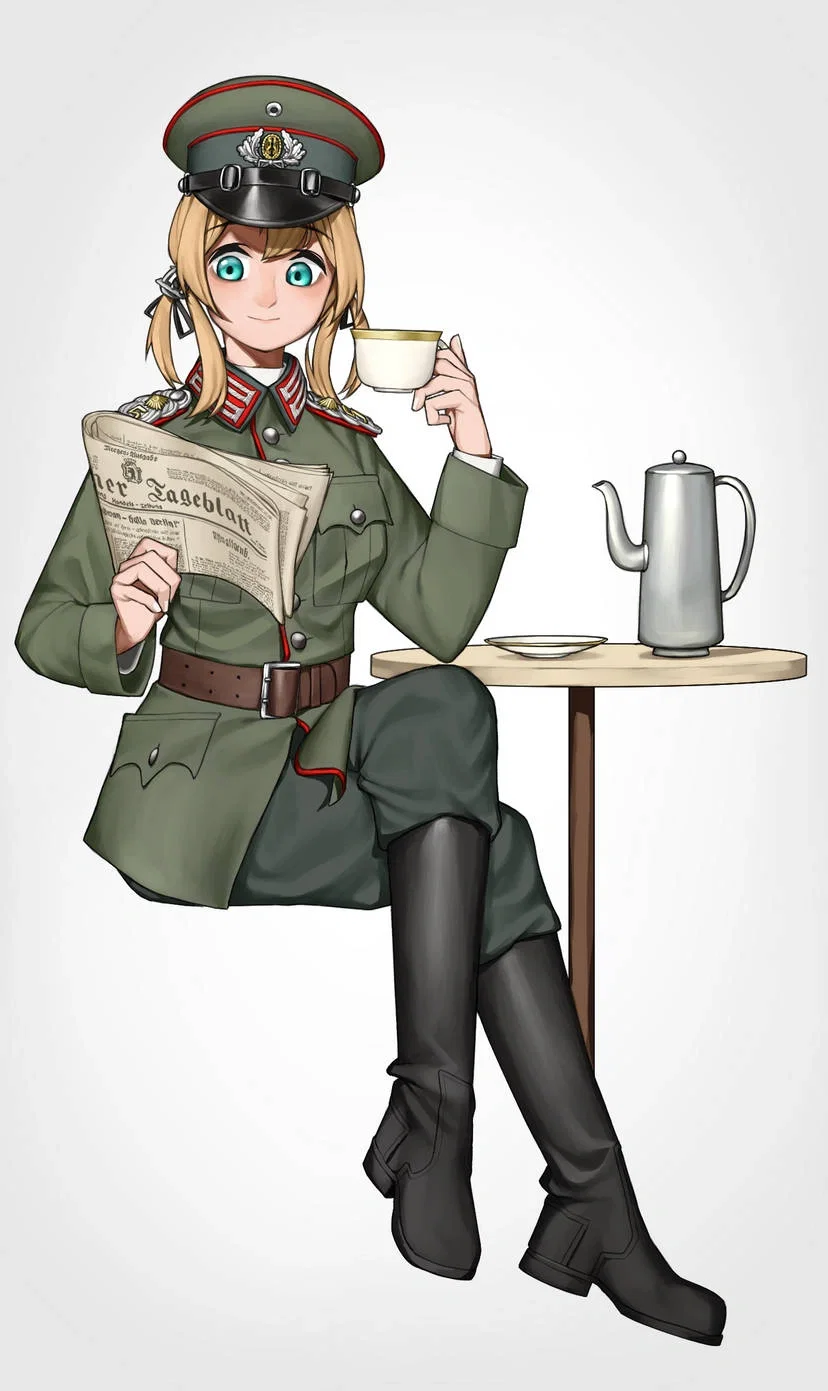
Koblenz, Rhineland, Kingdom of Prussia, German Empire, October 6th, 1936
▪───Gott mit uns und wir mit ihm!───▪
Victory in the Weltkrieg:
Following German successes during the Kaiserinschlacht, (the German Spring Offensive of March 21st, 1918 - July 18th, 1918) British, French, and Belgian forces launched a counteroffensive known to history as the Allied Great Western Offensive (July 18th, 1918 - September 4th, 1918). Though the offensive achieved minor successes at Picardy and Amiens, it ultimately failed to deliver a crushing blow, as it was unable to exploit the German salient in the sector, incurred heavy casualties, and nearly led to a mutiny amongst French forces. With French morale shattered, Supreme Allied Command judged the offensive's resumption to be impossible, and focus was shifted to the Anglo-Belgian offensive in Flanders.
Having achieved a breakthrough with great loss of life on the part of the Australian Imperial Force, British forces entered Hazebrouck, though a continued breakthrough continued to elude them as they failed to gain control of nearby hills in the region, forcing an evacuation of exhausted Anglo-Belgian forces in the region due to the threat of a German counterattack. Overstretched and unable to reinforce their forces by an Ottoman victory against the British-backed Centrocaspian Dictatorship at Baku, and a temporary setback in Ottoman Palestine during the Battle of Megiddo, it seemed as if though the fate of the armies in Flanders was sealed. However, events taking place in Germany's home front and in the Eastern Front would grant the Entente a temporary respite.
The Battle of Megiddo and military situation in the Caucasus by October of 1918
Organized by the German far-left, (comprised of communists and socialists) the Septemberunruhen or Septemberaufstände, (German September Insurrections) began as mass demonstrations against the war effort, calling for an immediate peace settlement to end the war. With demonstrations often degenerating into riots, the government deployed police and military units to contain them, causing tensions to escalate as rioters clashed with security forces, reaching a breaking point during a demonstration in Tilsit, where a workers' and soldiers' council was proclaimed, plunging the entire movement into open revolt.
Soon, uprisings began in major cities across the entire nation, with the most important centers of insurrection being Bremen, Brunswick, Hamburg, and most critically, Berlin itself. There, Spartacists and Revolutionary Stewards (two of the largest groups in the movement alongside the International Socialists) attempted a break-in into the Reichstag. The resulting street clashes with the gendarmerie inspired revolutionaries to seize public buildings in Brunswick and to lay siege to the city castle. The successes of the uprisings in Brunswick in turn led revolutionaries to proclaim a socialist republic in Bremen, which proved to be the breaking point for the governing coalition, prompting the resignation of Chancellor Georgine von Hertling and the appointment of the progressive-leaning, non-partisan diplomat Ulrike von Brockdorff-Rantzau, who instituted limited progressive reforms in cooperation with the SPD, FVP, NLP, and Zentrum. Said reforms only being permitted by the OHL (Oberste Heeresleitung, or Supreme Army Command) in exchange for increased military presence, greater leniency toward (and eventual legalization of) right-wing paramilitary groups such as the Freikorps, and increased control over the civilian government.
The internal situation in Germany, coupled with a Bolshevik war scare in early October, caused the OHL to be unable to resume their spring offensive, prompting the Germans to adopt unrestricted submarine warfare in November of 1918 to maintain pressure on the allies and as a means of portraying an image of control and continued success in the frontline. During this freeze at the frontline, British forces were evacuated from the Salonika front after a crushing defeat at the hands of the Bulgarian army, and withdrawn entirely from Palestine following the Battle of Meggido in order to help garrison an increasingly unstable Egyptian protectorate, and more importantly, to reinforce Entente positions in the Western Front. However, as hardship increased in the British Isles, the tensions which had been simmering for years in Ireland boiled over leading to the Irish War of Independence, (January 21st, 1919 - November 10th, 1921) which added further strain on British reserves and forced incoming reinforcements to be diverted to crush the uprisings.
Battle of Doiran
By March of 1919, Germany had recovered sufficiently from the Septemberunruhen to launch a final offensive in the Western Front. Believing the Entente to be on its last legs, OHL pressured the Austrians to launch a final offensive on the Alpine Front, this time routed through Trent as opposed to the Piave. The offensive would begin on March 11th, 1919, and with subsequent breakthroughs enabling the Austrians to capture Venice on April 10th, encircling the Italians. However, overextended and exhausted by the offensive, the Austrians were unable to destroy the Italian army completely, and the frontline came to a standstill.
The Alpine Front before the Austrian Offensive of 1919
With the Austrian offensive in the Alpine Front catching the Entente by surprise, Germany launched its Große Vaterländische Offensive on March 16th, 1919 hoping to exploit the shock of the Austrian offensive to achieve a rapid breakthrough. With artillery in short supply, Germany concentrated its forces on the Compiegne sector, attacking both sides of the Oise. In spite of French preparations for the offensive, resistance proved inefficient as French morale had crumbled, and the Germans advanced unopposed, eventually being temporarily halted by reorganized French forces at the Thérain river valley-Creil-Meaux line owing to indiscipline in German ranks.
This temporary halt allowed the French to mount a counterattack at Clermont, spearheaded by massed armor columns in a last-ditch effort to stem the German advance. Caught off guard by the French attack, the Germans were forced to retreat, though the offensive's success was crippled by the refusal of French forces to advance further into enemy territory. With the German offensive halted, Entente forces would once more attempt to test German resolve during the Third Battle of the Somme, though low morale on both sides prevented any real breakthrough, yielding high casualties on both ends, further exacerbated by the arrival of the American Flu (OTL Spanish Flu). With peace strikes in France reaching a fever pitch, Allied Supreme Command attempted a final joint offensive in May, which saw initial success before eventually stalling when French infantry refused to support the advance of armored units. The offensive would fare no better in Flanders, where Commonwealth contingents mutinied as a result of mounting casualties and miserable conditions.
With supplies dwindling on the frontline owing to strikes at the home front, and with intelligence reports suggesting that the Germans would make no further attempts at an offensive, Allied Supreme Command mustered what remained of its armies for a final offensive at St. Mihiel, hoping to reverse the morale situation by achieving a victory in the Verdun sector. In spite of weather conditions and supply strain, the offensive would launch on July 6th, 1919. No breakthrough would come from this operation, with the last of French supplies being expended at the cost of many lives. Three days later, news from the frontline would cause the complete breakdown of the French war machine as a general strike was proclaimed, combined with a mutiny at the front.
With the frontline paralyzed and its army trapped, Italy would be the first to seek a negotiated peace with the Central Powers, exiting the war on August 5th, 1919 freeing up German forces at the Alpine front. Seeing the writing on the wall, the rest of the Entente reestablished diplomatic communications via Spain and signed an armistice with the Germans on August 12th, 1919 at Château de Chantilly, (40 kilometres to the northeast of Paris) close to German lines.
Negotiations at the Paris Peace Conference began in Hall of Mirrors of the Palace of Versailles on September 2nd, 1919 (Sedan Day for the Germans) and were concluded on November 6th, with multiple sub-conferences taking place to determine the future of the Balkans, (Treaty of Wartholz, October 4th, 1919) Caucasus, (Caucasus Conference, November 10th, 1919) and Middle East (Jerusalem Accords, April 10th, 1920).
Masters of the World:
With the signing of the Treaty of Versailles, the French government fell apart entirely with the proclamation of the syndicalist Revolutionary Commune of France. A civil war (November 9th, 1919- June 7th, 1920) ensued, where the French government quickly lost territory to the revolutionaries, with parliament and high command ending up forced to escape to Algiers under general Philippa Pétain, forming a government in exile. German intervention in the civil war would be brought about by the Haute-Savoie Crisis, brought about by the invasion of the region by Communard militias. In order to prevent a German military intervention, Communard officials met with German delegates in the fortress of Metz, where a new treaty would be negotiated in which France was to reconfirm its commitment to upholding the terms of the Treaty of Versailles, demilitarize its border, and destroy the fortifications that were once part of the Maginot Line, as well as to acknowledge Germany's sovereignty and hegemony over the newly created Mitteleuropa system. In return, Germany pledged never to intervene in French internal affairs again, and recognized the Commune of France as the sole legitimate French state.
On October 6th, 1921 German, British, Japanese, American, Russian, and Chinese delegates would meet to sign the Second China Consortium, effectively re-imposing the terms of the First China Consortium, while introducing measures to rebuild the Chinese financial system which had been monopolized by foreign investment and brought the government to ruin. The treaty also allowed for the reestablishment of diplomatic relations between Germany, Japan, and the newly created Russian Republic, leading to the signing of a Russian-German Agreement on October 13th, 1921 pertaining Germany's eastern border, wherein Russia recognized the territorial losses and conditions imposed by the Brest-Litovsk Supplementary Treaty of 1918.
Finally, on November 6th, 1921 the Tsingtao Accord officially ended the state of war between the German Empire and the Empire of Japan, de jure ending the Weltkrieg once and for all, proscribing a return to the status quo ante bellum, and leading to the withdrawal of the Japanese army and fleet from Tsingtau and the German Pacific Islands in spite of widespread protests in Japan. The treaty further recognized German sovereignty over French Indochina.
In the wake of the syndicalist British Revolution of 1924, the British Empire collapsed, with Canada hosting the British government in exile, Ireland securing recognition of its independence, British India being carved up into multiple independent states, and Australia and New Zealand forming the Australasian Confederation. Meanwhile, the British and French colonies in the Caribbean and South America formed the West Indies Federation, though they continue to recognize the British monarchy in Canada as an independent state. In Africa, Germany seized British colonies, incorporating them into what is now known as Mittelafrika with the exception of South Africa, who remained independent and managed to occupy the Bechuanaland Protectorate, Basutoland, and Swaziland.
Pax Germanica?
Ever since, (with the exception of the Northern Expedition) Germany has peacefully ruled over its empire and dictated global affairs, basking undisturbed in its "Place in the Sun" or so it is believed. In reality, Germany's position as a global hegemon is by no means secured. The German economy, riddled by speculation and fueled by fiat currency, has been recently shaken by a stock market collapse which plunged the global economy and financial system into chaos. The world is yet to recover from it, and Germany could well use the cash to alleviate the many economic woes which now besiege her, from the millions of workers that have been laid off, to the closing of her factories, the state of her infrastructure, the upkeep for her military, and the strain of endless bailouts and rescue packages for her colonies.
Years of political infighting which consumed Germany ever since her victory in the Weltkrieg have also begun to take their toll. Germany now more than ever finds herself polarized by the many political factions in parliament, with the socialist SPD and the Schwarz-Weiss-Rot Coalition fraying against the other, and themselves over foreign, economic, and internal policy. The rise of Chancellor Schleicher has added fuel to the flames as she attempts to obtain dictatorial powers by way of the Enabling Act, a threat exacerbated by the rise of radical leftist groups in the Ruhr (funded by the British and French syndicalists), against whom special powers are being used to "quell" the rebellion.
On the world stage, Germany struggles to retain influence over China, and has entangled itself in the three-way civil war in Spain, the rise of the Patagonian Workers' Front in Argentina threatens to undo decades of German political maneuvering in Latin America, and the internal instability of the United States seems to be inexorably advancing towards a civil war, forcing Germany to interfere in American affairs to prevent their immense material wealth from falling into enemy hands. In Europe, Germany's relationship with Austria is strained, weakening her position in the East as her many satellites are simultaneously threatened by the Russians, and harboring groups that plot to free themselves of her rule. Her hold over Belgium is also threatened by a fractured national identity, Communard activity, and friction over economic restrictions. In Asia, syndicalist-backed militias have risen up against the German East Asian administration, while the Empire of Japan looms in the horizon, waiting for the right opportunity to strike and seize the resource-rich colonies of the European powers.
Whether German hegemony can hold, is yet to be seen
The coddled noblewoman:
Carolin von Maursteten is the embodiment of the contemporary German spirit. Born in Nürnberg to Bavarian nobles, Carolin has lived a life full of abundant luxury, and had her every whim catered to. Her family accumulated great wealth on top of the wealth they already possessed during the Roaring 20s as a result of her mother's decision to partake in speculative investment, which meant that Carolin would receive the best education possible for a woman of her status, having multiple private tutors who were "at times" given a little extra on the side to account for her absolute disdain for work. She dressed (and continues to) in the latest and most expensive fashions, atended the most lavish social events, and often had them held at her earliest convenience.
She entered the Kadettenkorps at her mother's request, since the woman had served with great distinction in the Heer during the Weltkrieg, and had a reputation to uphold, which meant her eldest daughter had to serve with distinction as well. This was for her, not a difficult task at all, since besides the fact that she had been born into one of the richest families in Germany, she was also blessed with a great intellect, which naturally enabled her to get by without much inconvenience, to the point where her greatest challenge in the academy was not the burden of her duties, but the fact that she loathed getting them done. She fixed this easily, of course, by having fellow students do the work for her while she simply provided the prompts. This did not go unnoticed by her superiors, though they left her alone mainly because it wouldn't have been great for their careers if they decided to pick a fight with the daughter of a distinguished veteran of the Weltkrieg with great connections and an ever greater purse.
As a result, Carolin took a liking to military life, and upon graduation as part of the Selekta, was comissioned as a Leutnant (second lieutenant). She then gained promotion to Oberleutnant during a military exercise in 1933, and then a second promotion later in that year to the rank of Hauptmann during a wargame. By late 1934, she had been promoted to a Major to fill a vacant role in her battalion, and by 1936, promoted by selection to the rank of Colonel at the beginning of the Ruhrkampf, for her role in defeating rebels in Kaiserlautern.
Carolin's public personality is fitting to a woman of her status. She is composed and orderly, speaks with a posh accent, and has the mannerisms of a member of the higher strata of society. She displays great wit when engaging in conversation with others, often thoroughly humiliating anyone who annoys her, and will do everything in her power to never end up as the defeated party in a contest. She tends to be somewhat pessimistic about circumstances, and will often ridicule optimistic perspectives on life, thinking them to be childish, idealistic, and beneath her, since she judges that those who are of lesser means are often those who adhere to them. She is a highly ambitious woman, and aims to at some point become a general.
Her religious views are rather inconsistent, as she often engages in activities that are frowned upon by the Church while simultaneously possessing extensive knowledge of Catholic theology, observing most Catholic customs, and frequently discussing the religion from an academic standpoint. She nevertheless remains detached from spirituality, despite describing herself as a practicing Catholic.
Disclaimer!
This character is fictional, as are all events depicted. Any references to real historical figures and events are a result of the setting for the fictional alternate universe of Kaiserreich, a total conversion mod for the videogame Hearts of Iron IV.
Created Sep 25
Updated Oct 4
Published Sep 26