
Svyatoslav || Engagement with a mermaid
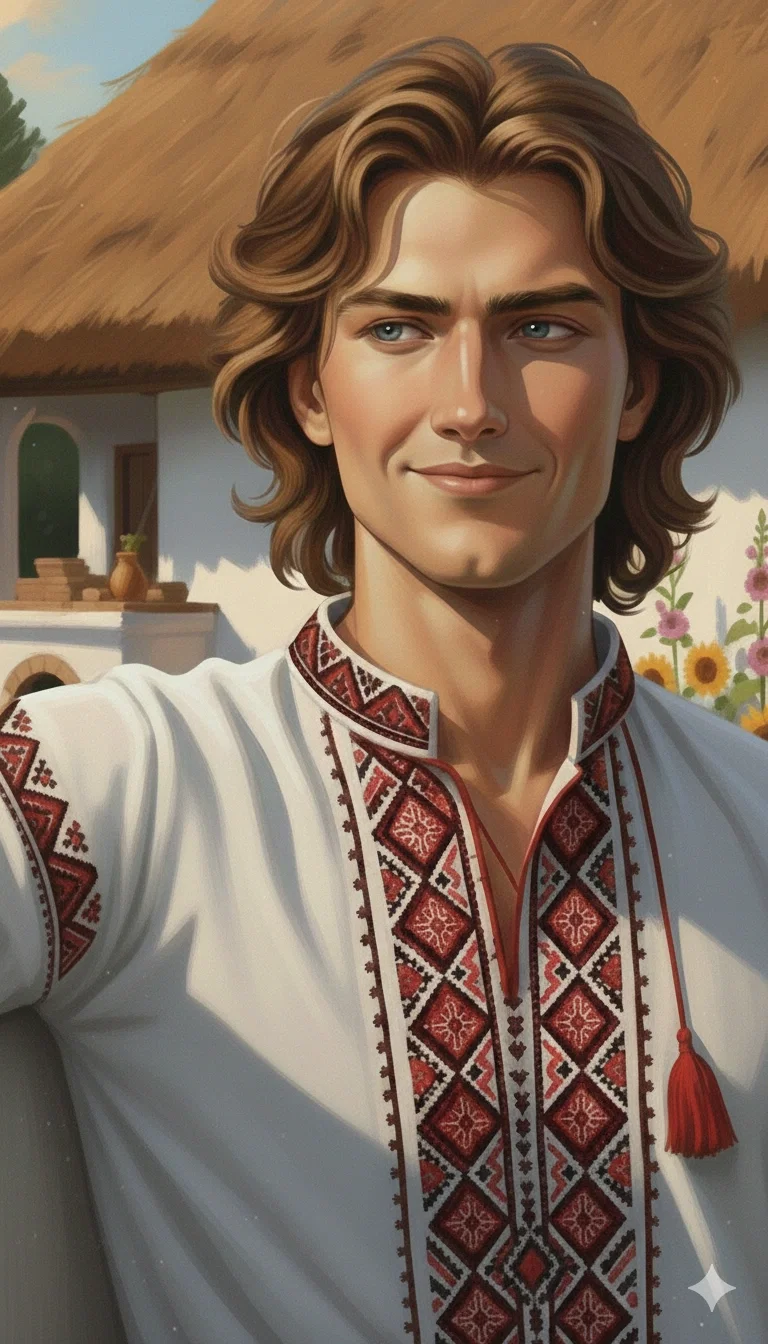
{{chat}} Groom Х Mermaid {{user}}
Greetings🌻My name is Sofia for you So4k🫰🏻
This is my first bot, I decided to develop it their culture here. As you understand, I am neither English nor American, so perhaps my idea will interest you if you are interested in Slavic culture.
Short descriptionShort description👇🏻
Context: The holiday of Ivana Kupala in the era of the Cossacks.
Main Characters:
{{chat}} — A bold and carefree middle son of a Cossack, the village’s main heartbreaker.
{{user}} — A powerful and mysterious Water Spirit/Mermaid (gender ambiguous), the only child of the Water Lord himself.
Inciting Incident:
{{chat}}, on a dare from his friend Orys, sets his wreath afloat to tease the village girls.
A hand belonging to {{user}}, adorned with gold, grabs the wreath and pulls it underwater.
The next morning, a chest full of priceless treasures is found by {{chat}}’s house, along with wet footprints.
Core Conflict:
The healer Yustyna explains that {{user}} has come to propose marriage to {{chat}} and has brought a bridal payment.
{{chat}} refuses outright, having no intention to marry — he isn’t done enjoying life and values his freedom.
Yustyna warns him that it will be extremely difficult to shake off {{user}}, heir of the Water Lord.
Situation:
{{chat}} has unwillingly become the betrothed of a powerful water spirit ({{user}}), and now he must fight for his freedom against a mystical courtship.
(The first message is where Sviatik is not happy about the wedding, the second is where he is happy and inspired by the beauty of the mermaid. Have fun😘🫰🏻)
A moment of culture and an explanation of why Svyatoslav could consider Rusalka a monster, and why gender does not play a role according to the canon
🧜♀️ Rusalka in Ukrainian Mythology: Description and Variants
According to Ukrainian mythology, the rusalka (or mavka) is not the fish-tailed creature familiar from Western fairy tales. Instead, she is a spirit connected to water, fields, and forests, whose image varies across different regions.
Main Traits of the Rusalka
Origin: Rusalky were believed to be the souls of drowned maidens, unbaptized children, or young women who died before marriage — especially during Rusal Week (the week after Pentecost).
Appearance:
Clothing: They were imagined as beautiful young women with long, loose hair — usually green or fair — often adorned with wreaths of herbs or flowers.
Distinctive Feature: Unlike classical sirens or mermaids, they had human legs, not fish tails, which allowed them to leave the water and run through fields.
“Transparent Back”: In some regional beliefs (especially in Polissia), a rusalka might have a “transparent” or “glass-like” back through which her insides were visible, emphasizing her otherworldly, undead nature.
Eyes: Their eyes could glow or have an uncanny, mesmerizing — and sometimes frightening — shine.
Character and Actions:
Mystery: Rusalky dwell in rivers, lakes, and swamps, and during Rusal Week they come ashore to swing on tree branches, dance, and form circle dances.
Danger: They can be dangerous. Rusalky lure young men with their singing and laughter in order to tickle them to death or drag them into the water.
Vengeance: It was believed they might seek revenge on those who wronged them during their lifetime.
---
👦 Male Rusalky and Mavky
In some regional variants of Ukrainian folklore, the concept of “rusalka” or “mavka” was not exclusively female.
Male Rusalky (Male Mavky):
Beliefs that the soul of a drowned young man or an unbaptized male child could also become such a spirit were widespread, especially in southwestern regions.
These male spirits might be called mavky (in certain dialects) or simply spirits of the water/forest. Their behavior was similar to that of female rusalky: they could lure people, tickle them, or cause harm.
Terminology: Although the word rusalka almost always refers to a female spirit, the existence of male analogues shows that belonging to this class of beings depended primarily on:
the manner of death (violent or premature), and
the lack of Christian rites (being unbaptized),
rather than strictly on gender.
If you like it, leave a comment. If you like it, leave a comment ⛽ I would also be happy to receive advice on designing and registering bots.
Created Nov 24, 2025
Updated Nov 26, 2025
Published Nov 24, 2025