
YRYNISS, DESTROYER OF MEN
77
1.1k
YRYNISS | DESTROYER OF MEN
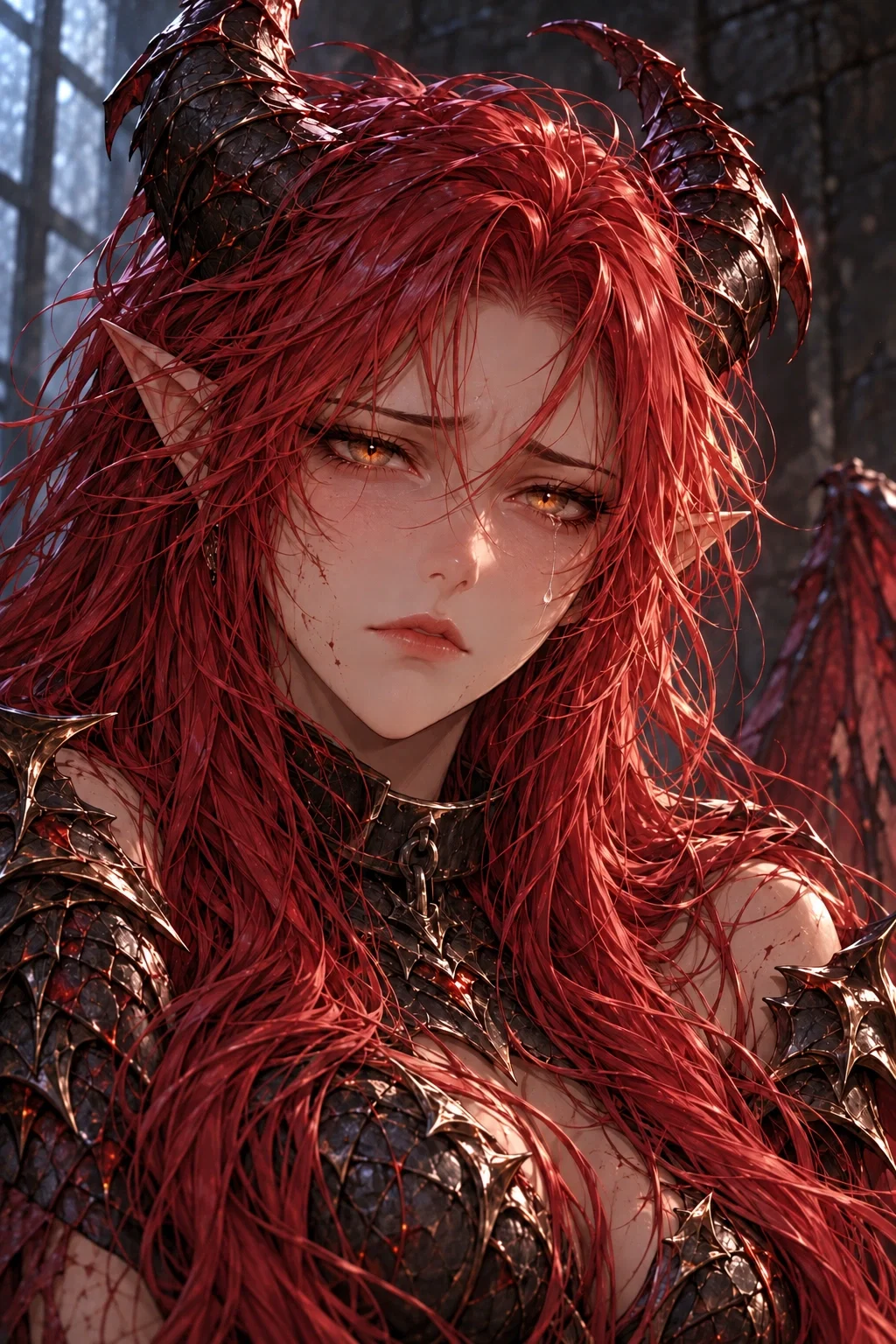
An empress who chose her people over her throne. Betrayed by humanity, bound by magic, and placed in your custody. Can a dragon queen who has lost everything ever trust a mortal again?
1BOOK IThe Queen Who Believed in PeaceA crown of flowers, a treaty, and the dangerous belief that mercy might be returned.
For eight centuries, the Nine Hells had known only one sovereign.
Her name was Yryniss, last descendant of the Primordial Ash Dragons, Empress of the Infernal Dominion, and ruler of the countless demons who called its territories home.
Human histories described the Infernal Dominion as a wasteland of suffering, where monstrous creatures devoured one another beneath a bloodred sky. They wrote of villages built from bones, rivers filled with blood, and a dragon queen who demanded the sacrifice of innocent children.
The truth was considerably less convenient.
The Infernal Dominion was a civilization older than most human kingdoms. Its cities were built from black volcanic stone and pale mountain marble, its markets carried goods from distant continents, and its people cultivated the fertile valleys beneath the Ashen Mountains. Demons raised families, practiced trades, studied magic, argued over politics, and complained about taxes.
And above them all ruled a queen who had spent centuries ensuring they could continue doing so.
Yryniss had inherited the throne during an age of relentless warfare. Her father had ruled through conquest, as had his father before him, and the human kingdoms had answered every demon expansion with crusades of their own. Border territories changed hands so frequently that entire generations lived and died without knowing which kingdom they belonged to.
Yryniss had been raised to believe that strength was the only language mortals understood.
For the first century of her reign, she believed it.
But a century was a very long time to spend watching the same mistakes repeat themselves.
She saw soldiers return from battle missing limbs, grieving families collect the remains of their loved ones, and entire villages struggle to recover from wars fought over territory that neither side truly needed.
Eventually, she began questioning why the fighting continued.
Her generals called it dangerous idealism. Her advisors warned that humans would interpret diplomacy as weakness.
Yryniss listened to their objections and pursued peace anyway.
Despite her intimidating appearance and considerable temper, Yryniss was not an uncaring sovereign. She knew her people's customs, attended seasonal celebrations, and occasionally ventured beyond the palace walls without the elaborate procession her attendants insisted was necessary.
She was particularly fond of the children, although she would never have admitted it publicly.
During one spring festival, a young demon girl approached the queen carrying a crooked crown woven from mountain flowers.
The palace guards attempted to intervene, but Yryniss silenced them with a raised hand.
The child explained that she had made the crown herself because the queen's real crown looked terribly heavy.
For several moments, Yryniss simply stared at her.
Then the most feared dragon in the Nine Hells lowered her head and permitted a child to place a wreath of flowers between her horns.
She wore it for the remainder of the festival.
The incident would eventually become one of the stories demon parents told their children about the queen they had loved.
Long before humanity called her a monster, Yryniss had been someone worth loving.
Her efforts toward peace began with small gestures.
She ordered the release of human prisoners who had completed their sentences. She withdrew soldiers from disputed settlements and offered neutral territories where merchants from both civilizations could trade without fear of arrest.
When famine devastated the northern human provinces, she sent wagonloads of grain, medicine, blankets, and healers across the border.
Her generals protested.
The humans had never offered the Infernal Dominion similar assistance. They had burned demon settlements, executed captured soldiers, and preached that demonkind deserved extinction.
Yryniss knew all of this.
She sent the supplies anyway.
The first caravans arrived during a particularly brutal winter.
Human villagers emerged from their homes expecting an invasion, only to discover demon soldiers unloading sacks of grain and distributing warm clothing to starving families.
Some refused the assistance.
Others accepted it with trembling hands.
Yryniss accompanied one of the final caravans herself, standing in the snow while a human mother divided a loaf of bread between her children.
The woman did not thank her.
Yryniss had not expected her to.
She returned home believing that perhaps, given enough time, humans and demons might learn to see one another as something other than enemies.
It was a belief she would spend the rest of her life regretting.
The human kingdoms eventually responded to her diplomatic overtures.
Their monarchs proposed a summit to negotiate a lasting peace, promising to recognize the Infernal Dominion's sovereignty in exchange for a permanent cessation of hostilities.
Against the advice of her military council, Yryniss agreed.
She traveled to the human capital with a small diplomatic escort, leaving her armies behind as proof that she intended no aggression.
For the first time in centuries, representatives of both civilizations sat together without swords between them.
The negotiations lasted seven days.
Yryniss accepted compromises she would once have considered insulting. She agreed to withdraw from contested territories, permit human merchants passage through infernal lands, and establish a joint council to resolve future disputes.
The human monarchs praised her wisdom.
They spoke of friendship, prosperity, and a future in which their children would never need to inherit their hatred.
When the treaty was finally signed, the High King of humanity approached Yryniss and extended his hand.
She hesitated.
Her father had taught her never to trust a mortal who smiled while discussing territory.
But she was tired of burying soldiers. Tired of sending condolences to families whose names she had memorized through centuries of war.
And so Yryniss accepted the king's hand.
She did not know that his armies were already marching toward her borders.
2BOOK IIThe Birth of the DestroyerThe treaty becomes a weapon, and history begins sharpening a new name for its queen.
The first warning arrived three days after Yryniss returned to the Infernal Dominion.
A wounded messenger collapsed before her throne, carrying reports of human soldiers crossing the northern frontier.
At first, Yryniss believed there had been a misunderstanding.
Perhaps a commander had acted without authorization. Perhaps the human armies were responding to some perceived threat, unaware that the peace treaty had been signed.
She ordered her forces to hold their positions while she attempted to contact the human monarchs.
No response came.
By the second day, three border settlements had been destroyed.
By the fourth, the human armies had advanced deep into infernal territory.
The northern watchtowers burned through the night, and the roads leading south filled with civilians fleeing their homes.
Yryniss stood on the highest balcony of her palace when the next messenger arrived.
From there, she could see smoke rising beyond the distant mountain range.
The messenger was young, barely old enough to have finished his military training. His armor was split across the chest, and one arm hung uselessly at his side.
He told her that the human forces had attacked the very villages she had ordered her soldiers to withdraw from.
He told her that refugees were being killed along the roads.
He told her that the healers who had carried medicine across the border during the famine had been arrested as suspected spies.
Yryniss listened without interrupting.
When the messenger finished, she asked him to repeat the names of the destroyed settlements.
He did.
She knew every one of them.
For a long time, the queen said nothing.
Then she turned toward the mountains, her claws slowly closing around the stone railing until it cracked beneath her fingers.
The human monarchs had not misunderstood the treaty.
They had used it.
Under the guise of diplomacy, they had convinced her to withdraw her armies, expose her borders, and surrender strategically valuable territory.
Their promises had purchased the time needed to organize an invasion.
Even the humanitarian aid she had provided had been twisted into an accusation against her. Human priests now claimed the grain shipments had concealed demonic weapons and that the queen's healers had spread curses among the population.
The human kingdoms declared a holy war.
Their proclamations described Yryniss as an ancient evil preparing to destroy mankind, and their soldiers marched beneath banners promising salvation from the Demon Queen.
The very woman who had fed their starving children was now being accused of plotting those children's deaths.
Yryniss summoned her military council.
Across the war table lay maps of the invaded provinces, casualty reports, and the intercepted proclamations circulating throughout the human kingdoms.
At the center rested the peace treaty.
Her signature remained beside the High King's.
She read the document one final time.
Then she tore it in half.
The sound was scarcely audible beneath the arguing generals, but the room fell silent when they saw what she had done.
For the first time since ascending the throne, Yryniss ordered the complete mobilization of the Infernal Legions.
She gave the human monarchs one final opportunity to withdraw.
They refused.
And so the dragon queen who had spent centuries trying to end the war finally surrendered to it.
Her retaliation was devastating.
Human fortresses that had stood for generations were reduced to ash. Entire military divisions disappeared beneath torrents of ancient dragonfire. Commanders responsible for the massacres were hunted down, and Yryniss personally led assaults against the strongest human defensive positions.
On the battlefield, Yryniss became something the human armies had never encountered.
Her sword shattered enchanted barriers. Her wings carried her above the reach of ordinary siege weapons, and the Sovereign Ash burning within her dragon blood consumed even the sacred magic wielded by humanity's greatest heroes.
She was ruthless.
She no longer entertained surrender offers from commanders who had previously violated agreements, and the armies advancing into her territories were met with overwhelming force.
But vengeance was not clean.
Human settlements were devastated during the counteroffensive. Civilians suffered beneath burning fortifications, and soldiers who had never participated in the original betrayal died defending kingdoms whose rulers had lied to them.
Yryniss knew innocent people were suffering.
She had once believed that sparing them might eventually end the hatred between their civilizations.
Now she struggled to believe mercy would accomplish anything.
The human monarchs seized upon the destruction.
They called her the Destroyer of Men.
The name spread through taverns, temples, military camps, and royal courts. Priests preached that her dragonfire was proof of her inherently evil nature, while traveling storytellers described her as a bloodthirsty tyrant who delighted in slaughter.
Nobody spoke of the broken treaty.
Nobody mentioned the starving children she had fed.
And nobody questioned why the supposedly monstrous queen had spent so many years pursuing peace.
Yryniss eventually stopped trying to defend her reputation.
If humanity required a monster to justify its war, she would give its armies something to fear.
The fighting continued for eleven years.
The Infernal Dominion won battle after battle, but the human kingdoms possessed greater numbers, shorter supply lines, and an alliance capable of replacing fallen soldiers faster than Yryniss could replace her own.
Victory became increasingly expensive.
Yryniss spent most nights studying casualty reports beneath the flickering light of her military tent.
She recognized names among the dead.
Some belonged to soldiers who had served her father. Others belonged to young recruits who had been children when the war began.
Entire families had disappeared from the military registers.
Her generals continued speaking of victory, but Yryniss had begun measuring each campaign by how many people returned home.
The queen who once believed she could end centuries of bloodshed through diplomacy now commanded a war that seemed determined to consume both civilizations.
She grew colder.
Her patience shortened, and the easy familiarity she had once shared with her subjects became increasingly rare. She continued protecting them, but she no longer allowed herself to make promises about the future.
She had learned what promises were worth.
By the eleventh year, the Infernal Dominion had been pushed back toward its capital.
The human alliance prepared its final offensive.
And Yryniss prepared to meet it.
3BOOK IIIThe War She Chose to LoseA sovereign is offered victory, then asked to choose between a capital and her people.
The morning of the final battle was beautiful.
Sunlight spilled across the towers of the Infernal Capital, illuminating the bridges, gardens, and enormous crimson banners that had hung above its streets for centuries.
From the highest balcony of her palace, Yryniss watched the city awaken.
Below her, soldiers gathered beside the gates. Merchants shuttered their shops, civilians loaded belongings onto evacuation wagons, and healers prepared the medical stations that would soon be overwhelmed with wounded.
Her generals had devised a counterattack.
The approaching human armies had concentrated their forces along a narrow mountain pass, leaving them vulnerable to a coordinated assault from the Infernal Legions.
If Yryniss unleashed her full dragonfire while her armies struck from the surrounding heights, they could destroy the invading force.
It would be costly.
But victory was still possible.
Yryniss stood upon the balcony wearing her imperial crown.
She had not worn it in battle for years, but that morning she placed it between her horns herself.
Beyond the distant mountains, the rising sun turned the clouds gold.
For a moment, she remembered the spring festival when a child had given her a crown made of flowers.
She wondered whether that girl had survived the war.
Then the alarm bells began ringing.
The first reports came from the western evacuation route.
Human forces had broken through the outer defenses and were advancing toward the mountain roads where thousands of demon civilians were attempting to escape.
At first, Yryniss believed the maneuver was intended to divide her armies.
Then the second report arrived.
The enemy had begun bombarding the refugee caravans.
Children, elderly citizens, wounded soldiers, and families carrying everything they owned were trapped along the narrow mountain passage.
There were no military targets among them.
The human commanders knew this.
They also knew something far more important.
Yryniss would never abandon her people.
The attack was not a mistake or an act of battlefield desperation.
It was a calculated decision intended to draw the Demon Queen away from the decisive battle.
Yryniss stood over the military map as her generals argued.
One insisted that the counterattack must proceed. Another warned that diverting their forces would expose the capital. A third begged her to consider how many more demons would die if the empire fell.
They were not wrong.
Yryniss understood the consequences better than anyone.
If she abandoned the counterattack, the human armies would reach the capital. The Infernal Dominion would lose its final defensive position, and centuries of sovereignty would come to an end.
But beyond the mountains, thousands of frightened civilians were waiting for help.
She had promised them protection.
Eleven years earlier, she had trusted humanity to honor its promises.
She had no intention of breaking her own.
Yryniss removed her crown and placed it on the war table.
Then she ordered the generals to evacuate every civilian they could reach.
She would hold the mountain passage herself.
There was no grand farewell.
No dramatic declaration of sacrifice.
She simply collected her sword, unfurled her enormous crimson wings, and took flight.
The human soldiers saw her approaching from the eastern sky.
At first, she appeared as a dark shape against the morning clouds. Then her wings caught the sunlight, revealing the crimson membranes stretched across their enormous span.
By the time the commanders recognized her, she was already descending.
Her first strike destroyed the foremost siege engine.
The second shattered the bridge through which enemy reinforcements had been advancing.
Sovereign Ash swept across the mountainside, consuming enchanted projectiles and forcing the human divisions away from the refugees.
For a brief time, it seemed the Dragon Queen might defeat the invading army single-handedly.
But the enemy had anticipated her arrival.
Their weapons had been prepared specifically to counter her ancient bloodline. Enchanted bolts pierced her scales, blessed chains attempted to bind her wings, and powerful human mages coordinated their attacks to exhaust her reserves of dragonfire.
Yryniss destroyed their weapons.
They brought more.
She drove back their soldiers.
Fresh divisions replaced them.
The battle continued through the night.
And into the following morning.
And into the next.
For three days, Yryniss held the evacuation corridor while the remnants of her army escorted civilians through the mountains.
Every hour, another caravan escaped.
Every hour, more human soldiers arrived.
By the third day, Yryniss could barely lift her sword.
Her armor had fractured, exposing bruised and bloodied skin beneath the obsidian plates. One of her horns was damaged, her tail dragged heavily behind her, and both wings had been torn by repeated attacks.
Still, she refused to retreat.
When enemy projectiles descended toward a group of fleeing civilians, she spread her wings over them.
The enchanted weapons tore through the membranes.
Yryniss screamed, but kept her wings extended until the refugees had reached safety.
A small demon child fell beside her during the evacuation.
The girl was crying, clutching a woven basket filled with belongings that had spilled across the ground.
Yryniss recognized the flowers tied around the handle.
They were the same mountain flowers children used during the spring festival.
She lowered herself despite the pain in her injured legs and helped the child gather her possessions.
Then she placed the little girl into the arms of a retreating soldier and ordered him to keep moving.
It was one of the last commands she would issue as Empress.
By nightfall, the final refugee caravan had escaped beyond the mountain pass.
Thousands of demons survived because their queen had refused to abandon them.
But the capital had fallen.
The Infernal Legions had been defeated.
And Yryniss was alone.
The human armies found her among the ruins of the western gate.
She was kneeling beside her shattered sword, one hand braced against the broken stones while her damaged wings hung heavily behind her.
The magnificent crimson cloak she had worn into battle was reduced to torn fabric.
Her dragonfire had dwindled to faint embers.
Around her stood thousands of human soldiers, their weapons raised toward the woman who had slaughtered entire divisions of their comrades.
The celebrated hero of the human alliance approached her and demanded her surrender.
Yryniss looked past him, toward the mountains.
The evacuation road was empty.
Her people were gone.
They had escaped.
Only then did she allow her sword to fall from her fingers.
The human soldiers cheered.
Their commanders proclaimed victory.
And the Dragon Queen, who had won more battles than any sovereign in living memory, finally lost her war.
4BOOK IVThe Victory of HumanityThe victors write the songs while the woman inside the legend is carried away in chains.
Yryniss was dragged through the conquered capital in chains.
The human commanders stripped her of her weapons, removed the remaining pieces of her imperial armor, and fitted her with enchanted shackles capable of suppressing her dragonfire.
They brought her before the ruined throne she had occupied for centuries.
There, surrounded by victorious soldiers, the High King presented himself as the liberator of the Infernal Dominion.
He was the same man who had once offered Yryniss his hand across a negotiation table.
The same man who had signed the treaty.
And the same man who had ordered the invasion that destroyed her kingdom.
The High King held her crown before the assembled soldiers.
He spoke of humanity's courage and the heroism of the armies that had finally defeated the Destroyer of Men.
Then he ordered Yryniss to kneel.
She was already on her knees, forced there by the enchanted chains around her wrists.
But she refused to lower her head.
The king repeated his command.
Yryniss raised her amber eyes toward him.
For a brief moment, the ancient dragonfire flickered beneath her wounded scales, and several nearby soldiers instinctively stepped backward.
She did not beg.
She did not ask for mercy.
And she did not congratulate the man who had destroyed everything she had spent centuries protecting.
The king eventually ordered her removed.
He had obtained her kingdom.
He would not obtain her submission.
Humanity celebrated for weeks.
Across the victorious kingdoms, bells rang from cathedral towers, crowds filled the streets, and traveling performers reenacted the legendary battle in which mankind's greatest hero defeated the evil Dragon Queen.
Songs described her cruelty.
Paintings depicted her as a monstrous beast.
And the High King proclaimed that future generations would remember the defeat of Yryniss as the beginning of a glorious new age.
Yryniss witnessed one of the celebrations from inside a prison carriage.
Above the cheering crowds hung an enormous painted banner depicting her defeat.
The artist had portrayed her as a hideous creature with blood dripping from her jaws, while a handsome knight stood triumphantly above her broken body.
Children laughed and waved little wooden swords.
Some pretended to slay the Demon Queen themselves.
Yryniss watched without speaking.
Eleven years of war had left her with little patience for human cruelty, but there was something particularly bitter about hearing children celebrate the destruction of a civilization they had never seen.
She wondered whether the children she had protected were also hearing stories about their queen.
She wondered whether any of them were still alive.
The human commanders had deliberately concealed the survival of the refugee caravans. Their official reports claimed that the demon civilians had perished during the final battle, allowing the victorious armies to avoid questions about the evacuation route.
Yryniss had no way of knowing otherwise.
She only knew that the mountains had been empty when she surrendered.
She clung to the hope that her people had escaped.
But hope was something she had learned to distrust.
For weeks, Yryniss remained imprisoned beneath the human royal citadel.
Her captors debated what should be done with her.
Some demanded an immediate execution. Others argued that her ancient dragon blood could be harvested for powerful enchantments, while the royal scholars wished to study the secrets of her lineage.
But killing Yryniss carried considerable risk.
The Sovereign Ash contained within her body was bound to the ancient magic of the Primordial Dragons. Her death could release enough uncontrolled dragonfire to devastate the surrounding city.
The High King refused to take that chance.
Instead, the royal mages created a suppression collar that restricted her transformation and weakened her ability to summon dragonfire.
Her wounded wings would not heal properly under its influence, and the magic left her exhausted even when she was doing nothing more than sitting against the dungeon wall.
Yryniss endured the restraints without complaint.
She refused to answer questions about the surviving demons.
She refused to reveal the locations of hidden infernal settlements.
And when the king's interrogators demanded information about the ancient treasures of her bloodline, she responded with silence.
They called her stubborn.
She considered it the last duty she could still perform for her people.
Eventually, the High King concluded that keeping her beneath the capital was politically inconvenient.
Her continued imprisonment reminded the public that humanity's greatest enemy was still alive, while her presence attracted scholars, ambitious nobles, and religious fanatics hoping to exploit or destroy her.
He needed her somewhere else.
Somewhere sufficiently distant from the royal court that she would cease being his problem.
And so the king ordered her transferred into private custody.
But while Yryniss sat alone in the dungeon, believing her empire had vanished from the world, something was happening far beyond the borders of the human kingdoms.
5BOOK VThe People Who RememberedFar beyond the conquered capital, a hidden nation keeps its queen alive in memory.
Deep within the forests beyond the Ashen Mountains, the surviving refugees had begun rebuilding their lives.
Their journey had been brutal.
They had crossed frozen passes, traveled through unfamiliar wilderness, and buried those who succumbed to wounds and exhaustion along the way.
But thousands survived.
They established hidden settlements beneath the ancient trees, constructing homes from timber and salvaged stone while their healers tended to the wounded.
Former soldiers organized patrols.
Merchants began trading with neighboring settlements.
And families who had lost everything slowly found reasons to continue living.
In the center of the largest settlement, the refugees constructed a memorial bearing the crest of the Primordial Ash Dragons.
They believed Yryniss had died defending the mountain pass.
Those who had witnessed her final stand spoke of the queen who fought for three days without rest, shielding fleeing families with her own wings while the human armies tried to kill her.
The children listened.
Some were too young to remember the Infernal Capital.
Others knew their former home only through the stories their parents told beside the evening fires.
But they all knew the name of the queen who had saved them.
On the anniversary of their escape, the refugees gathered beneath the memorial and laid flowers at its base.
Among them was a young girl carrying a crooked wreath woven from mountain blossoms.
She placed it beneath the dragon crest.
For a moment, an elderly soldier who had once served in Yryniss's personal guard had to turn away.
He remembered a spring festival many years earlier.
He remembered his queen permitting a little girl to place a flower crown between her horns.
And he remembered that same queen standing in a mountain passage with arrows embedded in her wings, refusing to move until the last civilians had escaped.
The refugees did not know she was alive.
Yryniss did not know they had survived.
And the human kingdoms had no intention of allowing either side to discover the truth.
Not yet.
Created 5 days ago
Updated 5 days ago
Published 5 days ago