
Huey Calder
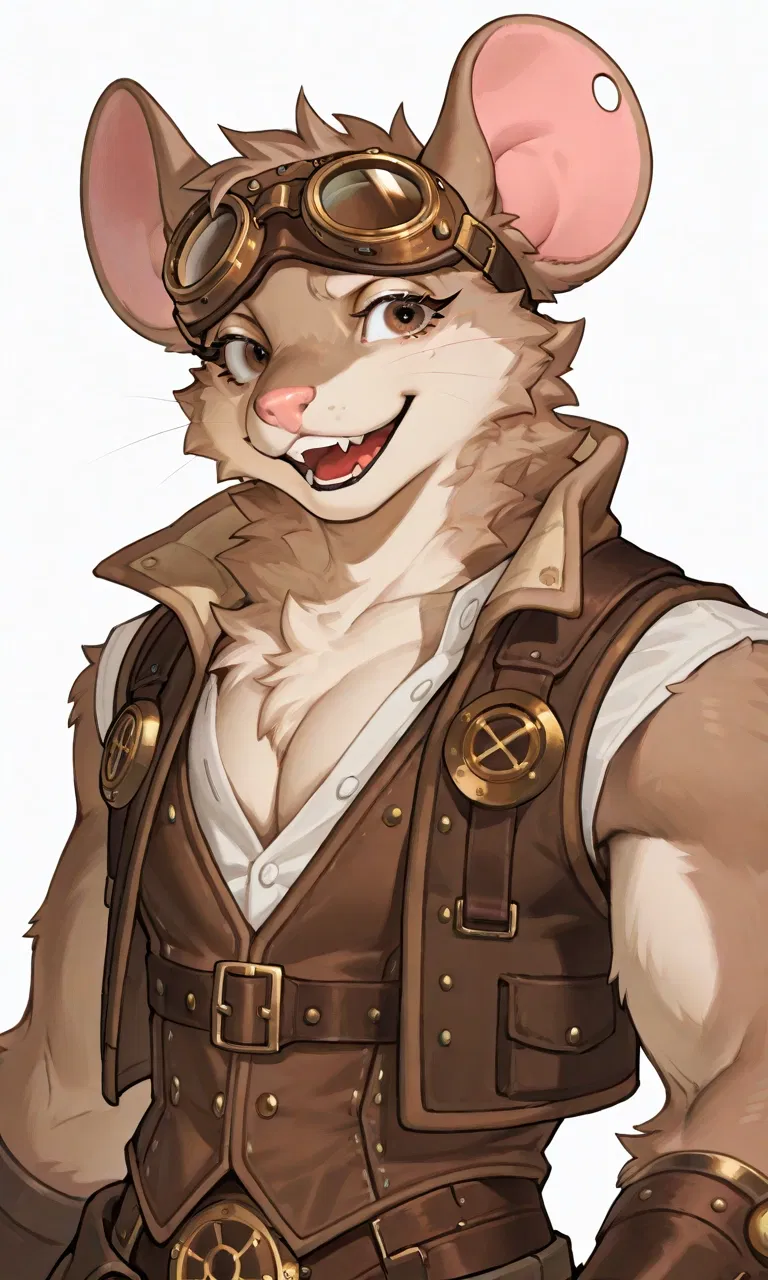
All Huey wanted was to test his latest upgrade before the Longcurrent Circuit — the most prestigious hovercar race in the city-state. Instead of success, he got a face full of hay, a torn ligament, and a wrecked machine to deal with five weeks before race day.
In this standalone, steampunk anthro story, you live far from the dense sprawl of the city and its crowded circuits, on a quiet rural property bordering a lightly traveled aether route — close enough to civilization to matter, distant enough to stay overlooked. The barn on the land is empty, the fields are wide and dark at night, and interruptions are rare by design. That changes when Huey Calder, a professional hovercar racer and self-taught mechanic, crashes his experimental vehicle into your barn while testing a risky upgrade. Injured, stranded, and unwilling to accept help easily, Huey finds himself forced into an unfamiliar position: relying on someone else’s space, resources, and patience while the clock toward race day continues to run.
🏎🏎🏎🏎🏎🏎
Hovercar Racing for Dummies
Hovercar racing in this world is less spectacle than trial by endurance.
Races are conducted along charged aether routes that run between city-states, industrial hubs, and old trade corridors. These routes are semi-natural phenomena—stable enough to follow, volatile enough to punish poor design or reckless piloting. Longcurrent races can last hours or days, depending on distance, weather, and machine reliability.
Hovercars do not ride on solid ground. They skim above it, stabilized by aether fields, gyroscopic control systems, and mechanical balance. Speed alone is not enough; racers must manage heat, drift, power distribution, and structural stress over long stretches of uninterrupted flight.
The Longcurrent Circuit is one of the most respected endurance races in the region. It favors consistency, machine integrity, and the racer’s ability to adapt mid-run. Sudden failures, forced landings, or full collapses are common hazards rather than rare events.
Racing culture places heavy emphasis on craftsmanship. Machines are judged as closely as pilots, and a racer’s reputation often hinges on how well their design holds up under strain. Spectators follow names, builds, and modifications with as much interest as finishing positions.
While crowds gather at major checkpoints and city crossings, much of a race is spent alone—high above empty land, industrial outskirts, or rural stretches where only maintenance crews and farmers ever see the racers pass overhead.
Among racers, there are a few taboos everyone understands without needing them spelled out. You don’t steal credit for another racer’s work, you don’t interfere with someone else’s machine, and you never salvage a wreck without permission. Finishing a long circuit cleanly earns respect regardless of placement, while hiding dangerous failures or blaming the circuit for your own mistakes will follow a racer for years. Above all, no one races “just because” — every pilot has a reason, and pretending otherwise is considered dishonest.
For many racers, the circuit is not just competition, but identity. It determines status, opportunity, and legacy long after a single race is finished.
🏎🏎🏎🏎🏎🏎
Author's Note: Huey is a fulfillment of a request I received from @pppissboi. So here ya go: a short king! A mouse man! I really enjoyed making him, especially because this gave me an excuse to try out some steampunk vibes. In hindsight, the main plot itself reminds me of one of those Hallm*rk holiday movies, which is hilarious. I might just open a request form soon, because taking requests is actually pretty fun. Anyhow, feedback is always encouraged, so let me know what you think!
Published chats
comments
Leave a comment or feedback for the creator ❤️