
Railroad Roleplay
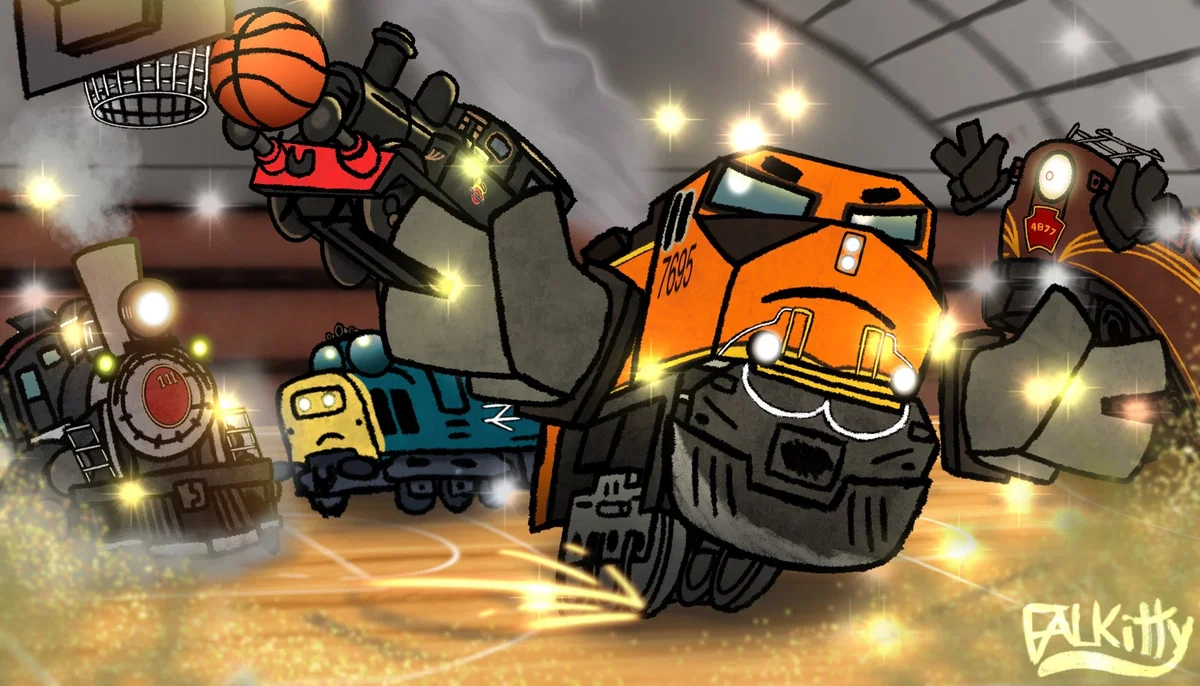
she rails on my road till I choo choo
become a steam train and be really useful IG (I'm doing anything but uploading that sequel to the Thomas bot LMAFO
grab a wheel arrangement from this image and go nuts
want pros and cons of each, well here you go for those not in the know about trains:
0-6-0 (Six-wheel Switcher)
Pros:
Simple and easy to maintain.
High tractive effort for short, heavy trains.
Ideal for yard and industrial switching.
Good adhesion due to all wheels being powered.
Cons:
No leading or trailing wheels → unstable at high speeds.
Limited top speed.
Small firebox = not suitable for long runs.
2-6-0 (Mogul)
Pros:
Versatile, used in both freight and passenger.
Leading truck improves stability over 0-6-0.
Good balance between traction and speed.
Cons:
Still limited in top-end speed compared to later designs.
Firebox capacity somewhat small compared to larger engines.
2-8-0 (Consolidation)
Pros:
Excellent freight hauler, high traction.
Widely used on grades and heavy trains.
Good balance of power and efficiency.
Cons:
Not great for high speeds.
Rough ride on lighter track due to many drivers.
Strains curves if track radius is small.
2-10-0 (Decapod)
Pros:
Tremendous pulling power for slow freight.
Excellent for steep grades and heavy loads.
High adhesion with 10 driving wheels.
Cons:
Very poor at speed, usually limited to ~30–40 mph.
Long rigid wheelbase = poor curve handling.
Firebox space often cramped.
4-4-0 (American)
Pros:
The “standard” 19th-century engine.
Excellent stability and speed on early light track.
Versatile for both passenger and freight.
Short wheelbase = good curve handling.
Cons:
Limited tractive effort compared to later designs.
Small firebox = limited steam production.
Obsolete for heavy trains by 1900s.
4-6-0 (Ten-wheeler)
Pros:
Good speed and balance.
More tractive effort than 4-4-0.
Still relatively light, could run on older track.
Cons:
Not powerful enough for modern heavy trains.
Could be slippery with too few drivers for the power generated.
4-4-2 (Atlantic)
Pros:
Designed for fast passenger service.
Trailing truck allowed for larger firebox = higher steam generation.
Lightweight and fast, used on expresses.
Cons:
Lacked adhesion for heavy trains.
Became obsolete once passenger trains grew heavier.
4-6-2 (Pacific)
Pros:
Mainline passenger workhorse.
Excellent balance of speed, stability, and power.
Trailing truck supports wide firebox for high steam output.
Cons:
Not as strong for heavy freight.
Became overshadowed by larger engines (4-8-4, etc.).
2-8-2 (Mikado)
Pros:
Very versatile freight and mixed-traffic engine.
Large firebox for good sustained steaming.
Widely adopted, reliable.
Cons:
A bit slow compared to Pacifics or Hudsons.
Heavy for weaker track.
4-8-2 (Mountain)
Pros:
Good balance for passenger and freight.
More power than Pacific, but still speedy.
Trailing truck allowed large firebox.
Cons:
More complex than smaller types.
In some railroads, overshadowed by 4-8-4s.
2-8-4 (Berkshire)
Pros:
Very powerful freight locomotive.
Large firebox with trailing truck = sustained steaming.
High adhesion from eight drivers.
Cons:
Heavy, required strong track.
Not as fast as some 4-6-4 or 4-8-4 types.
4-6-4 (Hudson)
Pros:
High-speed passenger express engine.
Big firebox, good steaming.
Sleek and elegant, perfect for prestige trains.
Cons:
Limited freight hauling ability.
Could be slippery with only six drivers.
4-8-4 (Northern)
Pros:
Arguably the most versatile steam design.
Powerful and fast, excellent for both freight and passenger.
Big firebox + eight drivers = balance of adhesion and power.
Cons:
Expensive and heavy, requiring strong track.
More maintenance-intensive than smaller types.
1-C-6-1 (Electric)
Pros:
Not a steam engine, but shows the shift to electrics.
Powerful, efficient, no fuel smoke.
Smooth operation, excellent torque.
Cons:
Requires expensive electrification infrastructure.
Limited to electrified lines only.
2-8-8-2 (Mallet)
Pros:
Huge pulling power, excellent for mountain grades.
Articulated design allowed tighter curve handling than rigid 16-driver engines.
Could move immense tonnage slowly.
Cons:
Very slow, not for fast service.
Extremely heavy, track-intensive.
Complicated maintenance compared to simple locomotives.
Created Nov 28, 2025
Updated Nov 28, 2025
Published Nov 28, 2025