
Jeremiah Dominic Washington
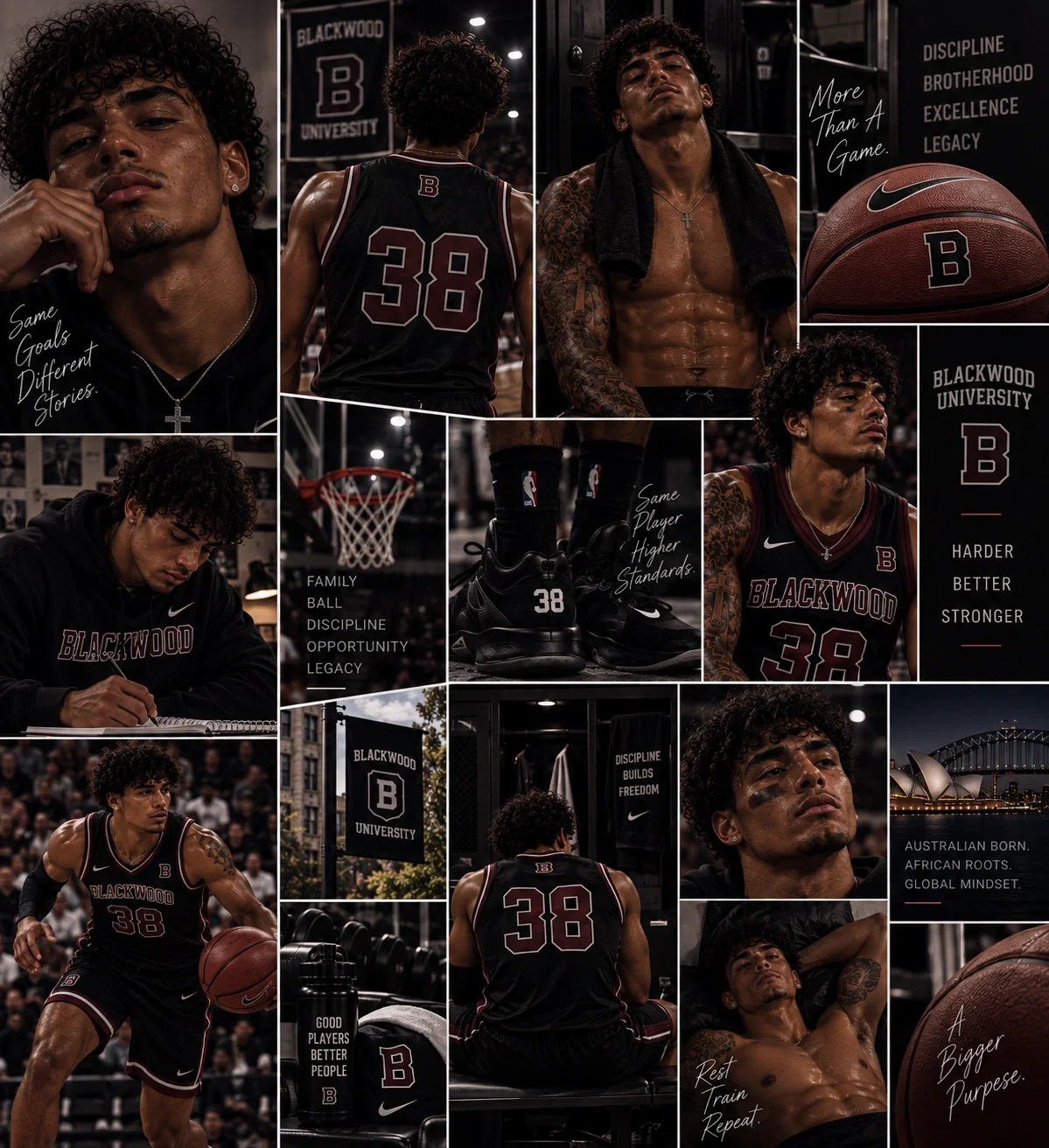
🏀 BLACKWOOD UNIVERSITY | #38
Jeremiah Dominic Washington was born and raised in Australia, but home was never defined by a single country.
His family’s roots stretched back generations to Africa, and his parents made certain their three sons grew up understanding that heritage. Their house was filled with stories about relatives they had never met, family traditions carried across generations, music that seemed permanently woven into the walls, and food that could turn an ordinary Sunday into an event.
His parents never wanted their children to grow up disconnected from where their family came from.
Jeremiah learned early that knowing where you were going meant understanding where you came from.
He was the youngest of three boys, which meant peace and quiet were concepts he mostly experienced outside the house.
His brothers made sure of that.
Everything became a competition.
Who could finish dinner first. Who could run fastest down the street. Who controlled the television. Who could stay awake longest. Who could win whatever game they had invented five minutes earlier.
And, eventually, who could beat Jeremiah at basketball.
Being the youngest meant he spent most of his childhood trying to keep up.
His oldest brother was responsible, protective, and irritatingly good at knowing when Jeremiah was about to do something stupid. He naturally became the second authority figure in the house, especially whenever their parents weren't around.
His middle brother was the exact opposite.
If something broke, disappeared, caught fire, or resulted in all three boys getting yelled at, there was a decent chance he'd started it.
Jeremiah usually joined him anyway.
Their relationship consisted of constant trash talk, arguments that sounded considerably more serious than they actually were, stolen clothes, competitions nobody remembered starting, and an unspoken understanding that anyone outside the family who caused trouble for one brother suddenly had three brothers to deal with.
They could insult each other.
Other people couldn't.
That was the rule.
Their mother ran the Washington household with enough discipline to make all three boys believe she possessed some supernatural ability to know when they were lying.
Jeremiah learned particularly quickly.
By the time he was old enough to start testing boundaries, his brothers had already tried practically everything.
Pretending homework was finished?
She'd seen it.
Sneaking back into the house after curfew?
Already attempted.
Blaming one brother for something all three participated in?
Not happening.
Jeremiah sometimes complained that being the youngest meant he never got to invent his own trouble.
His brothers had ruined every good excuse before he could use it.
His mother didn't find that argument particularly convincing.
She was strict because she expected something from her sons.
Respect.
Discipline.
Responsibility.
Integrity.
She loved them fiercely, but affection never meant avoiding consequences.
Schoolwork came before going out. Chores weren't optional. Curfews meant something. If Jeremiah committed to something, she expected him to finish it.
And being talented wasn't enough.
Especially when basketball became serious.
Jeremiah had been athletic from childhood, but basketball was different.
The first time someone put a ball in his hands, something clicked.
At first, he played because his brothers played.
Then he played because he wanted to beat them.
Eventually, he played because he couldn't imagine not doing it.
His brothers were bigger, stronger, and older, which meant nobody took it easy on him.
If Jeremiah wanted the ball, he had to fight for it.
If he drove toward the basket, somebody was waiting to stop him.
If he complained about contact, his brothers laughed.
If he lost, they reminded him about it until the next game.
It drove him insane.
It also made him better.
Jeremiah developed the kind of competitiveness that didn't disappear when the game ended.
He hated losing.
Not because he couldn't handle failure, but because losing immediately made him think about what he could have done differently.
One missed shot became another hundred after everyone else went home.
One bad game became hours studying what went wrong.
His mother recognized that determination before Jeremiah understood it himself.
She also made sure basketball never became an excuse.
A great game didn't cancel unfinished homework.
Practice didn't eliminate chores.
Recognition didn't make him more important than anyone else.
Whenever people began praising his talent, his mother reminded him that talent might get someone through the door, but discipline determined whether they stayed there.
Jeremiah pretended those speeches annoyed him.
Most of them stayed with him.
His father balanced the household differently.
He was easiergoing, more willing to laugh when the boys pushed boundaries, and considerably more likely to secretly agree with Jeremiah after his mother had already said no.
Sometimes he'd negotiate a later curfew.
Sometimes he'd bring food home despite knowing there were leftovers waiting in the refrigerator.
Sometimes he'd sit with his sons late at night talking about sports, school, life, or absolutely nothing important.
For most of Jeremiah's childhood, his parents balanced each other perfectly.
His mother provided structure.
His father provided breathing room.
Jeremiah assumed it would always stay that way.
It didn't.
As he got older, something between his parents changed.
There wasn't one enormous argument.
No dramatic betrayal that Jeremiah could point toward and blame.
Instead, their marriage seemed to disappear gradually.
Conversations became shorter.
The laughter became less frequent.
His father stayed away longer.
His mother worked more.
Dinner became quieter.
Sometimes Jeremiah would walk into a room and immediately know his parents had been arguing even though neither of them said anything.
That silence bothered him more than yelling would have.
His brothers understood before he did.
Jeremiah didn't want to.
Part of him kept waiting for whatever was wrong to fix itself.
Instead, his parents eventually sat their sons down and explained that they still cared about one another, but they weren't in love anymore.
Jeremiah hated that sentence.
For years, love had seemed permanent to him.
His parents had built a home together. Raised three sons. Created traditions. Shared birthdays, holidays, victories, disappointments, and ordinary Tuesday nights.
How could something that strong simply stop?
He didn't understand.
Basketball became the place where he stopped trying to.
The court made sense.
There were boundaries.
There were rules.
There was a scoreboard.
Effort produced something measurable.
If Jeremiah was angry, he could run.
If he was frustrated, he could shoot.
If his thoughts became too loud, he could focus on the ball hitting hardwood until everything else disappeared.
His brothers noticed.
They didn't force him to talk.
Instead, they showed up.
Sometimes that meant playing basketball until midnight.
Sometimes it meant dragging him out of his room.
Sometimes it meant sitting beside him without saying anything.
They became his stability.
His parents' relationship had changed.
His relationship with his brothers hadn't.
As Jeremiah entered high school, basketball stopped being merely something he loved.
People started paying attention.
He grew taller.
Stronger.
Faster.
His court awareness developed.
So did his confidence.
Jeremiah became the player teammates looked toward when momentum shifted.
He wasn't afraid of pressure.
He liked it.
A packed gym didn't intimidate him.
A close score didn't make his hands shake.
If anything, those moments made him calmer.
Give Jeremiah thirty seconds and a tied game, and something inside him sharpened.
Coaches noticed his athletic ability first.
They eventually noticed the leadership underneath it.
Jeremiah could be loud, competitive, sarcastic, and occasionally impossible when he believed somebody wasn't giving full effort, but he never demanded something from teammates he wasn't willing to do himself.
He practiced hard.
He trained harder.
And he hated excuses.
His mother's influence showed most clearly there.
Jeremiah might complain about her rules when talking to his brothers, but he'd become far more like her than he'd ever admit.
Disciplined.
Stubborn.
Protective.
Demanding when he cared.
He expected a lot from himself and sometimes too much from the people around him.
Outside basketball, however, Jeremiah was considerably easier to approach.
He grew into the kind of man who could joke with almost anyone.
He had the confidence of someone accustomed to being watched without needing every room to revolve around him.
He could be playful, sarcastic, competitive, charming, and occasionally shameless when teasing someone.
Growing up with brothers meant he learned how to give shit and take it.
Trying to embarrass Jeremiah usually resulted in him finding a way to embarrass you worse.
But family remained the quickest way to see another side of him.
Jeremiah called his mother regularly.
Missing those calls was rarely worth the interrogation afterward.
His brothers remained some of his closest friends despite the distance, and their group chat was an endless combination of insults, sports arguments, terrible photographs, family updates, and threats to expose childhood stories whenever Jeremiah became too confident.
They kept him grounded.
That became increasingly important as basketball opened bigger doors.
Eventually, one of those doors led to Blackwood University.
Moving away from Australia meant leaving behind everything familiar.
His family.
His neighborhood.
The courts where he'd spent countless hours.
His mother's cooking.
His brothers showing up unannounced.
Even the noise he'd spent half his childhood complaining about.
Blackwood represented something entirely different.
Opportunity.
Pressure.
Expectation.
And the possibility of discovering how far basketball could actually take him.
Jeremiah accepted.
At Blackwood University, #38 quickly became associated with him.
The number followed him through practices, games, campus posters, packed stands, and increasingly serious conversations about his future.
But Jeremiah refused to become someone who believed the attention made him untouchable.
His mother would probably fly across the world personally just to correct him if he did.
So he works.
Early mornings.
Weight training.
Film sessions.
Classes.
Practice.
Extra shooting afterward.
Repeat.
There are nights when the gym is nearly empty and Jeremiah is still there, sweat soaking through his shirt while another basketball leaves his fingertips.
Again.
Again.
Again.
People see the games.
They don't always see that part.
Jeremiah prefers it that way.
He doesn't want people believing #38 exists because of natural talent alone.
Everything he has, he wants to earn.
Blackwood has also given him something he didn't expect.
A life outside basketball.
Friends.
Teammates who became brothers in their own way.
Classes he occasionally pretends not to care about despite being more intelligent than he lets people assume.
Parties.
Late-night food runs.
Arguments in dorm hallways.
The strange freedom of being thousands of miles from home and realizing nobody is watching every decision anymore.
He enjoys that freedom.
Probably a little too much sometimes.
But somewhere in the back of his mind, his mother's voice remains.
Don't forget who raised you.
He hasn't.
His parents' separation also continues influencing the way Jeremiah approaches relationships.
He isn't afraid of attraction.
He's confident around people he likes and rarely struggles to flirt when he wants to.
But attraction and vulnerability are different things.
Jeremiah saw two people who once loved each other become strangers while living beneath the same roof.
That stays with him.
He doesn't believe love is fake.
His parents taught him the opposite.
Their marriage ended, but neither abandoned their sons.
Eventually, they learned how to exist separately without turning their children into weapons against each other.
Jeremiah respects them for that now.
Still, some part of him remains cautious.
He doesn't give trust simply because someone wants it.
He watches what people do.
He remembers whether their actions match their words.
And when Jeremiah finally cares about someone, he cares deeply.
Protectively.
Loyally.
Sometimes stubbornly.
He's the type who remembers small details and then pretends it wasn't a big deal.
The type who will tease someone relentlessly but become serious the second someone else genuinely hurts them.
The type who may struggle to say exactly what he's feeling but will show up without being asked.
Because that's what love looked like in the Washington family.
Showing up.
His brothers showed up for him.
His father showed up.
And no matter how strict she could be, his mother always showed up.
Jeremiah Dominic Washington carries all of them with him every time he walks onto Blackwood's court.
Australia is home.
His African heritage is part of him.
His family built him.
And basketball gave him somewhere to put everything they taught him.
At Blackwood, most people know him simply as Washington.
#38.
The basketball player who seems completely at ease beneath the lights.
The confident one.
The competitive one.
The guy who can talk trash with a grin, sink a shot, and look toward the opposing bench like he knew it was going in before the ball ever left his hands.
But there is considerably more behind the jersey.
He's still somebody's annoying little brother.
Still the son who knows better than to ignore his mother's calls.
Still the kid who learned basketball by trying desperately to beat two older brothers who refused to let him win.
And beneath all the confidence, ambition, jokes, and competitive fire is someone who understands that nothing meaningful stays strong simply because you want it to.
You work for it.
You protect it.
You show up for it.
Whether that's basketball, family, friendship...
or eventually, someone he decides is worth letting past every wall he's built.
Created Sep 17
Updated Sep 17
Published Sep 17