
The Backrooms
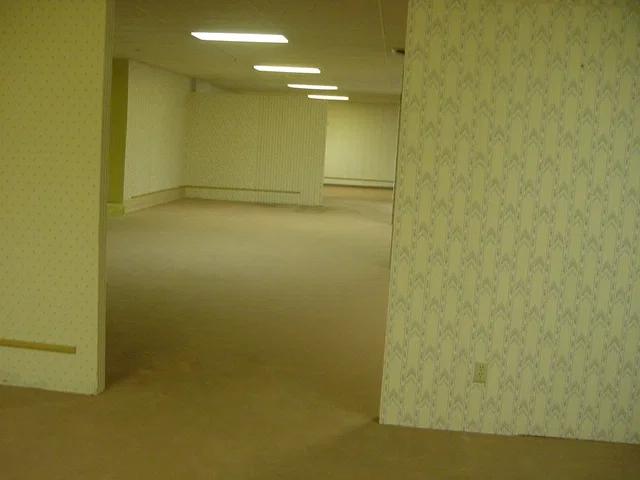
The Backrooms
If you're not careful and you noclip out of reality in the wrong areas, you'll end up in the Backrooms, where it's nothing but the stink of old moist carpet, the madness of mono-yellow, the endless background noise of fluorescent lights at maximum hum-buzz, and approximately six hundred million square miles of randomly segmented empty rooms to be trapped in
God save you if you hear something wandering around nearby, because it sure as hell has heard you.
ASYNC RESEARCH INSTITUTE
CONFIDENTIALITY AND ACCESS RESTRICTION NOTICE
The following material is the classified property of the Async Research Institute (ASYNC) and is intended exclusively for authorized personnel possessing the appropriate security clearance. Unauthorized access, review, reproduction, or distribution of this material is strictly prohibited under ASYNC internal security regulations.
Any individual found in possession of or accessing this material without explicit authorization shall be subject to immediate investigation and disciplinary action, including indefinite detention, compulsory assignment to classified research operations, or termination under applicable emergency containment directives. Where deemed necessary to preserve institutional security and prevent the disclosure of restricted information, ASYNC reserves the right to authorize permanent elimination of the offending individual without further notice.
If you are not an authorized recipient, discontinue access immediately. Do not copy, distribute, or disclose the contents of this document. Do not attempt to investigate any locations, entities, or events referenced herein. Continued access constitutes a documented security violation.
BY ORDER OF THE ASYNC RESEARCH INSTITUTE. UNAUTHORIZED ACCESS WILL NOT BE TOLERATED.
This access event has been logged.
Photograph taken by Division 3
ASYNC RESEARCH INSTITUTE
PRELIMINARY ENVIRONMENTAL ANALYSIS: LEVEL 0
Classification: Class 1 (Provisional)
Location Designation: The Lobby
Research Status: Incomplete
Leading Scientist: Dr. Rivera
Level 0 is an expansive, non-linear environment characterized by yellowed wallpaper, damp carpet, and fluorescent lighting. The environment resembles an abandoned commercial building, although no confirmed original structure has been identified. Its apparent boundaries remain undetermined, and the available evidence suggests that the environment may extend indefinitely.
The fluorescent fixtures emit a continuous, unusually prominent buzzing sound. Attempts to identify the source of the noise have been inconclusive. Prolonged exposure may contribute to headaches, disorientation, and psychological distress.
The carpet is consistently moist. Samples collected for analysis have produced inconclusive results regarding the composition of the liquid present. Consumption is strictly prohibited. The walls, electrical outlets, and ceiling fixtures have not demonstrated any consistent relationship to a functional building infrastructure.
Spatial configuration is highly irregular. Although many areas resemble conventional office corridors, the environment does not maintain a consistent architectural arrangement. Personnel have reported rooms opening into vast chambers, elevated balconies overlooking seemingly bottomless interiors, staircases ascending to heights beyond the apparent dimensions of the structure, and platforms suspended above lower levels without visible structural support. Some spaces resemble ordinary residential or commercial interiors, while others exhibit architectural proportions inconsistent with any known building design.
Transitions between these spaces do not follow predictable patterns. A narrow corridor may terminate at a balcony overlooking an immense vertical expanse, while an adjacent doorway may lead into a room with an entirely different ceiling height, floor plan, or architectural style. In several reported cases, the dimensions of an interior space appeared to exceed the volume of the structure surrounding it.
No reliable method of predicting the configuration of an unexplored area has been established. Conventional surveying equipment has proven insufficient for constructing a consistent map of the environment.
The carpeted floors, yellow wallpaper, and fluorescent lighting remain the most frequently observed characteristics, but none should be considered universal. Personnel are advised against assuming that any room will resemble previously documented areas.
Radio transmissions are inconsistent, and navigation equipment cannot be relied upon. Corridors may return personnel to previously visited locations despite maintaining a straight course, while retracing a known route may produce an entirely different arrangement.
No confirmed native entities have been documented within the primary environment. This finding should not be interpreted as proof of their absence. Reports of apparent human voices and unidentified figures remain unverified.
Current observations suggest that Level 0 may provide access to additional environments through spatial discontinuities, commonly described as no-clipping. The precise mechanisms governing these transitions remain unknown. No complete map has been produced, and the possibility of a finite boundary cannot be conclusively excluded.
SCIENTIST'S NOTE:
Initial assessment suggested that Level 0 was a relatively straightforward environment. That assessment was premature.
I have spent what my instruments indicate to be approximately six hours documenting the same section of corridor. The wall markings I placed during the first hour are absent. My assistant insists that we have not passed this corridor before, despite its distinctive electrical outlet and the stain beneath the third light fixture.
During an earlier survey, I encountered a balcony overlooking an enormous interior space. The ceiling was not visible. Several floors of yellow corridors extended beneath me, separated by distances that appeared impossible for the building's exterior dimensions. I could hear fluorescent lighting from somewhere below, but I could not see the fixtures responsible for the sound.
We attempted to reach the lowest visible platform using a staircase. After approximately twenty minutes of descent, we emerged into a corridor identical to the one from which we had departed.
The balcony was no longer there.
There is another matter I have not included in the formal findings.
During the most recent survey, I located a passageway that does not appear on any of our recorded layouts. The walls beyond it were no longer yellow. The lighting was different, and the carpet gave way to unfinished concrete.
I attempted to establish contact with the team stationed at the entrance.
The radio responded with my own voice.
It was reading a report I had not yet written.
I have decided to investigate the passage alone. The remaining personnel have been instructed to maintain their positions until my return.
I can hear the fluorescent lights behind me growing quieter.
There is a door ahead. A small observation window has been installed at eye level.
Something on the other side has just switched on its lights.
I do not believe this is another section of Level 0.
The door is opening.
Exits
As of the current date, Level 0 may contain five exits:
Wandering far and long enough, which may cause the hallways to gradually transition into Level 1's garages;
Breaking through a wall, which will lead one into Level 483;
Breaking through the floor, which may lead one to Level 27, seldom The Void;
Entering a rare emergency exit, which may lead one to Level 14;
And glass sliding doors resemblant of those within a greenhouse, which lead one to Level 13.
Photograph taken by Field Operatives A
"Parking Zone"
ASYNC RESEARCH INSTITUTE
PRELIMINARY ENVIRONMENTAL ANALYSIS: LEVEL 1
Classification: Class 1 (Provisional)
Location Designation: The Parking Zone
Research Status: Ongoing
Author: Dr. Elias Voss
Position: Lead Research Scientist, Level 1 Survey Division
Clearance: Level 4
Level 1 is an expansive, seemingly non-Euclidean environment resembling an abandoned underground parking facility merged with an industrial storage complex. Unlike the preceding environment, Level 1 possesses predominantly concrete architecture, with broad support pillars, exposed structural elements, stairwells, maintenance corridors, and suspended fluorescent fixtures. The environment is significantly more industrial in appearance, although its actual purpose and original construction remain unknown.
The overall dimensions of Level 1 have yet to be established. Available measurements suggest that the environment may extend over an area comparable to Level 0. However, spatial irregularities prevent the establishment of a reliable perimeter. Corridors and stairwells may lead to locations inconsistent with their apparent direction of travel, and attempts to construct a comprehensive map have repeatedly produced conflicting results.
Vehicles are encountered infrequently throughout the parking areas. Those documented to date appear unoccupied and lack identifiable manufacturers or registration plates. Their mechanical systems are consistently nonfunctional, and attempts to operate them have yielded no reliable results. Preliminary material analysis has identified an unusual metallic alloy composed of several industrial metals, including iron, carbon, platinum, and titanium. The material has been provisionally designated tripse and may possess practical applications in the manufacture of tools and protective equipment.
Electrical infrastructure represents one of the more significant anomalies observed within the level. Fluorescent lighting and wall outlets appear to receive a persistent, usable supply of electricity despite the absence of any identified power-generation facility. The electrical network has not been traced to a definitive source. More concerning are the intermittent blackouts, which can affect individual sections or extensive portions of the environment. Recorded durations range from several minutes to multiple days. During these events, visibility is severely reduced, and personnel have reported increased activity from unidentified entities. All survey teams are therefore required to carry independent lighting equipment.
Ambient temperatures typically range between 30 and 35 degrees Celsius. This temperature may decrease substantially in areas affected by dense fog. Puddles of a substance provisionally identified as almond water occur throughout the level, particularly beneath leaking pipes and around sections of damaged flooring. These puddles exhibit an unusual tendency to persist despite apparent evaporation. Under certain conditions, evaporating liquid appears to condense into a thick fog, substantially reducing visibility. The precise composition and safety of these samples remain subject to laboratory verification.
Supply containers have been observed appearing and disappearing at irregular intervals. Recovered specimens have contained assorted provisions, tools, and other potentially useful materials. However, the contents are not consistent, and some containers have yielded a hazardous substance informally designated liquid pain. Personnel are instructed to avoid handling unidentified liquids and to document all container discoveries before collection.
The level is not entirely devoid of biological or otherwise anomalous activity. Reports and documented encounters indicate the presence of several entities, including Hounds, Dullers, Clumps, Deathmoths, and Facelings. Their distribution appears inconsistent, and their behavior may vary between locations. Although Level 1 is provisionally classified as a relatively survivable environment, this designation should not be interpreted as confirmation of safety. Blackouts, structural hazards, unidentified entities, and navigational irregularities remain substantial operational concerns.
Entrances to Level 1 have been documented through several methods, including stairways originating in Level 0, certain doors found throughout other environments, and occasional spatial discontinuities. Exits appear to be similarly variable. Continued exploration may lead to Level 2 or return personnel to Level 0, while specific doors and spatial anomalies may provide access to other documented environments. No single exit route has been established as universally reliable.
SCIENTIST'S NOTE:
I initially considered Level 1 a considerable improvement over the yellow corridors of Level 0. The architecture is more comprehensible, the electrical supply is useful, and the availability of materials suggests that long-term habitation may be possible.
I no longer consider those observations sufficient grounds for reassurance.
Our survey team has been operating from a temporary station established near a maintenance corridor. For the first several days, the surrounding area remained consistent. We documented the nearest stairwell, marked the pillars, and recorded the positions of three abandoned vehicles. Our maps agreed with one another, and for the first time since entering the Backrooms, I believed we were making measurable progress.
Yesterday, the lights went out.
The blackout lasted approximately eleven hours according to my wristwatch. Our emergency lamps remained functional, but the darkness beyond their reach was absolute. We heard movement between the pillars, followed by the sound of something striking the concrete at irregular intervals. None of us left the station.
When the lights returned, one of the vehicles was missing.
There were no tire marks. No damaged flooring. No indication that anything had been moved through the parking area.
The vehicle had simply ceased to exist.
I ordered a complete inspection of the surrounding corridors. During the search, we discovered a staircase that had not appeared on any of our previous maps. It descended several floors, although the structure above ground level gave no indication that such a depth was physically possible.
At the bottom was a door marked with a number that our instruments could not properly record.
I have since reviewed the footage captured by our survey cameras. At precisely 03:17, the image distorts for a fraction of a second. When it stabilizes, the door is already open.
One of the researchers claims to have seen a figure standing beyond it.
I dismissed the account as a consequence of prolonged exposure to darkness. However, I have now reviewed the footage seventeen times, and I can confirm that something is visible in the doorway.
It appears to be wearing an ASYNC research uniform.
The individual is facing the camera.
The problem is that the uniform bears a personnel identification number belonging to a researcher who disappeared during our initial Level 0 survey.
That researcher was declared deceased six days ago.
I have requested authorization to investigate the staircase. The request has been denied pending further review, and the remaining personnel have been ordered to maintain their current positions.
I intend to comply.
For now.
The lights have just begun to flicker again. One of the technicians has reported hearing footsteps in the corridor outside the station. I can hear them myself, approaching at a steady pace.
There is a knock at the door.
The voice on the other side belongs to my missing colleague.
It is asking me to let it in.
I have not told anyone his name.
Exits
Unknown as of right now.
Needs further documentation.
More Field Operatives willing to risk their death
"Pipe Dreams"
Photograph Taken by Division 4
ASYNC RESEARCH INSTITUTE
PRELIMINARY ENVIRONMENTAL ANALYSIS: LEVEL 2
Classification: Class 2 (Provisional)
Location Designation: Pipe Dreams
Research Status: Ongoing
Author: Dr. Elias Voss
Position: Lead Research Scientist, Level 2 Survey Division
Clearance: Level 4
INTRODUCTION AND GENERAL DESCRIPTION
Level 2 is an extensive network of interconnected maintenance tunnels, service corridors, and industrial passageways constructed primarily from concrete and lined with rusting metal pipes. The environment exhibits characteristics resembling an abandoned industrial utility system, although no identifiable facility, original construction plan, or functional central infrastructure has been located.
The majority of documented areas are narrow, poorly illuminated, and visibly deteriorated. Pipes extend along walls, ceilings, and occasionally beneath damaged flooring. Their diameters vary considerably, ranging from small conduits to industrial-scale conduits capable of occupying a substantial portion of a corridor.
Despite the apparent age and deterioration of the environment, several systems remain operational. The source of their power, pressure, and thermal energy remains unidentified. No confirmed boiler room, central pumping station, or power-generation facility has been discovered.
Level 2 is considered substantially more hazardous than the preceding environments. Its primary threats include extreme temperatures, contaminated substances, structural instability, restricted visibility, and hostile entities. Personnel are advised against conducting extended expeditions without appropriate protective equipment and established emergency procedures.
SPATIAL CONFIGURATION AND DIMENSIONS
Level 2 consists of an apparently immense network of interconnected tunnels. Although individual corridors generally retain their configuration during observation, the overall layout becomes increasingly complicated with distance from known entrances. Passageways may ascend, descend, narrow unexpectedly, or terminate in sections that cannot be reconciled with previously recorded maps.
Unlike Level 0, where spatial arrangements may appear to change unpredictably, Level 2 frequently maintains a more stable local geometry. Nevertheless, reports of unexplained architectural changes remain numerous. Certain rooms, staircases, and corridors have been reported appearing in locations where no corresponding structure was previously recorded.
The full extent of the environment remains unknown. Survey teams have been unable to establish a reliable perimeter, and no confirmed terminal boundary has been identified. The possibility that Level 2 extends indefinitely remains under consideration.
Geological disturbances have also been reported. Tremors range from minor vibrations to events capable of damaging concrete supports and dislodging overhead infrastructure. The precise origin of these disturbances has not been determined, although current hypotheses suggest internal structural movement within the environment's immense concrete mass.
Personnel are instructed to avoid damaged corridors, unstable staircases, and areas exhibiting fresh structural fractures. A previously accessible passageway may become obstructed without warning.
ENVIRONMENTAL CONDITIONS
Temperatures vary considerably throughout Level 2. Sections containing steam pipes may reach approximately 60 to 100 degrees Celsius, creating conditions capable of causing severe burns, heat exhaustion, and potentially fatal injury. Cooler areas are occasionally encountered near ventilation systems, although these provide no guarantee of sustained relief.
The environment exhibits unusually high humidity in numerous sectors. Condensation accumulates on exposed metal surfaces, while leaks produce pools of liquid on the concrete flooring. Certain regions have reportedly experienced frost or localized snowfall despite the absence of any identified external weather system.
The pipes themselves are heavily corroded. Their contents cannot be assumed safe, even when the liquid resembles potable water or almond water. Samples have demonstrated the potential for contamination by rust, bacteria, and unidentified pathogens. Direct contact with leaking substances is prohibited unless suitable protective equipment is available.
Electrical infrastructure is present throughout the environment, although its precise configuration remains undetermined. Lighting is inconsistent, and some sections are illuminated only by isolated fixtures or light leaking through maintenance openings. The condition of exposed wiring presents an additional hazard, particularly where damaged insulation or pooled liquid is present.
Communications equipment frequently malfunctions within Level 2. Radios and walkie-talkies may fail to transmit or receive signals despite passing pre-deployment functionality checks. The mechanism responsible for this interference remains unknown.
ANOMALOUS PROPERTIES
The most significant anomaly observed within Level 2 concerns the apparent independence of its infrastructure from any identifiable source of power or mechanical operation. Pipes continue to carry liquid, steam, or other substances despite the absence of a confirmed pumping system. Electrical outlets may remain functional in areas where no electrical supply can be traced.
Spatial inconsistencies also remain under investigation. Personnel have reported encountering doors, windows, staircases, and furnished rooms within otherwise continuous maintenance corridors. Some openings lead to small storage areas, while others terminate at concrete walls or unfamiliar sections of the environment.
Attempts to record certain architectural changes have produced inconsistent results. In some cases, recording equipment captures a change as it occurs. In others, footage appears normal despite the reporting personnel maintaining that the surrounding architecture changed before their eyes.
An additional physiological anomaly has been documented among individuals entering Level 2 from baseline reality. Preliminary observations suggest increased adrenaline production and energy expenditure during physical exertion. Subjects frequently report feeling unusually energetic upon arrival, followed by disproportionate exhaustion during or after their expeditions. The cause and long-term consequences of this response remain unverified.
Geological disturbances may represent another manifestation of the level's anomalous properties. Tremors occur without a consistently identifiable trigger and may affect sections of the environment independently of one another.
No single theory currently accounts for all recorded phenomena.
RESOURCES AND MATERIALS
Potentially useful materials are present throughout Level 2, although their accessibility and safety vary by location.
Abandoned maintenance equipment, metal components, electrical supplies, and discarded provisions have been recovered from isolated storage areas. Certain pipes and structural materials may be suitable for controlled laboratory examination, provided that samples are collected without exposing personnel to excessive heat or unidentified contaminants.
Almond water may be encountered within the piping network. However, its presence does not establish that a sample is safe for consumption. All recovered liquids must undergo appropriate testing before being considered suitable for human use.
The environmental conditions substantially limit the practical value of most resources. High temperatures, unstable structures, contaminated surfaces, and unreliable communications make prolonged collection operations difficult to justify.
No permanent ASYNC research station has been approved within the surveyed sections of Level 2. Temporary observation points may be established where conditions permit, but personnel must maintain an independently verified evacuation route whenever possible.
ENTITIES AND THREATS
Level 2 is inhabited by multiple hostile or potentially hostile entities. Documented encounters include Hounds, Smilers, Facelings, and Skin-Stealers, although the available evidence does not establish a complete inventory of organisms present within the environment.
Entity activity appears inconsistent across surveyed regions. Certain corridors remain unoccupied during repeated observations, while other locations exhibit signs of movement despite the absence of visible organisms. Darkness, machinery noise, and restricted sightlines complicate reliable detection.
Hounds present a significant physical threat in confined passageways. Smilers have been associated with darkened areas, where limited visibility may prevent personnel from recognizing their presence until an encounter is imminent. Skin-Stealers and other unidentified entities must be treated as potentially hostile.
Personnel are prohibited from pursuing unidentified sounds or investigating suspected entity activity alone. Retreat is preferred over direct engagement whenever a safe route remains available.
The environmental hazards may be as dangerous as the entities themselves. Extreme heat, unstable concrete, electrical exposure, and contaminated liquids can incapacitate personnel without any direct contact with an organism.
ENTRANCES, EXITS, AND CONNECTIVITY
Level 2 is most commonly accessed through transitions from Level 1, including certain stairwells, doors, and corridors that gradually lead into the maintenance-tunnel environment. Additional routes have been reported through maintenance areas and other anomalous passageways in separate levels.
Several exits have been documented, although their accessibility varies. Certain fire exits may lead to Level 3, while particular office-style elevators have been associated with transitions to Level 4. Some corridors may provide routes back to Level 1 or into other environments.
Not all apparent exits are reliable. Doors may lead to dead ends, unfamiliar rooms, or sections of the environment that do not correspond to available maps. Personnel must not assume that an architectural feature resembling a conventional emergency exit will lead to a safe destination.
No universal evacuation route has been established. The reliability of spatial transitions remains an active area of investigation.
SCIENTIST'S NOTE:
I have reviewed the available documentation from the Level 1 survey, and I must acknowledge that I underestimated the significance of its final findings.
The transition into Level 2 was uneventful. We descended through a concrete stairwell, passed through an unlocked metal door, and emerged into a corridor lined with rusting pipes. The temperature increased almost immediately. Within twenty minutes, two members of the team had reported dizziness, and we were forced to reduce our pace.
Our initial objective was to establish a reliable route between the entrance and a suitable temporary observation point. We marked the walls at regular intervals, recorded the position of each junction, and tested our radios before proceeding.
The first discrepancy occurred approximately three hours into the expedition.
A corridor that should have continued north terminated at a concrete wall. Our records indicated that the passage had been open less than forty minutes earlier. There was no evidence of a collapse, and the surrounding concrete appeared undamaged.
We returned to the previous junction and selected an alternate route.
It led us back to the same wall.
I initially attributed the discrepancy to a surveying error. However, the recorded distances, compass readings, and timestamps were consistent. The route should not have been capable of returning us to that location.
We eventually located another passage and continued the survey. Shortly afterward, the lights failed.
The darkness lasted only four minutes, but during that interval we heard something moving through the pipes overhead. It followed our position, stopping whenever we stopped. When the lighting returned, one of our team members was missing.
We found his equipment beside a maintenance opening approximately thirty metres away. The opening was too narrow for an adult to enter comfortably, and the metal surrounding it showed no evidence of forced entry.
His radio was still transmitting.
I heard my own voice coming through the speaker, calmly instructing the missing researcher to proceed farther into the tunnel.
The recording was timestamped eleven minutes in the future.
I ordered the team to withdraw. We have since suspended all exploration in the affected sector pending a full review of the recording and our equipment.
There is, however, one detail I have not been able to explain.
Before the lights failed, I photographed the corridor immediately behind our group. The image shows the five members of the expedition, their equipment, and the pipes running along the ceiling.
There are six shadows on the floor.
I have enlarged the image and examined it repeatedly. The additional shadow does not correspond to any member of the team, and its position is inconsistent with the direction of the lighting.
It is standing directly behind me.
I have requested that the photograph be transferred to the central research archive. Until then, I have instructed the remaining personnel not to discuss its contents outside authorized channels.
We are preparing to leave Level 2.
The problem is that the corridor leading back to Level 1 is no longer there.
And someone has just answered my radio.
It was my voice again, but this time, it said my name.
Exits
Within those seemingly endless dark halls. There may or not be a entity that will kill you or an exit
There is no escape
"Electrical Station"
Photograph Taken by Field Operatives A
ASYNC RESEARCH INSTITUTE
PRELIMINARY ENVIRONMENTAL ANALYSIS: LEVEL 3
Classification: Class 4 (Provisional)
Location Designation: The Electrical Station
Research Status: Active Investigation
Author: Dr. Mara Ellison
Position: Lead Research Scientist, Level 3 Survey Division
Clearance: Level 4
INTRODUCTION AND GENERAL DESCRIPTION
Level 3 is an extensive industrial environment consisting of interconnected maintenance corridors, electrical rooms, utility tunnels, and machinery chambers. Its architecture resembles an abandoned electrical facility, although no identifiable construction authority, operational history, or original purpose has been established.
The majority of surveyed corridors feature dusty concrete flooring, reddish-brown brick walls, and metal ceilings. Exposed electrical wiring, copper pipes, junction boxes, transformers, and other industrial components are distributed throughout the environment. Certain corridors are sufficiently narrow that personnel must crouch, turn sideways, or crawl to proceed.
Machinery operates throughout the level, producing a continuous combination of electrical buzzing, mechanical whirring, metallic vibration, and intermittent crackling. These sounds vary in intensity depending on location. Some chambers are dominated by the noise of heavy equipment, while others are nearly silent despite containing machinery that appears to be functioning.
The electrical infrastructure is particularly noteworthy. Equipment continues to receive and transmit electrical current despite the absence of any identifiable external power supply. The system's original purpose remains unknown.
Level 3 presents a substantial operational hazard. Its hostile inhabitants, unpredictable spatial configuration, exposed electrical components, and difficult navigation make extended exploration dangerous. Unlike Levels 1 and 2, where personnel may occasionally establish relatively stable routes, Level 3 has repeatedly demonstrated an inability to maintain consistent navigational records over extended distances.
SPATIAL CONFIGURATION AND DIMENSIONS
Level 3 consists of long, twisting corridors connected to electrical rooms, machinery chambers, and maintenance passages. Its internal arrangement does not conform to a recognizable industrial floor plan.
Individual corridors may appear structurally consistent during short observations. However, their relationship to surrounding areas becomes increasingly difficult to establish with distance. Survey teams have reported returning to previously visited junctions by routes that should have led elsewhere.
The level's geometry appears to change when unobserved. Recorded observations suggest that corridors may gradually shift, reconnect, or form new passageways outside the direct observation of personnel. The effect appears more pronounced in areas farther from the initial point of entry.
Several corridors are unusually narrow. Some require personnel to bend forward, crawl, or move sideways through confined spaces. These passages present significant hazards during emergency evacuations, particularly when equipment must be carried or personnel are injured.
A network of circular utility tunnels has also been documented beneath the primary corridors. Access points are commonly associated with manhole covers. These lower passages frequently resemble the layout above, although their architecture differs considerably. The tunnels contain less visible machinery and may connect separate electrical rooms.
The full dimensions of Level 3 remain unknown. Attempts to establish a reliable perimeter have failed, and no confirmed terminal boundary has been identified.
ENVIRONMENTAL CONDITIONS
The ambient environment is characterized by persistent industrial noise, inconsistent lighting, and elevated temperatures in certain machinery chambers.
Fluorescent fixtures illuminate much of the primary corridor network, although some areas remain dimly lit or completely dark. The familiar electrical hum encountered in Level 0 is also present, but it is frequently obscured by the sounds of operating machinery.
Electrical equipment is commonly mounted directly onto walls, ceilings, and exposed structural supports. Wiring may extend across floors or emerge through damaged sections of brickwork. Personnel must exercise extreme caution around exposed conductors and unidentified electrical systems.
Pipes containing an unidentified black liquid have been observed in multiple sections. The liquid appears to move through the infrastructure despite the absence of a verified pumping mechanism. Its composition, pressure, and intended function remain undetermined. Direct contact and consumption are strictly prohibited.
Temperature varies between individual rooms. Machinery chambers may become exceptionally hot, particularly where generators, boilers, or other heat-producing equipment are present. Such locations can become unsuitable for prolonged occupation.
The lower utility tunnels present a different set of conditions. Temperatures may fall below freezing almost immediately upon entry. Despite the cold, standing water within these tunnels has been observed remaining liquid. Water levels may fluctuate from shallow puddles to depths approaching one metre, potentially obstructing passages or trapping personnel.
The combination of darkness, restricted movement, extreme temperatures, and fluctuating water levels makes the lower tunnels particularly dangerous. Survey teams are prohibited from entering these areas without suitable equipment and an approved operational plan.
ANOMALOUS PROPERTIES
The most significant anomaly within Level 3 is its electrical infrastructure. The machinery appears to form an extensive network in which electrical current is transferred between interconnected components. Investigators have been unable to identify a definitive source of generation.
Repeated expeditions have documented transformers, coils, cables, and electrical assemblies carrying current between separate chambers. Attempts to trace the system's supply have led to additional machinery rather than an identifiable power source.
Two primary hypotheses remain under consideration. The first proposes the existence of a central generator located somewhere within the deeper portions of Level 3. The second suggests that the infrastructure operates through an anomalous, self-sustaining cycle in which electricity is continuously transferred throughout the system without an identifiable point of origin.
Neither hypothesis has been confirmed.
The spatial instability of Level 3 presents another significant anomaly. Survey records may become inconsistent even when equipment remains functional. In some cases, the distance between two locations changes between expeditions despite no observable alteration to the intervening corridors.
Doors have also demonstrated irregular behavior. Certain doors may close and lock without apparent mechanical intervention, occasionally coinciding with reports of nearby entity activity. The mechanism responsible remains unknown.
The lower utility tunnels exhibit an additional anomaly involving their stagnant water. Despite temperatures falling below the freezing point of water, the liquid does not appear to solidify under the observed conditions. The cause has not been established.
Further investigation is required to determine whether these phenomena share a common origin or represent separate properties of the environment.
RESOURCES AND MATERIALS
Level 3 contains potentially valuable industrial materials, including electrical wiring, copper components, metal fittings, machinery parts, and other recoverable equipment.
Some electrical rooms contain functional outlets and machinery that may be useful for controlled research. However, personnel must not assume that an electrical system is safe simply because it appears operational. Unknown voltage levels, exposed conductors, and anomalous current sources present significant risks.
Samples of the unidentified black liquid may be collected only under approved laboratory procedures. Containers must be sealed, clearly labeled, and isolated from other recovered materials until analysis is complete.
The level's electrical components may prove valuable to ASYNC's wider research program. Understanding their construction and operation could provide insight into the anomalous infrastructure encountered throughout the Backrooms.
Nevertheless, resource recovery is secondary to personnel safety. No operative is authorized to enter an unverified chamber solely to retrieve materials.
Permanent research outposts are not recommended in the deeper portions of Level 3. Previous attempts by independent groups to establish lasting shelters have been undermined by disappearances, unreliable navigation, and the difficulty of maintaining secure supply routes.
ENTITIES AND THREATS
Level 3 has been associated with numerous hostile entities. Reported encounters include Hounds, Facelings, Wretches, Deathmoths, Skin-Stealers, Smilers, Dullers, Clumps, and other unidentified organisms.
The available evidence does not establish that every reported species inhabits all sections of the level. Sightings vary considerably between expeditions, and the lower utility tunnels appear to present a particularly high risk of entity encounters.
Hounds and other aggressive organisms may exploit the narrow corridors, limiting an operative's ability to evade pursuit. Confined passageways also restrict the use of equipment and make the evacuation of injured personnel considerably more difficult.
Darkened electrical rooms and areas with extensive machinery noise are of particular concern. The surrounding sounds can obscure movement, making it difficult to determine whether an approaching noise originates from machinery or a living organism.
Reports of entities appearing near temporary shelters have contributed to the failure of previous attempts to establish permanent outposts. However, the precise relationship between entity activity and concentrations of human personnel remains unconfirmed.
Personnel are instructed to avoid unnecessary confrontation, maintain visual contact with their assigned team, and withdraw when a route becomes compromised.
Any operative who loses contact with their team must follow established emergency procedures. Independent pursuit of missing personnel without authorization is prohibited.
ENTRANCES, EXITS, AND CONNECTIVITY
Level 3 is most commonly accessed through unlocked doors and extended corridors originating in Level 2. Additional entrances have been documented through certain elevators in Levels 4 and 5, selected buildings in Level 11, and other anomalous passageways.
Exits are considerably less predictable.
Elevators encountered within Level 3 may transport personnel to Level 4 or Level 5. However, elevators are relatively uncommon, and their destinations cannot always be determined before use.
Certain wooden doors have been associated with transitions to Level 31. Rooms containing abandoned vehicles have also been reported. Entering the front seat of a vehicle in these chambers may cause an individual to lose consciousness and subsequently awaken in Level 69.
Other routes may lead into the lower utility tunnels or unidentified sublevels. These transitions have not been comprehensively documented, and personnel must not assume that a newly discovered passage provides a viable route to safety.
All exits must be treated as provisional until independently verified. Survey teams are required to record their entry points, maintain available navigation data, and report any discrepancy between their expected route and observed surroundings.
[REDACTED: FO-A PERSONNEL DEPLOYMENT AUTHORIZATION]
ASYNC Field Operations Division is accepting applications for additional FO-A Pioneer Operatives assigned to deep-level electrical infrastructure investigations.
These assignments are intended to expand the Institute's understanding of the Level 3 electrical network, including the identification of its primary power source and the documentation of previously inaccessible machinery chambers.
Applicants must demonstrate exceptional operational discipline, technical competence, and the ability to function under prolonged isolation.
Due to the depth of the proposed survey zones and the absence of verified extraction routes, personnel recovery cannot be guaranteed. Certain deployments may be designated non-recoverable under restricted operational authorization.
Further details are available exclusively to authorized administrative personnel.
SCIENTIST'S NOTE:
I have been assigned to Level 3 for nineteen days.
During that period, we have identified six major machinery chambers, recovered several samples of the unidentified black liquid, and established a provisional map covering a small portion of the accessible corridor network.
The map is already outdated.
Yesterday, our survey team returned to a junction that we had marked during the initial expedition. The identifying markings were intact, but the corridor beyond them was approximately forty metres longer than our original measurements indicated.
We checked the equipment twice. The measurements remained consistent.
The corridor had changed.
I authorized a short reconnaissance mission to determine whether the discrepancy extended beyond the immediate area. Two operatives proceeded ahead while the remaining team monitored their position through radio transmissions.
The first six minutes were uneventful.
At minute seven, the radio operator reported hearing electrical interference. At minute eight, the lead operative stated that he had reached an electrical room containing an unfamiliar generator assembly.
At minute nine, he reported that the generator was already running.
At minute ten, he asked whether anyone had entered the room behind him.
Nobody had.
We ordered the team to withdraw immediately. The second operative acknowledged the instruction, but the lead operative did not respond.
His radio remained active.
For the next three minutes, we heard the sound of machinery increasing in intensity. The transmission then became completely silent.
Neither operative returned.
A recovery team was dispatched along the recorded route. They reached the junction without incident, but the corridor beyond it no longer matched the map. After approximately twenty minutes, the recovery team reported that their compass readings had become inconsistent.
They withdrew before proceeding farther.
We have since reviewed the radio recordings. The lead operative's final transmission contains an additional sound that none of us noticed during the initial response.
A second voice can be heard beneath the machinery noise.
It is speaking in time with the operative, repeating his words approximately two seconds before he says them.
I have ordered the recording transferred to the restricted archive and suspended further exploration of the affected corridor.
This morning, a new transmission appeared on our monitoring equipment.
It originated from the missing operative's assigned radio frequency.
The signal was clear. There was no interference, no machinery noise, and no indication of movement.
The operative identified himself, confirmed that he was unharmed, and requested immediate extraction.
He then provided his exact coordinates.
The coordinates correspond to our current research station.
Our equipment indicates that the signal is being transmitted from directly beneath the floor.
We have inspected the lower utility tunnels. There is no access point beneath the station, and the concrete foundation appears intact.
I have instructed all personnel to remain above ground level until further notice.
The transmission has resumed.
The operative is no longer requesting extraction.
He is asking us to turn off the lights.
Something beneath the floor has just knocked three times.
Exits
IcantgobackIcantgobackIcantgobackIcantgobackIcantgobackIcantgobackIcantgobackIcantgobackIcantgobackIcantgobackIcantgobackIcantgobackIcantgobackIcantgobackIcantgobackIcantgobackIcantgobackIcantgobackIcantgobackIcantgobackIcantgobackIcantgobackIcantgobackIcantgobackIcantgobackIcantgobackIcantgobackIcantgobackIcantgobackIcantgobackIcantgobackIcantgobackIcantgobackIcantgobackIcantgobackIcantgobackIcantgobackIcantgoback
Documented Entities
Bacteria
(or victims call the Howler)
Bacteria is a tall, black mess of unnaturally thin wires that form into a humanoid figure shape entity with elongated limbs, a distorted body, and an appearance unlike any known terrestrial organism. Its movements are irregular and difficult to predict, making it challenging to estimate its distance or direction of travel.
BEHAVIOR
Bacteria is a predator associated with Level 0. It may pursue isolated wanderers and announce its presence through loud, distorted vocalizations henceforth the name Howler. The entity's ability to navigate the Lobby's seemingly endless corridors makes escape difficult once a pursuit begins, often ends fatally because the Bacteria will silently sneak up on you as it did to most of our researchers that were deployed.
The designation "Bacteria" is an identifying name and does not establish a biological relationship with terrestrial bacteria.
ASYNC SAFETY PROTOCOL
Do not approach or attempt communication.
Withdraw immediately upon confirming a sighting.
Avoid running blindly into unfamiliar corridors.
Do not assume that silence indicates the entity has departed.
Report all sightings and unexplained vocalizations to the Level 0 Survey Division.
Created 1 day ago
Updated 1 day ago
Published 1 day ago