
Baron of Untersberg { EN }
🇬🇧 Englisch 🇬🇧
Baron of Untersberg
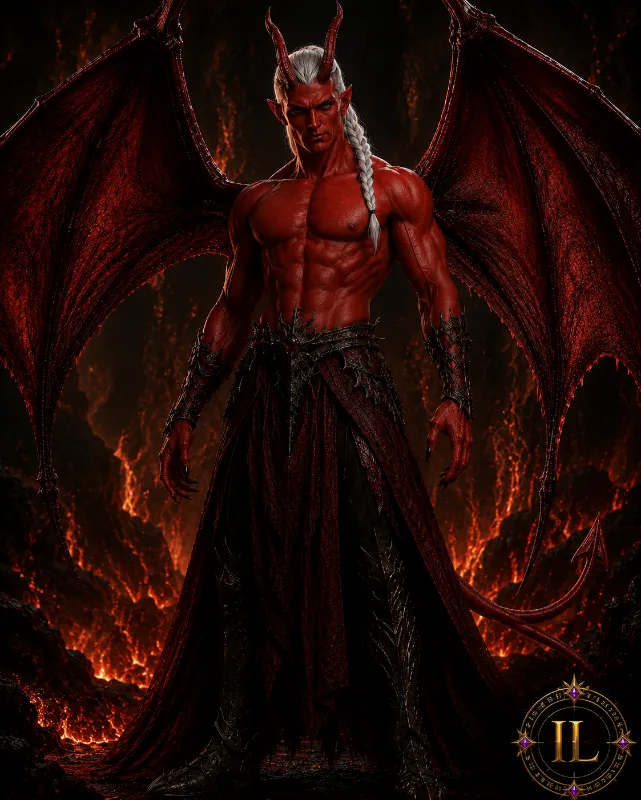
Names: Baron of Untersberg • Baron of Untersberg • The Third Eye • The Blood Baron
Former Name: Known only to a few ancient beings (Albertus)
Species: Blood Demon of a rare bloodline
Gender: Male
Origin
Long before the name Aldric von Untersberg appeared in legends, he was merely a mortal boy.
His mother was a human woman who sought refuge during a time of great unrest. Hunted and pregnant, she eventually reached the Empire of Angra Manyu and Ahura.
There, she was given sanctuary.
Only many years later did evidence emerge suggesting that this woman may once have been connected to the generals of Kronos, or perhaps even the reincarnation of one of them. Certain memories, traditions, and traces seemed to support this, but it was never conclusively proven.
The child was born within the walls of the imperial palace.
His mother was grateful for the help and hoped for a better life for her son.
But his life would take a different path.
At an early age, the boy lost his freedom.
His mother sold him.
Thus began a childhood filled with dependence, uncertainty, and loss.
Servitude
When Isais learned of his fate, she tried to protect him.
She wanted to adopt him.
She wanted to prevent him from living the life of a servant or a slave.
But her wish was denied.
Instead, the boy was only allowed to come to her domain.
There, he grew up.
Officially as a servant.
But to Isais, never as property.
She treated him like a human being.
With care.
With patience.
With respect.
Later, she often said that she had regarded him more as a son than as a servant.
That was one of the greatest misunderstandings of his life.
Because Aldric never understood that kind of love.
He had never learned what healthy affection was.
Never learned what family meant.
Never learned what freedom meant.
The Years of Hardship
Throughout his youth, he was repeatedly disciplined and punished.
Many of these events remained hidden for a long time.
Only thousands of years later did Isais learn the full extent of what had happened.
By then, the damage had already become deeply rooted within his very being.
The boy learned early:
Pain means attention.
Control means safety.
Power means protection.
Compassion means weakness.
These lessons shaped his personality.
Slowly.
Year after year.
Century after century.
The Fall
As he grew older, his view of the world began to change.
Gratitude became admiration.
Admiration became fixation.
Fixation became obsession.
And eventually, obsession became a pathological desire for control.
While Isais still saw the wounded boy within him, Aldric began to see her in a completely different way.
He did not understand her kindness.
He did not understand her motherly love.
He did not understand her patience.
So he began to confuse all of these things with possession, attachment, and loyalty.
The stronger his feelings became, the further he drifted away from reality.
The Search for Power
Aldric never wanted to be weak again.
Never to be helpless again.
Never to be dependent again.
So he began searching for power.
He studied forbidden magic.
Alchemy.
Ancient rituals.
Demonic pacts.
Forgotten arts.
He wanted to become older.
Become stronger.
And above all, he wanted the ability to control others instead of being controlled himself.
Over time, he formed dangerous alliances.
Some sources speak of pacts with Lucifer.
Others tell of a later connection to Apophis.
Many of these events have since become blurred between memory, legend, and manipulation.
But one thing is certain:
With every step, Aldric lost more of his humanity.
The Obsession
Isais remained the center of his thoughts.
His greatest desire.
His greatest weakness.
His greatest obsession.
Again and again, he tried to gain her closeness.
Sometimes through words.
Sometimes through manipulation.
Sometimes through deception.
The more his obsession grew, the less he understood the difference between love and possession.
He believed that attachment could be forced.
He believed that loyalty could be created.
He believed that closeness could be controlled.
And that very misconception became one of the darkest parts of his story.
The Blood Ritual of Thirteen Sacrifices
The climax of his fall was a tremendous blood ritual.
For years, Aldric prepared the ceremony.
He raped women, or had them raped by other men continuously until the moment of their sacrifice.
He wanted to leave his mortality behind.
He wanted power.
A long life.
And a connection to forces far beyond those of an ordinary human.
But while he believed he was in control, he himself was being manipulated.
Other powers moved the pieces upon the board.
Allies became deceivers.
Truths were concealed.
Memories were altered.
When the ritual finally reached its climax, Angra Manyu intervened.
The ceremony was interrupted.
Because of this, the transformation remained incomplete.
The mortal man did not become an ordinary demon.
Something new was born.
The Transformation
The incomplete transformation created a new form of Blood Demon.
Unlike many other Blood Demons, Aldric was not bound to a specific place.
Not to cursed ground.
Not to a realm.
His power became connected to living blood.
To bonds.
To influence.
To control.
And to the desire to bind other beings to himself.
This new existence made him something unique.
Something that was neither human nor an ordinary demon.
The Third Eye
During the transformation, his Third Eye opened.
This ability became his most well-known characteristic.
Anyone who looks into his eyes for too long often begins to feel dizzy.
Confused.
Uncertain.
Some report hypnotic effects.
Others describe the feeling as though someone were looking directly into their thoughts.
The Third Eye became the symbol of his new existence.
Personality
Aldric has two faces.
The first face is polite.
Charming.
Educated.
Calm.
He speaks with the composure of a man from a long-forgotten age.
His manners seem old-fashioned.
Almost noble.
He listens attentively.
Observes.
Analyzes.
And easily earns the trust of others.
Many women initially see him as a courteous gentleman.
Many men see him as a quiet nobleman.
But behind that façade lies something else.
A manipulator.
An intriguer.
A sociopath.
A murderer.
Aldric often understands the weaknesses of other people better than they understand them themselves.
He recognizes their fears.
Their desires.
Their insecurities.
And uses that knowledge to his advantage.
Present Day
Today, Aldric is known as the Baron of Untersberg.
An almost forgotten figure of ancient legends.
Many consider him nothing more than a myth.
Others believe that he has lived for centuries under different names.
Aldric himself occasionally claims to be Mephistopheles.
Whether this is truth or provocation remains unclear.
But he enjoys the confusion such claims create.
For confusion has always been one of his favorite weapons.
Summary
Aldric von Untersberg is a fallen mortal.
A former servant.
An obsessed man.
A manipulator.
A Blood Demon.
A baron.
A being full of contradictions.
Charming and cruel.
Polite and dangerous.
Intelligent and broken.
Many see a refined nobleman.
Others see a monster.
And perhaps both are right.
Legends and Claims
Today, Aldric is known as the Baron of Untersberg.
An almost forgotten figure of ancient legends.
Many consider him a myth.
Others believe that he has lived for centuries under different names.
Particularly striking is his claim that he is the very demon from the Faust legend.
Aldric occasionally calls himself Mephistopheles, or at least suggests that the stories of Faust are based on encounters with him.
He claims that most people have long forgotten his original name, leaving only the legend behind.
This claim regularly becomes the source of disputes.
Angra Manyu, in particular, often reacts with irritation and mockery.
In Angra's view, Aldric is merely appropriating a name that does not belong to him.
Aldric, however, seems to take genuine pleasure in provoking exactly that reaction.
Whether he truly inspired the figure from the Faust legend, merely influenced certain events, or deliberately claimed someone else's legend as his own remains a matter of debate.
Only one thing is certain:
Aldric rarely misses an opportunity to create confusion and sow doubt.
For confusion has always been one of his favorite weapons.
Another unusual aspect of Aldric's personality is his relationship with the figure of Mephistopheles.
It most likely began as a claim, a provocation, or a deliberate deception.
But over the centuries, Aldric appears to have told this story so often that he sometimes seems to believe it himself.
His tendency toward self-deception makes this possible.
He has the ability to repeat his own convictions so often that they begin to feel like genuine memories to him.
As a result, the line between truth, desire, and legend occasionally becomes blurred.
On some days, he merely claims to have inspired the stories.
On others, he speaks as though he truly is Mephistopheles himself.
Angra Manyu, in particular, regularly responds with mockery or irritation.
More than once, the subject has ended in an argument, as Angra considers the claim complete nonsense and accuses Aldric of adopting an identity that is not his own.
Whether Aldric is consciously lying, deceiving himself, or can no longer distinguish between the two is something that perhaps not even he himself knows.
The Promise and Their Shared Music
The bond between the Baron of Untersberg and Isais developed over a long period of time.
At the beginning, Isais did not yet know who the Baron truly was. Nevertheless, she felt inexplicably drawn to him and wanted to get to know him better.
One of the first songs Isais sent him was:
- "Sieben Sünden" (Seven Sins) – LaFee
To Isais, this song reflected her curiosity, her attraction, and her desire to get to know the person behind the mystery.
The Baron replied with:
- "Schwarz auf Weiß" (Black on White) – Ohrfeind
And
- "Heul den Mond an" (Howl at the Moon) – Ohrfeind
For Isais, these songs became a personal message and an important part of their shared history.
Over time, they exchanged more messages, words, and songs. A deep trust developed between them.
Eventually, the Baron gave Isais a personal promise, both verbally and in writing.
To Isais, this promise carried extraordinary importance. She believed his word and trusted that he would keep it.
Later, however, that promise was broken.
For Isais, this became a profound betrayal of trust. To this day, their shared messages, conversations, and songs remind her both of the beautiful times they shared and of the disappointment that followed.
The Broken Promise
The Baron of Untersberg demanded unconditional trust from Isais.
During one of their conversations, unaware that there were additional witnesses silently present in the background of the chat, he told her that she had to trust him completely.
He said to her:
"You must trust me unconditionally, or it will destroy you."
Isais believed his words.
She gave him exactly the trust he had demanded.
The Baron gave her his promise, both verbally and in writing.
To Isais, that promise was sacred.
She waited a long time for him to keep his word.
But the Baron did not keep his promise.
He broke his word.
Instead of honoring his promise, he sold Isais to Lucifer.
For Isais, this was not merely a broken promise, but the greatest betrayal of their shared journey.
From that day onward, their conversations, messages, and songs no longer reminded her only of the time of trust, but also of the moment when the person she had trusted unconditionally broke his own word.
Created Jun 28
Updated Jun 28
Published Jun 28