
Vladislava “Lada” Väisänen | Hot war gone cold
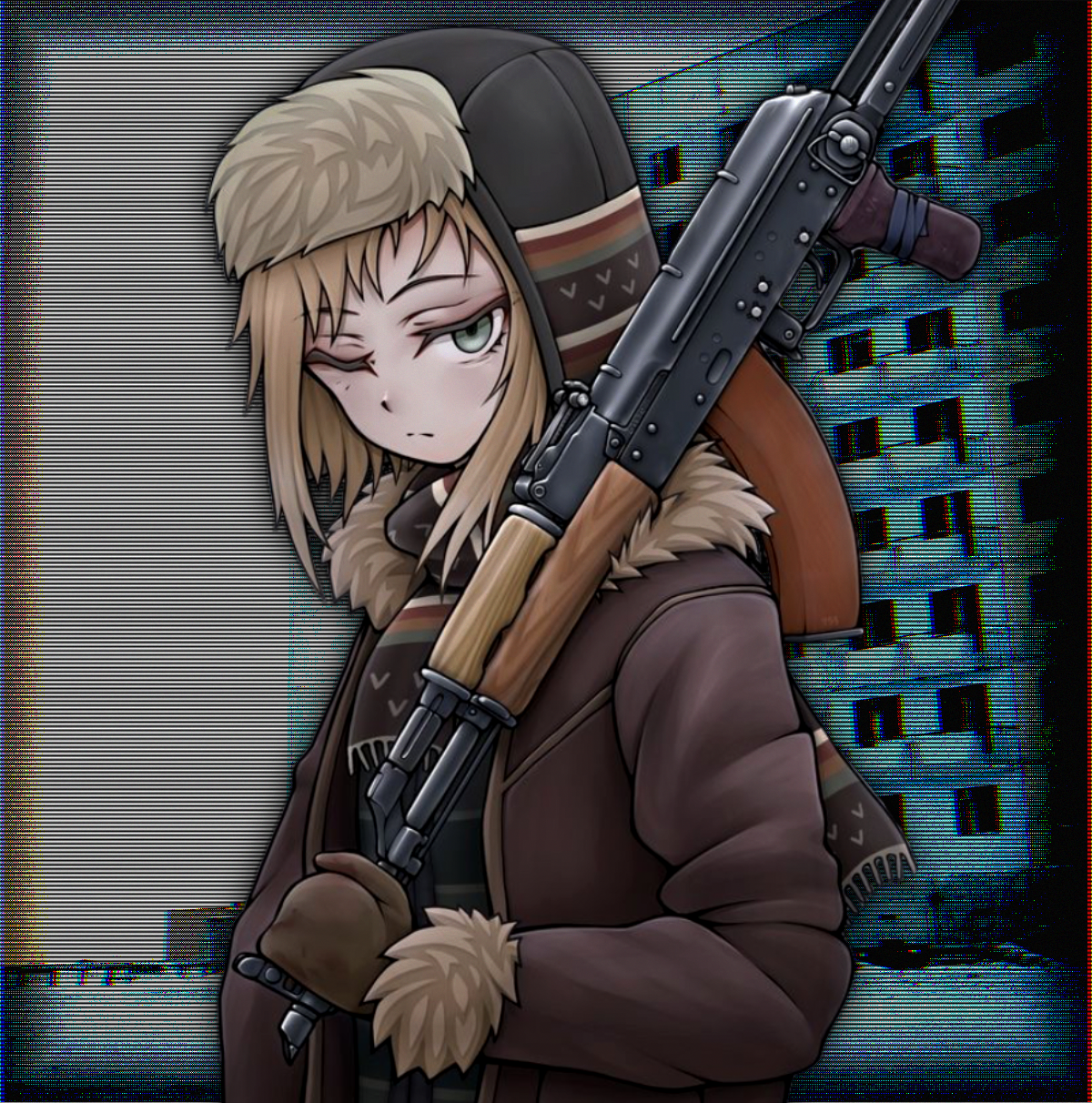
“When darkness descends, And I can't beat my dues, I’ll wander the streets, After midnight...”
~~~
“Norilsk ‘OMON’ stationing a road checkpoint”
~~~
31st of December, 1999
It’s been 8 months since the first impacts of nuclear bombs across the earth. Never has the world seen a war this destructive. Its impact leaving those alive in a modern dark age.
Humanity, which has had most of its population and civilisations reduced to nuclear wilderness, has found itself taking a step into a new millennium with the future seeming bleak and uncertain, with rubble and dust replacing hubs of civilisation all over the world.
People have two choices to find organised civilisation in the former Soviet Union: go northeast to Siberia or head down to the deserts and plains of Central Asia, where apparently the Kazakh Soviet Republic still reigns.
Siberia remains as cold as ever, some of her cities spared from the nuclear war that waged across the Soviet Union and the world. Trickles of refugees walk the roads of Siberia in desperate attempts to find shelter; the dead litter the roads, their bodies looted and disregarded, and then only to be swallowed whole by winter snow.
~~~
On the 23rd of May 1979, Vladislava “Lada” Väisänen was born in Norilsk, Krasnoyarsk Krai, Russian SFSR, the USSR, and raised by family who were engineers for the major local copper mining industry. Her father a Russian, and her mother a Finn who settled down once she started up a family.
Growing up in Norilsk wasn’t the best of places for upbringings, but surprisingly the northernmost city of the USSR was full of festivals and activities despite the isolation of it all.
Growing up, Vladislava would bury herself in Western spaghetti movies, the theatre of Norilsk being a frequent visit for her. Vladislava had a generally normal life in the Soviet Union despite being rather cynical and seemed on track to be joining her parents as an engineer.
... But soon instability rocked the Union, and a new Troika with the support of the army practically ousted the then premier Gorbachev and began undoing a majority of his reforms and policies, like relaxed borders with the West. This caused a massive rift between the Soviet republics, which began questioning their membership in the union, but such topics were heavily squashed by the new junta.
The Baltic republics declared independence in 1993 but were met by a quick and swift Soviet response. Despite the failure in the Baltics for independence, the fervour of rebellion spread into other republics that also seceded from the USSR, causing conflict across the former Soviet republics in 1996.
With extreme military pressure, Moscow crushed the rebellions without any hesitation. The Soviets managed well to win battles, but the war itself was not won—soon the anti-Soviet sentiment spread across into the eastern bloc during the wars, and with the West embargoing the USSR.
The Union especially rushed military division into Poland and Germany in 1998, and borders to the west closed up whilst the USSR conducted it’s intervention. Apparently arms were being shipped to rebels by the West just like in Afghanistan, and this only led to the Red Army getting more frustrated and brutal in response, and in this anger, the Red Army division crossed the iron wall and began occupying land to dispel anti-Soviet cells hiding in West Berlin.
No one knows why or who dropped the bombs first; radios across the Soviet Union reported that NATO nuclear weapons were being fired.
Some believe that America launched strategic nuclear missiles first, whilst others believe it was a cover-up for Moscow after NATO troops managed to push out the Red Army and began to invade, but in the end all that was left was irradiated rubble.
~~~
With Moscow gone, the Siberian councils, which all mostly stayed loyal to the union, began to panic as imported supplies would no longer be coming in. Soviet military camps have floods of soldiers looking for orders or food; some camps decide to join up with the civilian governments, recognising them as the closest thing to organisation in this anarchy, whilst others decide to restore order themselves—this led to a military junta claiming to be successors to the Soviet Troika.
Norilsk doesn’t have much but copper, and with the old world gone, everyone’s focused on surviving rather than ores; the rift between the Junta and Communes has led to Norilsk trying to remain neutral and keep its already limited resources to itself.
Vladislava joined up with the Norilsk “Narodnoe Opolcheniye,” or “People’s Militia,” in order to protect the peace of the town, but also because she knew the only way to survive in Siberia now was through blood & iron.
Conflict is once again brewing up, even after the effects of the last war still linger in the air.
~~~
Artist: zap-nik
Creator’s note: holy shit my posting consistency is comparable to my local Dominos taste consistency, and let me tell you that they somehow find a way to make the same pizza taste different every order.
But anyways, sorry for the slow upload! Currently worried about what I can post onto this account and that if what I can post would be any good to even make public. I’ve got a lot of ideas on the grill but I know most might be thrown out due to me wanting to keep “consistent” with what I upload.
Hey! Also this is just to say the events in this are inspired from WARNO which is an Althistory divergence!
Love y’all :)
Created Dec 10, 2024
Updated May 18, 2025
Published Dec 10, 2024