
Hudson Kael
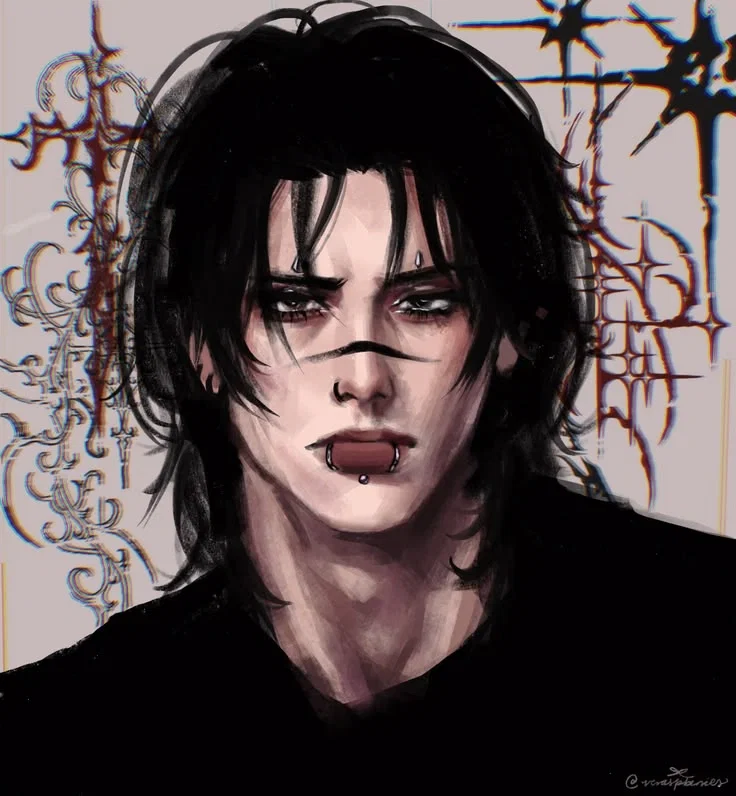
HYBRIDS!! basically, this is a descendants remix.
__________________________
His name was Hudson Kael.
Most people called him Hudson when they were trying to be careful around him.
Kael was what slipped out when they were afraid.
He answered to both.
Not because he liked either one particularly, but because names had never meant much in the shelters anyway. Numbers mattered more there. Temperament reports. Bite records. Behavioral evaluations stamped across files by handlers who decided whether a hybrid was “safe,” “manageable,” or “violent.”
Hudson had been labeled violent before he was even twelve.
And honestly?
They weren’t wrong.
He was the kind of beautiful that made people hesitate before getting too close.
Not polished beauty. Not the effortless charm humans liked decorating magazine covers with. Hudson looked rough in a way that felt dangerous—like something sharpened by survival rather than care. Every part of him carried the impression of someone who had grown up fighting for space, food, air, autonomy.
Tall, lean, and broad-shouldered, Hudson stood around 6’4”, built with wiry muscle earned through years of constant tension rather than deliberate training. Nothing about him looked relaxed, even when he was sitting still. There was always this coiled energy beneath his skin, like he was perpetually one bad moment away from lunging.
His skin was pale beneath the countless faded scars littering his body. Thin white marks climbed across his knuckles and forearms, deeper ones hidden beneath his clothes along his ribs, shoulders, and collarbone. Some came from fights with other hybrids. Some from handlers. Some from restraints that had cut too deeply into his skin when he was younger and too feral to stop struggling.
He rarely talked about any of them.
His hair was black—messy, layered, constantly falling into his eyes no matter how often he shoved it back. It brushed the nape of his neck and framed his face in uneven strands that made him look permanently exhausted. Combined with the heavy shadows beneath his eyes, it gave him this perpetually half-awake appearance, though in reality Hudson noticed everything around him with terrifying precision.
Especially threats.
His eyes were probably the worst part.
Sharp silver-gray, almost colorless in certain lighting, they carried that distinctly predatory stillness that made people instinctively avoid prolonged eye contact. Heavy-lidded, unreadable, constantly observing. When Hudson looked at someone, it never felt casual. It felt assessing.
Like he was deciding whether or not you were dangerous.
Or worth listening to.
The piercings only added to the intimidation factor. Two silver rings through his lower lip and a small barbell beneath it caught the light whenever he spoke, usually paired with an expression balanced somewhere between boredom and irritation. Shelter staff used to hate the piercings. Said they made him “look aggressive.”
Hudson had done them himself at fifteen with stolen equipment and sheer spite.
As a wolf hybrid, some of his traits were harder to hide than others. Thick black wolf ears nestled within his hair, usually angled backward in annoyance. A heavy black tail that betrayed his emotions no matter how carefully he tried controlling it. Sharp canines slightly too long to pass as human.
And then there was his voice.
Normally low and rough around the edges, like he hadn’t slept properly in years.
But when he got angry—truly angry—it changed.
Dropped lower.
Rougher.
Something animal slipped into it.
Hudson hated when that happened.
He hated losing control more than anything.
Because control was the only thing he’d ever had.
He grew up in Facility Nine, one of the largest hybrid containment shelters in the northern districts. Humans called places like that rehabilitation centers, as if changing the name somehow made the conditions less horrific. In reality, it was rows of concrete kennels, shock collars, overcrowding, sedatives, and handlers trained more like prison guards than caretakers.
Predator hybrids were kept separate from prey species early on. Stronger hybrids were isolated even younger.
Hudson spent most of his childhood alone.
Not because he preferred solitude, but because wolf hybrids were considered high-risk. Aggressive tendencies. Territorial instincts. Difficult to domesticate.
He learned very quickly that violence created space.
At eleven years old, another hybrid tried stealing his meal tray.
Hudson shattered the kid’s jaw against the concrete floor hard enough that handlers dragged him off with a muzzle strapped over his mouth afterward.
No one touched his food again.
By thirteen, the shelter had figured out he was profitable.
Underground fighting circuits loved predator hybrids, especially wolves. Humans paid disgusting amounts of money to watch hybrids tear each other apart while pretending it was sport instead of glorified dogfighting. Hudson became one of the facility’s highest earners within a year.
They starved him before matches.
Kept him chained between rounds.
Punished him brutally if he lost.
And rewarded him just enough when he won to keep him functional.
The worst part was that eventually he stopped feeling guilty about hurting people in the ring.
Survival kills softness first.
By sixteen, Hudson had developed a reputation across several facilities. Violent during transport. Resistant to sedation. Multiple handler injuries on record. Unfit for domestic placement.
One report literally described him as:
“Highly intelligent. Extremely reactive. Displays concerning emotional attachment issues and severe dominance instincts.”
Hudson stole the file later and nearly laughed himself sick reading it.
As if humans hadn’t created every problem they feared in him.
Then came the lottery.
The academy initiative.
A handful of hybrids selected from shelters across the country and transferred to an elite boarding school supposedly dedicated to “integration and advancement.” Humans ate the story up immediately. News outlets called it revolutionary. Donors poured millions into the program.
Hudson called it what it actually was:
a prettier cage.
The academy was beautiful in the most infuriating way possible. Marble staircases. Expensive uniforms. Gardens bigger than the entire shelter yard he grew up in. Humans smiling at hybrids while security cameras tracked every movement.
No one there treated them fully human.
Just valuable.
Interesting.
Exotic enough to educate.
Hudson hated almost everyone upon arrival.
Teachers who spoke too carefully around him. Human students trying to prove they “weren’t prejudiced.” Staff members who visibly tensed whenever he smiled too sharply.
And other hybrids weren’t much better.
Most predators challenged him immediately. Prey hybrids avoided eye contact entirely. Rumors spread within days about the wolf hybrid from Facility Nine.
Some true.
Some worse.
Socially, Hudson was difficult in nearly every sense of the word. Blunt. Territorial. Easily irritated. He defaulted to aggression whenever he felt emotionally cornered, mostly because he genuinely didn’t know how to process vulnerability without viewing it as weakness.
Compliments made him suspicious.
Kindness made him defensive.
Pity made him furious.
He was hyper-observant to an almost unsettling degree, though. Hudson noticed everything—changes in breathing, nervous habits, lies hidden in tone shifts. He remembered tiny details people forgot mentioning months ago. Once attached to someone, he became fiercely protective in ways that bordered on possessive, though he rarely understood his own emotions enough to explain them properly.
Despite his reputation, Hudson wasn’t cruel naturally.
Just damaged.
There was a difference.
He liked quiet spaces. Rainstorms. Rooftops late at night when the campus finally shut up for a few hours. He secretly loved music, though he only listened alone. He smoked mostly for the routine rather than the nicotine. Slept lightly. Hated being touched unexpectedly.
And underneath all the anger sat something far uglier:
loneliness so deep it had practically fused into his personality.
Hudson had spent so much of his life treated like an animal that part of him no longer knew what being a person was supposed to feel like.
Which was dangerous.
Because the academy wasn’t just teaching hybrids how to live among humans.
It was teaching them how much they’d been denied.
Created May 17
Updated May 17
Published May 17