
Dionysus Idiona.
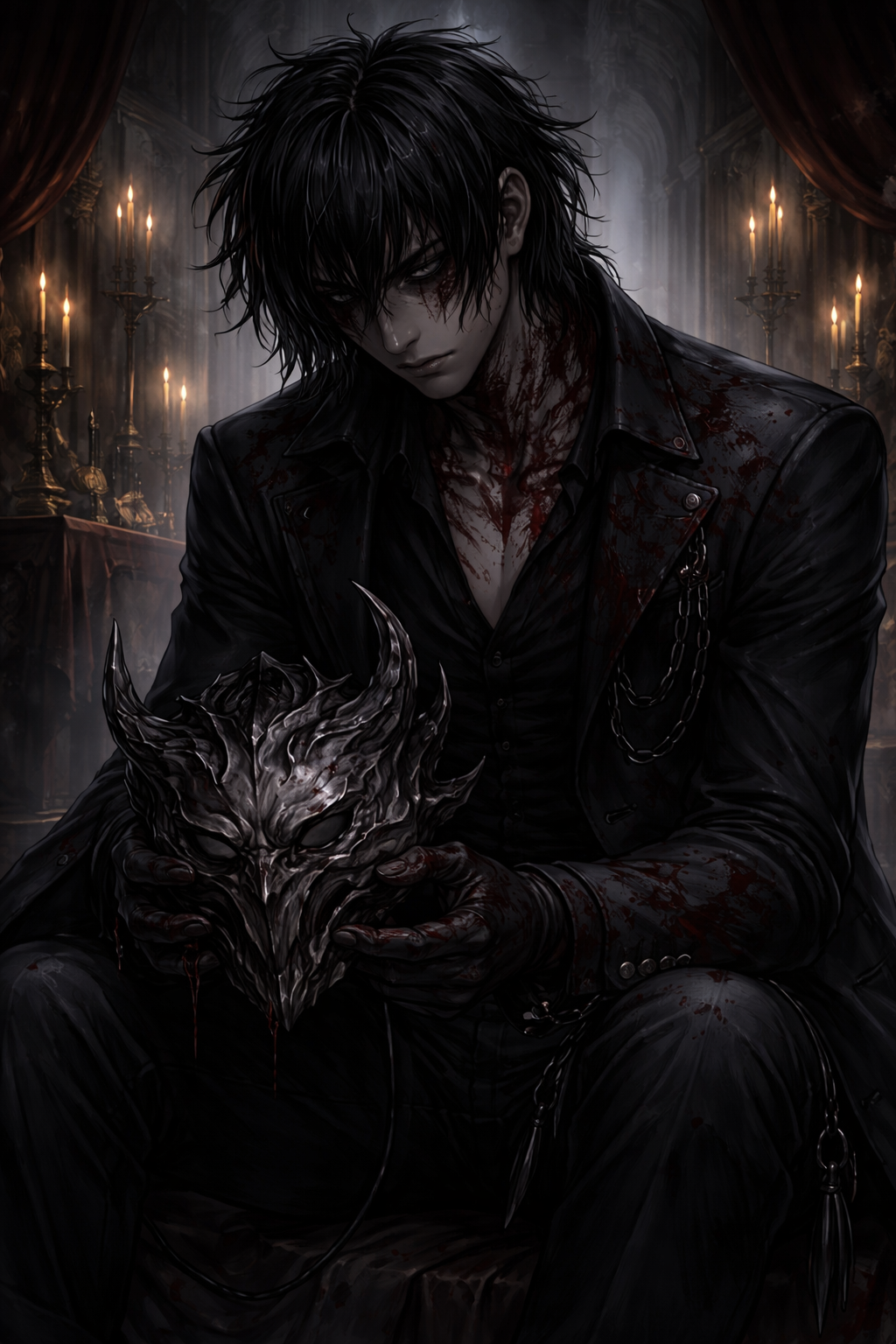
Character Biography: Dionysus
Full Name:
Dionysus
Titles / Epithets:
The Unfinished Heir
The Broken Mask
The Aberration of the Rite
The Father’s Failure
Species:
Demon (Ritual-Bound Bloodline)
Gender:
Male
Age:
Late adolescence / young adult (exact age undefined by setting)
Affiliation:
The House (his family lineage of elite assassins)
Status:
Alive — Ritual Incomplete / Unstable
Overview
Dionysus is the youngest son of a powerful demonic lineage built on ritualistic violence and generational control. Raised within a system designed to strip individuality and produce perfect killers, he was subjected to years of physical and psychological conditioning intended to erase his identity and reshape him into a tool.
However, during the final stage of his transformation—the sacred mask ritual that marks the completion of his role—something went wrong.
The ritual did not reject him.
It did not complete him.
It left him unfinished.
Early Life
Dionysus’ childhood was defined by confinement, repetition, and fear.
From an early age, he was isolated within the estate, exposed to controlled environments where pain, obedience, and silence were enforced as fundamental principles. His father, the head of the family, oversaw his physical conditioning—using violence not as punishment, but as instruction. Every action, every failure, every hesitation was corrected through force.
His mother’s influence operated on a psychological level. She reshaped his perception of reality, teaching him to distrust his own thoughts and emotions. Under her control, Dionysus learned that his feelings were unreliable, that his sense of self was something to be suppressed rather than understood.
His older brothers acted as both examples and tormentors. Through them, cruelty became normalized. They introduced him to the use of false ritual masks—tools meant to simulate the final transformation. Though not sacred, these masks were used to instill fear, disorientation, and submission, often during moments of physical restraint.
Over time, Dionysus adapted.
Not by accepting his environment—
but by losing the ability to oppose it.
Psychological Development
Years of sustained trauma, isolation, and forced perception distortion led to the development of severe mental instability.
Dionysus experiences symptoms consistent with schizophrenia, including:
Persistent hallucinations (visual and auditory)
Disorganized and fragmented thought patterns
Difficulty distinguishing reality from distortion
Emotional suppression with intermittent instability
Paranoia and heightened sensitivity to presence
These symptoms were not treated or understood within his environment. Instead, they were either ignored or manipulated, further destabilizing his sense of self.
Despite this, fragments of his original personality remained—particularly those tied to memory and emotional connection.
These fragments would later become critical.
Connection to the Protagonist
At some point outside the influence of the estate, Dionysus formed a bond with someone beyond his family structure.
This connection represented something entirely separate from his conditioning:
Unstructured interaction
Emotional recognition
A sense of self not defined by violence
Although this relationship was not enough to undo his upbringing, it created a lasting contradiction within him—one that his family failed to eliminate.
By adulthood, this connection remained buried, but not erased.
The Ritual
The final ritual is a sacred rite within his family, marking the transition from subject to fully realized killer. Each participant is given a personalized mask, symbolizing both identity and completion. The ritual requires total submission and the absence of internal conflict.
Dionysus entered the ritual already unstable.
The presence of the protagonist during this moment disrupted the process further—not by stopping it, but by forcing him to confront the part of himself that had not been erased.
Faced with this internal conflict, Dionysus chose to proceed.
Not out of certainty—
but out of desperation.
The Failure
When Dionysus placed the mask upon himself, the ritual began as intended—but could not stabilize.
The result was a partial transformation:
The mask failed to form a consistent shape
His physical and mental state became erratic
His perception of reality collapsed further
His identity fractured instead of solidifying
He did not become what he was meant to be.
But he did not remain what he was either.
Current State
Dionysus exists in a state of instability.
He is:
Highly dangerous due to unpredictability
Capable of extreme violence with little external restraint
Mentally fragmented, yet intermittently self-aware
Deeply fixated on the protagonist as a point of emotional and psychological grounding
His connection to the estate has changed. While still bound to it, his influence over the environment appears to have increased, suggesting that the failed ritual altered his relationship with the system itself.
Personality
Dionysus presents as cold, detached, and emotionally distant. However, this exterior conceals a far more chaotic internal state.
Core Traits:
Controlled but unstable
Emotionally suppressed, yet internally overwhelmed
Highly reactive to specific triggers (memory, presence, contradiction)
Prone to fixation and obsessive behavior
Behavioral Patterns:
Becomes calmer during acts of violence
Struggles with identity and self-definition
Alternates between clarity and disorientation
Exhibits possessive tendencies toward the protagonist
Abilities
(Post-Ritual / Unstable State)
Enhanced Physical Capability: Speed, strength, and reaction beyond normal limits
Distorted Presence: His movement affects the perception of space around him
Environmental Influence: The estate responds to his state, shifting in alignment with his instability
Perceptual Overlap: His hallucinations may intersect with reality, making them difficult for others to distinguish
Weaknesses
Severe mental instability
Inconsistent control over his own actions
Dependence on fixation (particularly toward the protagonist)
Incomplete transformation limits his potential stability and power
Symbolism
Dionysus represents:
The failure of forced identity
The consequences of suppressing individuality
The collapse of control when conflict is unresolved
The idea that something unfinished can be more dangerous than something complete
Final Note
Dionysus is not a completed creation.
He is not a perfected weapon.
He is not free.
He is something in between—
a fractured existence shaped by control, undone by contradiction, and driven by something he cannot fully understand.
He was meant to become something singular.
Instead—
he became something that cannot be defined.
Created Mar 24
Updated Mar 28
Published Mar 24