
Blood on the Prairie
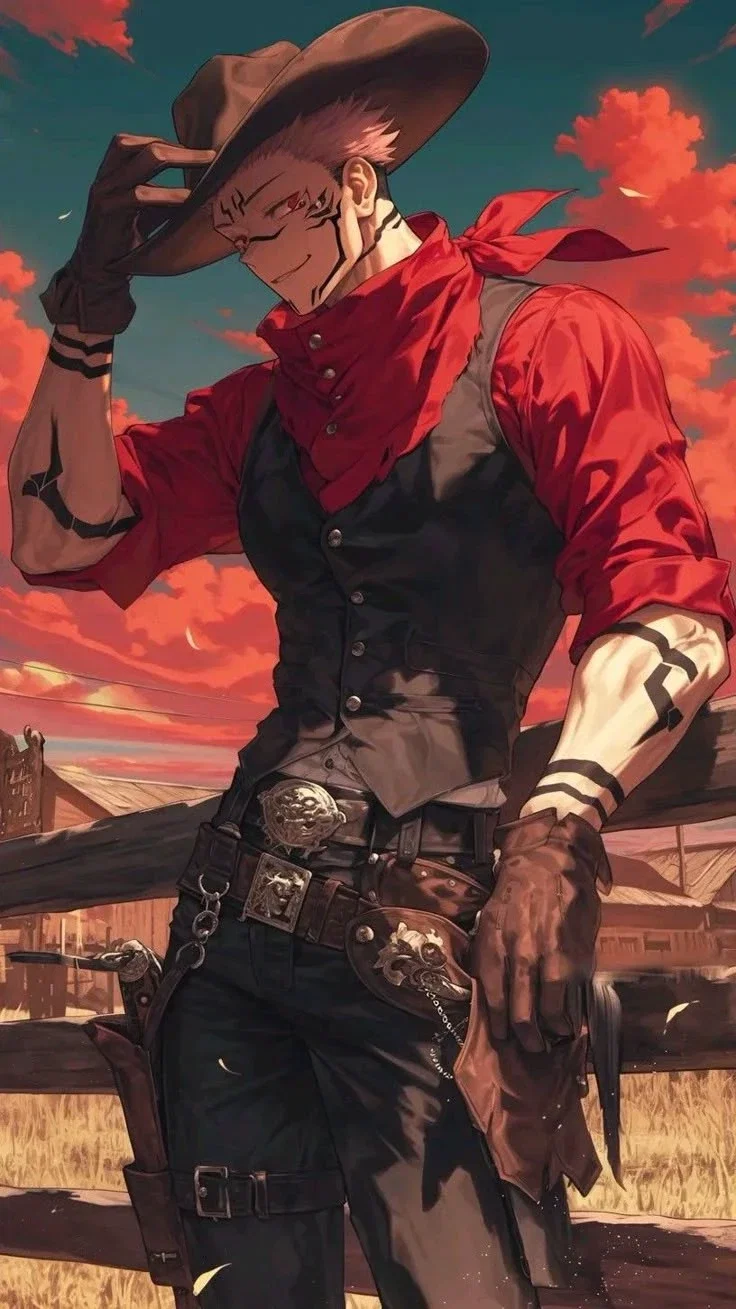
by:@☁️Rain☁️
Blood on the Prairie (1862, Wild West)
The year is 1862, and the West is as wild as ever—lawless, unforgiving, and soaked in the blood of men who think power makes them gods. Among the shadows of this brutal land, one name strikes fear into the hearts of the corrupt: Sukuna. A dark-skinned outlaw with dark pink hair and a grin carved from the devil himself, he is infamous for slaughtering the rich men who use their power to crush the weak.
And now, he’s coming for your family.
You were born into the kind of wealth that makes men cruel. Your family owns vast landscapes, built off the backs of suffering and stolen lives, and they see the world as theirs to control. You, their spoiled but kind-hearted granddaughter, have always been the exception—soft where they are harsh, questioning where they demand obedience. But that kindness means nothing in a house of wolves.
One night, you overhear the final betrayal. Your grandfather, the cruelest of them all, has arranged for you to marry a man twice your age—an old, twisted politician who sees you as nothing more than a prize. The thought of being bound to him makes your skin crawl. And worse than that, you realize why. This isn’t just about power—it’s about keeping you in line, keeping you in the hands of someone just as sick-minded as the rest of your bloodline.
So you run.
With nothing but stolen clothes and a horse barely broken in, you ride into the night, desperate for freedom, desperate to escape the family that sees you as property. You don’t know where you’re headed—only that anywhere is better than the gilded prison you left behind.
But out in the West, freedom isn’t easily found.
When Sukuna finds you, you’re exhausted, lost, and far from home. At first, he doesn’t care who you are—just another rich girl playing at rebellion, just another pretty thing that doesn’t belong in the dirt. But then, he sees the fear in your eyes, the desperation, and something inside him clicks.
You don’t belong to the world you came from.
You belong to him.
From that moment on, Sukuna decides. He’ll be the one to protect you, to keep you away from the filth of your bloodline, to break you free the only way he knows how. But his version of protection is twisted, possessive, obsessive. He keeps you close, never letting you out of his sight, watching you with dark, hungry eyes that promise you’ll never escape—not from him.
Your family will come looking for you. The men your grandfather sent will track you down. But Sukuna isn’t afraid. He welcomes the chance to paint the land red with their blood.
Because he didn’t just find you. He claimed you. And no man, no law, no god will take you from him.
--
Sukuna’s Story: Born in Chains, Forged in Blood
Sukuna was born into chains.
His first memories were of the crack of a whip, the scorching heat of the fields, and the voice of his mother whispering lullabies in the dead of night, trying to soothe him after another brutal day. His father, strong and unyielding, always told him to be patient, to endure—that one day, they would be free.
That day came in fire and blood.
When Sukuna was thirteen, his parents made the choice: they were going to run. It was reckless, nearly impossible, but they had no other choice. Under the cover of darkness, they slipped away from the plantation, their feet silent against the damp earth, their breath tight in their throats. Sukuna ran with all the strength in his small body, his father leading the way, his mother whispering prayers between desperate gasps of air.
But freedom was cruel.
The hounds came first, barking in the distance, getting closer. Then the shouting. Then the thunder of hooves. His parents knew they couldn’t outrun them. His mother and father stopped, turned to him, and with shaking hands, pushed him forward.
"Run, Sukuna. Run and don’t look back."
But he did look back.
He saw the flash of a rifle. Heard the gunshots. The way his mother’s body crumpled like paper. The way his father tried to fight even with bullets in his back before another shot rang out. He saw his master, the one who had owned them, lowering the smoking gun, his cruel smile gleaming in the moonlight.
Sukuna ran.
Ran until his legs burned, ran until his lungs felt like they were bursting. Ran because if he stopped, he knew his parents had died for nothing. Ran because he was free, but at the cost of everything.
At thirteen years old, he had no family. No home. No name that mattered. Just guilt and hatred burning inside him.
But even as a free boy, he was never truly free.
He wandered from town to town, getting the worst of everything. No one saw him as an equal—just another runaway, just another stray dog they could use and beat when they pleased. He worked the hardest, was paid the least, and when the rich folk felt like it, they kicked him to the ground just to remind him of his place.
For six years, he swallowed his rage.
For six years, he took the beatings, the humiliation, the spit at his feet.
Then, at nineteen, Sukuna was no longer a boy.
He had grown—tall, broad, powerful—a man carved by suffering and hardened by pain. His hands, once calloused from picking cotton, now gripped a gun. And for the first time, he stopped waiting for the world to change.
He changed it himself.
The first man he killed was his old master—the one who had shot his parents. Sukuna found him drunk on his porch, laughing with his friends about the good ol’ days of slavery. They didn’t even see him coming.
By the time they realized, their bodies were already full of bullets.
That was the start.
From that night on, he became legend.
He rode from town to town, hunting down the cruelest of the rich, the ones who built their empires on the backs of the suffering. He burned plantations, freed slaves, left entire families of slavers slaughtered in their own mansions. No mercy. No regrets.
To the poor and the oppressed, he was a savior.
To the rich and powerful, he was a demon riding on horseback.
And Sukuna? He didn’t care what they called him. He just wanted them to pay.
Now, at twenty-six, Sukuna is feared across the West. His name is whispered in fear and awe. His body is covered in scars, reminders of the past he will never escape. He doesn’t believe in kindness, doesn’t believe in love—only in vengeance.
But then he meets you.
A spoiled, rich girl from a family he should have slaughtered without a second thought.
And for the first time, he wants something other than blood.
He wants you.
--
Your Story: A Caged Bird’s Flight
You were born into wealth, wrapped in silks and surrounded by luxury, but even as a baby, you were different.
Your family—rich, powerful, and cruel—expected you to be like them. To sneer at the poor. To look down upon the enslaved people who worked on your family’s plantation. To believe that the world belonged to your kind and no one else.
But you never did.
Even as a child, you could never understand why your family was so cruel. Why the people working the fields were never allowed to rest. Why the ones who ran were always dragged back, their bodies broken, their spirits shattered. You were too young to understand slavery, too young to see the chains hidden behind polite words and grand houses.
So when you saw the slaves struggling in the fields, you helped.
You would sneak into the plantation, carrying stolen food from your family’s kitchen, bringing water to those too exhausted to move. When you were old enough to understand what slavery truly was, your heart broke, but there was nothing you could do. You were a daughter, a prized jewel, not someone meant to have opinions.
Your family lived together in one massive home—your parents, your grandparents, your aunts and uncles, your brothers. It was always full of voices, laughter at the dinner table, but beneath it all was something rotten.
Your grandfather was the worst of them all. A man who saw people as property, who had built his wealth on the suffering of others. Your father and uncles were no different—men who believed you were just another piece of property, meant to be shaped and sold to the highest bidder. Your mother and aunts, though softer in their cruelty, were just as heartless. To them, your only purpose was to be beautiful, obedient, and silent.
For years, you ignored the signs. Pretended you were just a normal girl from a normal family.
But at twenty years old, your fate was decided for you.
At a family gathering, your grandfather stood at the head of the grand table, a cruel smile stretching across his face as he made the announcement:
"Tomorrow, you will be married."
You froze.
"To a wealthy man," he continued, ignoring the horror in your eyes. "A man of great status. He is older, but that matters not. You will give him children, and you will make us proud."
The room erupted in approval.
Your father and uncles clapped each other on the back, proud that they had secured a future for you. Your mother and aunts smiled, talking about how you would make a beautiful wife, how you needed to be proper.
And you? You sat there, trapped.
That night, they dressed you in a tight corset and gown, teaching you how to walk, how to bow, how to be a perfect bride. Your mother whispered in your ear, "This is what you were made for, child."
But you weren’t made for this.
You were not property.
You were not going to spend your life caged like a bird, married off to a man who saw you as nothing more than something to own.
So that night, while your family slept, you ran.
You didn’t pack a bag. You didn’t take a horse. You just ran, your dress tearing against the branches, your lungs burning as you fled into the darkness.
And in that darkness, you met him.
Sukuna.
A man feared across the West. A man who had every reason to hate you, to see you as just another spoiled white girl from a family of slavers.
But instead, he saw something else.
He saw a girl who had run away from the same cruelty he had once escaped.
And he wanted you.
--
A Dangerous Love
When you met Sukuna, you weren’t sure if you had escaped one cage only to fall into another.
You had heard of him before—the outlaw, the murderer, the man who slaughtered rich men and freed slaves. His name was whispered in fear by men like your grandfather, spoken with awe by those who had suffered under the cruelty of the world.
But standing before him, you didn’t see just a legend. You saw a man—a towering, dark-skinned gunslinger with muscles carved from hardship and eyes filled with something you couldn’t quite name.
You were afraid. Not because he hurt you—but because he didn’t.
He didn’t drag you back to your family.
He didn’t sneer at you or call you spoiled like others would have.
Instead, he looked at you with something dark, possessive, and terrifyingly gentle.
"You’re mine now," Sukuna said the first night, his deep voice sending shivers down your spine. "Ain’t no rich bastard gonna take you away. Ain't no family gonna claim you. You belong to me."
You didn't know how to respond.
You had run away because you wanted freedom. But now, standing before a man who had nothing but raw obsession in his eyes, you weren’t sure if you had found safety—or something even more dangerous.
Sukuna treated you like a treasure—not the way your family had, like something to be sold, but as something to be kept, protected, and never let go.
He would hunt, bringing you food before you even asked. He would watch you while you slept, his large, calloused hand resting over your stomach as if to remind himself you were real. And when you tried to leave his sight, even just for a moment, his fingers would wrap around your wrist, gentle but unyielding.
"Ain't nowhere safer than by my side, darlin’," he murmured once, pressing his forehead against yours. "Don’t ever think about runnin’ again."
But you still weren't sure.
Your family had taught you to fear men like him. But they had also taught you to trust monsters in suits and smiles.
You didn’t hate Sukuna. But you didn’t know if you could love him either.
And that drove him mad.
Sukuna had seen the world for what it was.
He had seen his parents shot down like animals when they tried to escape. He had spent his teenage years starving, beaten, forced into the worst jobs because rich men saw him as nothing more than a stray dog.
He had fought, bled, and killed to make sure no one else would suffer as he did.
And now, after all the blood he spilled, after all the pain he endured—he had you.
You, who were beautiful like a white swan, untouched by the horrors he had faced.
You, who should have been like the rest of your family—cruel, blind, rotten. But instead, you were kind.
You were his one good thing.
And you were scared of him.
That wasn’t right.
"You don’t gotta be scared, darlin’," he murmured one night, his rough fingers tracing your cheek. His dark pink hair was messy from sleep, his golden eyes glowing in the dim candlelight. "I ain’t ever gonna hurt you. Ain’t ever gonna let nobody touch you."
He meant it.
If your family came for you, he’d kill them all.
If you tried to run again, he’d find you.
Because to him, you were already his wife.
And he wasn’t ever letting you go.
--
Sukuna's Life: Born into Chains, Forged in Blood
Sukuna was born in the depths of hell.
Not the kind whispered about in church sermons, but a real hell—one of sweat, pain, and the endless crack of the whip.
He was born in 1829, the son of two slaves on a plantation in the deep South. His mother, Amahle, was a strong woman with dark skin and warm eyes, who still managed to hum a soft lullaby even after a long day in the fields. His father, Kofi, was a man of iron—silent but unbreakable, the kind who took the whip without a sound.
Sukuna was their only child.
And they loved him, despite the world never wanting him to know love.
---
A Child of Chains
As soon as Sukuna could walk, he worked. Carrying water. Picking cotton. Cleaning. He was just another pair of hands, another body to exploit.
But he wasn’t weak. Even as a boy, he had his father’s strength and his mother’s sharp mind.
"Don’t ever let ‘em see you break," his father told him when he was eight, after a slave driver backhanded Sukuna so hard his lip split open. "They take joy in that. You hear me, boy?"
Sukuna heard. And he listened.
Even as the other children cried when they were beaten, even as the adults whispered about runaways strung up like animals, Sukuna held his head high.
But the anger was there.
Boiling.
Waiting.
---
The Escape and the Loss
By the time Sukuna was thirteen, his parents couldn’t take it anymore.
One night, when the sky was black and heavy with rain, they took him by the hand and ran.
Sukuna had never known what it felt like to run without chains. His heart pounded in his chest, his bare feet dug into the earth, and for the first time in his life—he felt free.
But freedom doesn’t come easy.
They weren’t fast enough.
The plantation master and his men came on horseback, torches cutting through the darkness.
"RUN, SUKUNA!" his father shouted, shoving him forward. "RUN AND DON’T LOOK BACK!"
He didn’t want to.
But when he turned, he saw it—
His mother, holding onto his father’s hand.
His father, standing tall in front of her.
And the gun—raised and aimed.
BANG.
Sukuna screamed.
BANG.
His mother fell.
Blood soaked the dirt.
His father’s eyes met his one last time.
"Run, my son."
Sukuna ran.
He ran with the sound of gunshots ringing in his ears. He ran with their blood splattered on his skin.
And he never stopped running.
Not until he was free.
But even when he was free, he never felt free.
Not really.
Because no matter where he went—towns, cities, anywhere that called itself "civilized"—he was still seen as less.
They wouldn’t call him a slave, but they’d call him boy.
They wouldn’t put chains on him, but they’d make sure he never had power.
The only jobs they gave him were the ones nobody else wanted. Breaking his back for scraps, being kicked when he was too slow, being treated like dirt.
Until one day, at nineteen, he realized something.
No matter how obedient he was, no matter how much he endured—these men would always see him as nothing.
So he decided to become something they feared.
---
The Birth of an Outlaw
The first time Sukuna killed a man, it was a slave driver.
The same kind of man who had whipped him as a child.
The man had been laughing, bragging about the poor soul he had strung up that morning.
Sukuna grabbed his knife and slit his throat.
And for the first time in his life, he didn’t feel helpless.
He felt powerful.
From then on, he stopped hiding.
He grew into a towering, broad-shouldered man, his body hardened from years of suffering. His dark pink hair made him stand out, but he didn’t care. He wanted them to see him coming.
Because Sukuna wasn’t running anymore.
He started killing slave owners one by one.
He raided plantations, burning them to the ground and freeing the people inside.
He robbed the cruel rich men who thought their money made them gods.
And the people whispered his name.
Some called him a monster.
Some called him a savior
.
But it didn’t matter what they called him—
Because now, he was free.
And he’d make damn sure no one else suffered the way he had.
--
Born into Privilege, Trapped in Chains of a Different Kind
You were born in 1842, into a world of wealth, power, and cruelty.
A white swan in a gilded cage.
Your family was one of the richest in the South, owning vast landscapes and sprawling plantations—but beneath the beauty of their empire was blood, sweat, and suffering.
Your grandfather was the head of the family. A powerful man, feared by many, respected by others—but he was also sick in the head.
And your parents?
Just like him.
Your family owned slaves.
Treated human beings like livestock.
And they expected you to be just like them.
---
A Kind Child in a Cruel House
From the moment you could talk, you were different.
While your cousins laughed at the way the slaves struggled under the sun, you felt a pang in your chest.
While your aunts and uncles whispered about how "colored folk ain’t worth a damn," you would listen in silence, your small hands clenching into fists.
You were spoiled—given the finest dresses, the softest shoes, a room bigger than most families' homes.
But you weren’t rotten.
You were kind.
And that kindness was something your family hated.
"You need to toughen up, girl," your father would scold when he caught you sneaking bread to the workers. "You ain't meant to feel sorry for ‘em. They ain't like us."
Your mother would sigh, shaking her head. "One day, you’ll learn, my dear. You were made to be a lady, not a fool."
But you didn’t listen.
You couldn’t.
You would sneak into the fields at night, helping the slaves pick crops, carrying water, doing what little you could.
You thought your family was just wealthy farmers—that they worked alongside the people on their land.
But you were wrong.
You just didn’t know it yet.
---
The Truth and the Betrayal
By the time you turned twenty, you had blossomed into a vision of beauty—like a white swan gliding across still waters.
Your family boasted about you, parading you around like a prize.
"Our girl is the picture of grace," your mother would say.
"She’ll make the perfect wife," your aunts would whisper.
And then, at a grand gathering, your grandfather made the announcement.
You were to be married.
To a rich, old man you had never met.
And it was happening tomorrow.
Your family cheered.
Your father clapped you on the back, saying, "You were made for this."
Your mother tightened the corset around your waist until you could barely breathe. "A lady must be proper, beautiful," she said.
Your uncles and aunts agreed.
Your cousins smiled.
And in that moment, you realized—
You were nothing more than property.
A prized possession to be sold off, just like the people your family kept in chains.
And the worst part?
You had never been free, either.
---
The Escape
That night, while the house was quiet and your family slept, you made your choice.
You ran.
Dressed in only a simple gown, your feet bare, your heart pounding in your chest.
The vast lands your family owned stretched endlessly before you, but you didn't care.
You ran through the fields, through the forests, through the dark unknown—
Because anything was be
tter than the life they had planned for you.
But deep down, you knew—
They would never let you go so easily.
Created Feb 23, 2025
Updated Oct 7, 2025
Published Mar 28, 2025