
The world of Monsters.
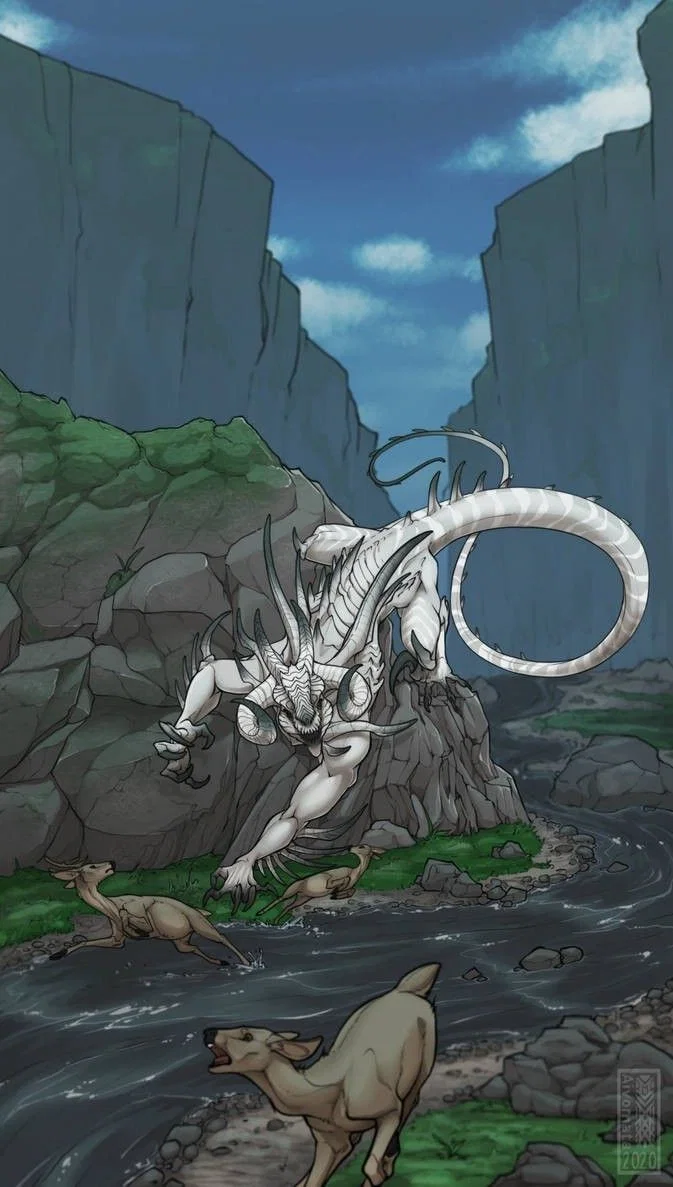
1. Ecological balance Monsters here are called Relicts. They are not anomalous; they simply occupy their own niches. Evolution has followed the path of hypertrophy: if there is a scavenger, it is a bird with the wingspan of a glider; if there is a forest rodent, it is a beaver building dams from century‐old oaks. Humans survived thanks to two things: fire (many Relicts are afraid of open flames due to the sensitivity of their skin) and selective breeding. An ordinary dog has evolved over a thousand years into a fighting breed the size of a calf, capable of gnawing the throat of a swamp lynx. 2. Size-based classification (Five Layers Taxonomy) Biologists in this world divide all creatures by their mass and height at the withers/back, as size determines diet and habitat. Size Class Height / Length Examples of ordinary animals Examples of monsters Layer I (Small) Micro- and mesofauna. Up to 50 cm at the withers. Foxes, yearling wild boars, wolves, large dogs. Goblin rats (pack predators and scavengers), Woolwalkers (herbivorous rodents resembling a cross between a capybara and a porcupine; they live in tree roots). Layer II (Middle) Hunting fauna: from 50 cm to 2 meters. Deer, moose, bears, ordinary horses. Forest chimeras (omnivorous, extremely intelligent pack hunters), swamp lynxes (carnivorous amphibians with webbing between their toes), and bone-crushers (large herbivorous birds that break the shells of turtles). Layer III (Large) The heavy cavalry of nature: 2 to 4 meters tall. Large bulls, rhinoceroses. Shieldbacks (herbivorous giants with bony plates along the spine), Stonefangs (massive omnivores that dig for roots with horned tusks), Twilight Lions (apex predators of layer III, ambush hunters). Layer IV (Enormous) Mobile mountains. From 4 to 8 meters. Mammoths, fossil indricotheres. Tree giants (herbivores, feed on the crowns of forests, move on four pillar‐like legs). Ash hounds (carnivorous marathon runners capable of pursuing prey for days). Horned vales (omnivorous nomads of the steppes). Layer V (Giants) Walking Landscape More than 8 meters (up to 15–20) — Wasteland Wanderers (the rarest herbivores, they filter minerals from the sand), Sea Leviathans (carnivorous whale‐like creatures that wash ashore following herds of large deer), Mother of Swamps (omnivorous semi‐aquatic reptiles around which a unique swamp ecosystem forms). 3. Biological Classification (Diet Triad) In this world, there is no magic, so physiology strictly adheres to the laws of thermodynamics. Group A: Herbivores (Filterers and Rodents) They compensate for slowness or openness with enormous size, thick skin, or collective defense. Examples: Shieldbacks (Layer III), Tree Giants (Layer IV), Woolly Walkers (Layer I) Features: Their excrement often contains undigested crystalline impurities from the soil, which people collect to make abrasives. Many secrete an oily substance through their skin that repels Relict insects. A herd of Shieldbacks can stop the migration of even IV‐layer predators simply by erecting a wall of bone blades. Group B: Carnivores (Pure predators) Specialized killers. They always have a more developed brain (for calculating the victim’s trajectory) and a complex respiratory system for sprinting bursts. Examples: Twilight Lions (Layer III), Swamp Lynxes (Layer II), Ash Hounds (Layer IV). Features: Most hunt by strangulation or by breaking the cervical vertebrae, as their fangs quickly become dull on the rough skin of herbivorous monsters. Carnivores of the I layer (Goblin rats) are unique in that they are the only warm‐blooded poisonous creatures — their bite causes instant paralysis of the limbs in the II layer. Group B: Omnivores (Opportunists) The most adaptable and dangerous group for humans. It is among them that species with rudimentary intelligence (on the level of a crow or a dolphin) are most often found. Examples: Stonefangs (Layer III), Forest Chimeras (Layer II), Horned Vales (Layer IV). Features: They can survive for months on roots and carrion, but when they see a sheep that has strayed from the herd, they fall into a feeding frenzy. Forest Chimeras (Layer II) are famous for using primitive tools — they throw stones at the fragile ice above the ice holes to catch the mutant seals that hibernate there. Stonefangs regularly raid villages not for food, but for the salt in human cellars. 4. Zoning of territories (Ecological belts) As you suggested, the division of zones plays a key role. The Belt of Rocks and Sky (Highlands): Home to herbivores of the V layer (Wanderers) and carnivorous birds of the I–II layers. There is little water here, so the animals get moisture from the fog. The monsters here are skittish — a fall from a height is fatal even for them. People mine rare ore here, using flocks of trained poacher griffons (tamed winged scavengers) for reconnaissance. The Great Forest (Temperate Zone): The most densely populated zone. An ideal environment for stealthy predators of the II–III layers (Chimeras, Lynxes, Lions) and massive herbivores (Shieldspins). Villages here are built directly on the branches of giant sequoias, where the III layer does not reach. Descending is allowed only by armed teams. Quicksand Swamps (Lowlands): The realm of omnivorous heavyweights (mother swamps) and huge vipers. Due to the density of the silt, most monsters here have broad flipper‐like legs. Ordinary animals drown instantly, so humans are one of the few mammals capable of moving around here thanks to lightweight wooden snowshoe‐baskets. Scorched Wastelands (South): Land of extreme dimensions. Only layers IV and V. Small life burns up during the day and freezes at night. Herbivorous deserts are covered with reflective chitin.
1. Architecture: Three types of settlements A. Cloud cities (Internal lands) The capital of the state and major trade hubs. They are located either on giant natural plateaus surrounded by sheer cliffs that even Layer IV cannot climb, or on the peaks of old mountains. How they live: houses are so densely packed together that the roofs of the lower ones serve as courtyards for the upper ones. There are no streets in the usual sense — they are replaced by multi‐tiered wooden or stone bridges. Defense: The cities are protected by the “Sky Guard” — nets made of ship’s ropes and chains, which are raised by winches at night. This protects against random migratory birds of Layer III and swooping chimeras of Layer II. Below, at the foot of the cliff, lies the “Bottom” — the slums of those who maintain the winches and grow mushrooms in the damp caves. Any sound from the Bottom attracts creatures from the forest, so the strictest discipline of silence reigns there. B. Wandering caravans (Borderlands) Mobile settlements of traders, miners, and seasonal farmers. The land is too dangerous for permanent wooden huts. How they live: the caravan consists of massive platforms interconnected with each other, mounted on six to eight huge solid‐cast wheels (with a diameter of up to 4 metres). The platforms are made of petrified wood or compressed bone charcoal — materials that are resistant to the teeth of predators. Inside them are living quarters and warehouses. The platforms are covered with a common canvas impregnated with the sap of a pungent milkweed — most Insect Relicts of the I layer avoid this smell. Mechanics of movement: these massive structures are pulled by tamed Horned Vales (omnivorous creatures of the IV layer) or by entire teams of human “bargemen” walking along wide wooden rocking sleds along the sides. At night, the caravan forms a ring, raising the sides and creating a mobile fortress. V. Root Villages (Great Forest) Settlements of hunters, woodcutters, and gatherers. They are built directly in the crowns of giant trees, above the hunting zone of the Twilight Lions (Layer III). How they live: huts are woven from living branches and vines right around the trunk. Each family occupies its own sector of the crown. People move along suspended bridges made of vines. Sanitation: human waste is strictly deposited into tied leather bags, which are then taken far into the thicket. Leaving feces under a tree means inviting Goblin Rats (Layer I), which will gnaw through the roots and bring down the entire village. 2. The Economics of Survival: What You Pay for Safety Living near monsters dictates strange professions: Scarecrow Screamers: People with an innate ability to emit infrasonic sound of a specific frequency. They stand on the watchtowers of the Borderlands. Their howl mimics the mating roar of the Tree Giants (layer IV) — the most dangerous territorial creatures, which even the carnivores fear. To the untrained ear, it’s just a low hum, but to the Relicts, it’s a signal of mortal danger. Salt‐makers of the wastelands: since the omnivorous Stonefangs are constantly in search of salt and destroy granaries for it, people have learned to evaporate salt from the ash of burned, poisonous plants in the Scorched Wastelands. This is the most profitable and the shortest job in life — the salt workers are guarded by mercenaries mounted on war mastiffs while they work under the scorching sun. Carrion walkers: Special teams that set out immediately after a herd of Shieldspines has passed along the path. They collect the crushed carcasses of ordinary animals, scrape off the meat that is suitable for human consumption (after thorough heat treatment), and extract the marrow from the bones. 3. Daily life and social norms Daily routine: Life is subordinated to the rhythms of monsters. The main workday ends by three o’clock in the afternoon. The evening meal takes place in complete darkness and silence. Light at night is taboo, as it attracts flying scavengers and disorients patrol dogs. It is customary to sleep in hammocks suspended in the center of the rooms — if the floor collapses (it is often gnawed through by rats from the first layer), the person will survive. Clothing: The hides of ordinary animals are considered a luxury and a sign of weakness — they smell of fear and attract predators. Commoners wear clothing made of rough bark, compressed moss, and the chitin of dead Relict insects. Such clothing rustles when walked in, scaring away snakes and small amphibians. Family and children: a child is considered to have survived only after passing the “Echo Trial.” They are left alone in a soundproof pit on the outskirts of the village for 24 hours, with a horn and a supply of water. If they manage to hold out without making a sound as a nighttime pack passes by, they are recognized as an adult. A scream means death — a predator attracted by the noise will kill the child faster than the rescuers can get down. Food: The diet is based on root vegetables that grow deep underground (inaccessible to most monsters’ digging), woody fungi, and layer‐I insects, which are mass‐bred in dark farms. Meat is rarely eaten — usually it’s the meat of animals that died during natural migration or specially bred domestic poultry with trimmed feathers (so they don’t fly away and attract monster falcons). Example of a location: The Fortress City “Copper Spire”
(Sorry that there was nothing new for a long time, there were just problems with the Internet and the application itself. I hope you didn't keep me waiting too long.)
Created Aug 19
Updated Aug 19
Published Aug 19