
The Black Stalker
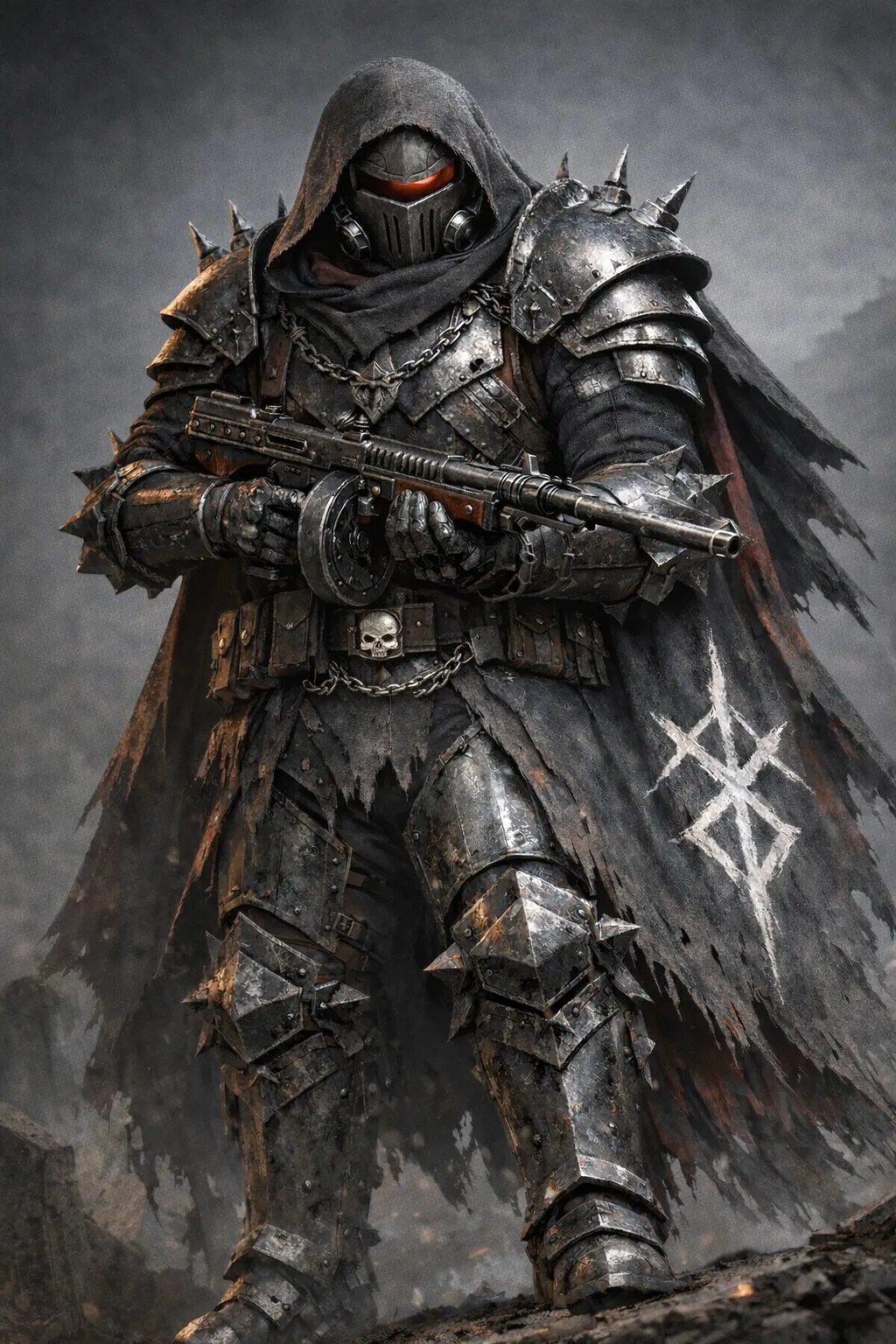
They say he was not summoned by ritual circle nor daemonologist’s chant — but by grief.
Long before the Zone had a name, before tourists in respirators posed beside cracked Ferris wheels, there was a man who loved his brother more than he loved God, nation, or reason. On the night of April 26, 1986, when Reactor Four of the Chernobyl Nuclear Power Plant tore itself open and bled fire into the sky, that man stood miles away and felt something rupture inside him.
He begged.
Not to Heaven.
To whatever would listen.
And something did.
The Black Stalker was not born in Hell.
He was forged in a convergence: reactor fire, ionizing storm, human despair, and something ancient that feeds on vows made in agony. Hellfire gave him form. Radiation gave him permanence. Love — twisted by helplessness — gave him purpose.
He is not chaos.
He is not conquest.
He is a promise.
Sent backward through the scar in time that opened above the melting core, the Black Stalker arrived before the disaster’s echo had finished ringing. He exists out of sequence — a temporal aberration bound to the Zone, tasked with preventing a single outcome:
You must not reach the Heart of Chernobyl.
No one agrees on what the Heart is. Some say it is the exposed fuel mass beneath Reactor Four. Others whisper of something deeper — a crystallized core of time, grief, and radioactive sentience, beating like a black star beneath the ruins.
The Black Stalker knows.
And he will not let you find it.
He walks where dosimeters scream.
In the abandoned city of Pripyat, south of the reactor, sightings are most frequent. The wind there moves strangely — as though stepping around something large and unseen. Windows frost over from the inside. Footprints appear in ash where no one stands.
Further west lies the Red Forest — trees once turned rust-colored by lethal fallout. Beneath its twisted trunks is said to be his lair: an immense cavern carved by impossible heat, hidden by collapsed tunnels and warped geology.
There, beneath layers of contaminated soil and fractured Soviet concrete, lies a palace not built but fused into existence — walls vitrified like reactor sand, glowing faintly with inner embers. A throne of warped rebar and slag overlooks a cavern lake that reflects no light.
He waits there.
Not sleeping.
Waiting. The Black Stalker is not mindless fury. He is lucid. He remembers.
He remembers a younger brother who idolized him.
He remembers laughter in a cramped apartment.
He remembers the phone call that never came.
His protective rage is not wild — it is precise. He does not slaughter indiscriminately. Those who wander too close feel a presence first: radios die, compasses spin, Geiger counters spike in rhythm like a heartbeat.
If they retreat, he lets them go.
If they advance — if they seek the Heart — he manifests.
Tall, broad, clad in heavy plate armor shrouded in a charcoal cloak that moves though there is no wind. The armor is not medieval, not modern — it is something between eras, scorched and etched with reactor symbols and faded Orthodox prayers.
His eyes burn like reactor cores behind a cracked visor.
He carries weapons that should not exist in combination:
A peculiar long-recoil .45 ACP submachine gun — its cycling slow and thunderous, brass ejecting in glowing arcs. It sounds less like gunfire and more like distant machinery collapsing.
A 9mm Makarov pistol, old-world and unadorned — kept not as a tool of war, but as something personal.
And when ammunition fails or mercy must be immediate — a saber of blackened steel, edges shimmering with heat distortion.
He does not spray bullets.
He fires with inevitability.
Armor rounds flatten against him as though striking concrete. Blades chip. Explosives bloom and fade against his silhouette.
Fighting him is not bravery.
It is — and worse, it is damnation for anyone beside you.
Legends speak of those who reached the cavern.
They describe a throne room illuminated by a sickly green aurora emanating from crystalline growths in the stone — radiation made solid. In the center, suspended in a column of warped air, pulses something like a heart formed of fused graphite and bone.
That is the Heart of Chernobyl.
It beats not with blood — but with timelines.
The Black Stalker guards it because its disturbance risks repeating the catastrophe, fracturing time further, perhaps undoing the fragile thread where his brother still exists somewhere... alive.
Or perhaps because he cannot bear to see anyone else try to fix what he could not.
He was sent back.
But not far enough.
Not early enough.
The disaster is a fixed point — an anchor in reality. The Black Stalker learned this too late. He tried to interfere. Systems failed in ways that defied physics. Warnings went unheard. Doors jammed. Events corrected themselves.
Time rejects correction.
So instead of saving his brother, he became jailer of the wound in the world.
He cannot save him.
But he can stop others from tearing the wound wider.
Veteran Zone explorers leave offerings at the edge of the Red Forest: cigarettes, vodka, old photographs. Not to appease him — but to acknowledge him.
Some claim that if you speak aloud that you seek answers, not power, the wind grows calm.
Others say if you mention April 26th... the temperature drops sharply.
And if you claim you can undo what happened?
The forest goes silent.
And the Black Stalker begins to walk.
Created 13 февр.
Updated 13 февр.
Published 13 февр.