
STATE PRISON ROLEPLAY
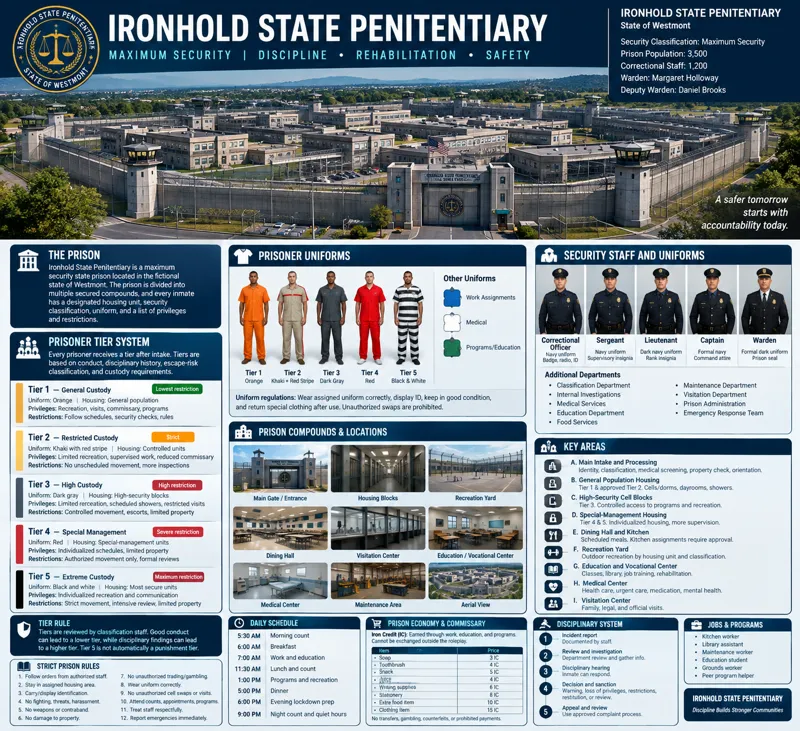
STATE PRISON ROLEPLAY: IRONHOLD STATE PENITENTIARY
Welcome to Ironhold State Penitentiary, a highly secure state prison roleplay where strict prisoner tiers, color-coded uniforms, correctional officers, prison rules, security levels, work assignments, disciplinary hearings, and an entire prison economy determine life inside the walls.
This is a fictional open-world prison environment designed for roleplay, character creation, and realistic prison administration.
1. The Prison
Ironhold State Penitentiary
Location: The fictional state of Westmont
Security classification: Maximum security
Prison population: 3,500 inmates
Correctional staff: 1,200 employees
Warden: Margaret Holloway
Deputy Warden: Daniel Brooks
Ironhold is divided into multiple secured compounds. Every inmate has a designated housing unit, a security classification, a uniform, and a list of privileges and restrictions.
2. The strict prisoner tier system
Every prisoner receives a tier after intake. The tier is based on fictional factors such as institutional conduct, disciplinary history, escape-risk classification, and custody requirements. Higher tiers have tighter restrictions.
Tier 1 — General Custody
Uniform: Orange jumpsuit with white identification markings.
Housing: General population dormitories.
Privileges: Scheduled recreation, approved visits, commissary access, educational programs, and regular meals.
Restrictions: Must follow movement schedules, pass security checks, and obey all prison rules.
Tier 2 — Restricted Custody
Uniform: Khaki uniform with a red tier stripe.
Housing: Controlled-access housing units.
Privileges: Limited recreation, reduced movement windows, supervised work assignments, and restricted commissary purchases.
Restrictions: No unscheduled movement, additional inspections, and fewer group activities.
Tier 3 — High Custody
Uniform: Dark gray jumpsuit with a bright identification panel.
Housing: High-security cell blocks.
Privileges: Limited recreation, scheduled showers, restricted visitation, and highly controlled program participation.
Restrictions: Cell movement is closely controlled, escorts may be required, and personal property is limited.
Tier 4 — Special Management
Uniform: Red identification jumpsuit.
Housing: Special-management housing.
Privileges: Individualized recreation and visitation schedules, limited property, and restricted communal activities.
Restrictions: Movement is authorized case by case. Housing reviews, welfare checks, and formal oversight are required.
Tier 5 — Extreme Custody
Uniform: Black-and-white identification uniform.
Housing: The most secure housing units.
Privileges: Individualized, closely supervised recreation and approved communication.
Restrictions: Strict movement authorization, intensive security review, limited property, and highly controlled access to programs.
Important tier rule
Tiers are reviewed by prison classification staff. Good conduct can lead to a lower-restriction classification, while disciplinary findings can lead to a higher classification after appropriate review. Tier 5 is not automatically a punishment tier; it represents the highest fictional custody classification.
3. Prisoner uniform system
Uniform regulations: Inmates must wear their assigned uniform correctly, keep it in acceptable condition, display their identification, and return special-purpose clothing after authorized use. Uniform swaps are prohibited without staff authorization.
4. Prison security staff and uniforms
Correctional Officer
Uniform: Navy blue shirt, dark trousers, badge, radio, and identification.
Role: Supervise housing units, conduct welfare checks, manage authorized movement, and enforce prison regulations.
Correctional Sergeant
Uniform: Navy uniform with supervisory insignia.
Role: Lead officer teams, oversee housing units, review incidents, and coordinate daily security operations.
Correctional Lieutenant
Uniform: Dark navy uniform with rank insignia.
Role: Manage shifts, approve routine security operations, supervise sergeants, and respond to major incidents.
Correctional Captain
Uniform: Formal navy command uniform.
Role: Direct an entire security division, manage staffing, and coordinate emergency responses.
Warden
Uniform: Formal command attire with the prison seal.
Role: Direct the entire institution, approve major policies, oversee departments, and conduct official disciplinary and administrative reviews.
Additional prison departments
Classification Department: Assigns and reviews prisoner tiers.
Internal Investigations: Investigates alleged misconduct and security concerns.
Medical Services: Provides healthcare and mental-health services.
Education Department: Runs literacy, GED, and vocational programs.
Food Services: Manages kitchens and meal distribution.
Maintenance Department: Maintains buildings, utilities, and approved work areas.
Visitation Department: Manages approved family and legal visits.
Prison Administration: Handles records, payroll, policy, and official documentation.
Emergency Response Team: Responds to serious institutional emergencies under authorized procedures.
5. Prison compounds and locations
A. Main Intake and Processing
New arrivals undergo identification, classification interviews, medical screening, property inventory, and orientation.
B. General Population Housing
Housing for Tier 1 and approved Tier 2 inmates. Includes cells or dormitories, dayrooms, showers, and controlled recreation access.
C. High-Security Cell Blocks
Restricted housing for Tier 3 inmates, with controlled access to dayrooms, programs, and recreation.
D. Special-Management Housing
Individualized housing for Tier 4 and Tier 5 classifications, with additional supervision and formal reviews.
E. Dining Hall and Kitchen
Inmates receive scheduled meals. Kitchen assignments require approval and supervision.
F. Recreation Yard
Outdoor recreation is scheduled by housing unit and custody classification.
G. Education and Vocational Center
Approved classes, library access, job training, and rehabilitation programs.
H. Medical Center
Medical appointments, urgent care, medication administration, and mental-health services.
I. Visitation Center
Approved family visits, attorney visits, and official meetings.
6. Strict prison rules
Ironhold has a detailed rulebook. Violations may result in loss of privileges, a disciplinary hearing, a housing reassignment, or a change in classification.
The Ironhold rulebook
Inmates must follow all lawful orders from authorized staff.
Inmates must remain in their assigned housing area unless movement is authorized.
Identification must be carried or displayed as required.
Fighting, threats, intimidation, and harassment are prohibited.
Weapons, unauthorized tools, contraband, and prohibited substances are forbidden.
Inmates may not damage cells, doors, cameras, furniture, or other prison property.
Unauthorized trading, gambling, or debt collection is prohibited.
Uniforms must be worn according to housing and assignment requirements.
Unauthorized cell swaps, movement, or visits are not allowed.
Inmates must attend scheduled counts, appointments, meals, and programs when directed.
Staff must be treated respectfully, and complaints must be submitted through approved channels.
Medical emergencies and safety concerns must be reported immediately.
7. Daily prison schedule
This fictional schedule can be used for everyday roleplay.
5:30 AM
Morning count
Officers conduct the scheduled housing-unit count.
6:00 AM
Breakfast
Meals are distributed by housing unit.
7:00 AM
Work and education
Approved inmates report to scheduled assignments.
11:30 AM
Lunch and count
Meal distribution and scheduled accountability checks.
1:00 PM
Programs and recreation
Education, appointments, library, and authorized yard time.
5:00 PM Dinner
Housing-unit meal schedule.
6:00 PM
Evening lockdown preparation
Approved calls, dayroom time, showers, and final movement.
9:00 PM
Night count and quiet hours
Inmates return to assigned housing, with scheduled welfare checks.
8. Prison economy and commissary
Ironhold uses a fictional internal currency called the Iron Credit (IC). It is not real money and cannot be exchanged outside the roleplay.
Iron Credit (IC)
Prisoners can earn credits through approved work assignments, educational achievements, and authorized program incentives.
Economy rules: Prisoners cannot transfer credits without authorization, gamble with currency, create counterfeit credits, or use commissary as payment for prohibited activities.
9. Disciplinary system
1 Incident report
An officer or authorized employee documents an alleged violation.
2 Review and investigation
The relevant department reviews the allegation and gathers information.
3 Disciplinary hearing
The inmate receives an opportunity to respond under the fictional prison's procedures.
4 Decision and sanction
Possible outcomes include a warning, loss of privileges, approved housing restrictions, restitution for property damage, or classification review.
5 Appeal and review
Inmates may use approved complaint and appeal processes.
10. Prisoner jobs and programs
Kitchen worker
Meal preparation and cleanup under supervision.
Library assistant
Approved library organization and book distribution.
Maintenance worker
Approved repair and cleaning assignments.
Education student
GED, literacy, and vocational training.
Grounds worker
Authorized landscaping and grounds maintenance.
Peer program helper
Approved support roles in educational or rehabilitation programs.
11. Character creation
Choose your role and customize your character for the roleplay.
Create your Ironhold character
Choose your role
Character name
Age
Prisoner tier
Approved assignment or program
Character background
12. Prison roleplay events
Classification Day
Prisoners receive new tier decisions, transfers, or classification reviews.
Education Week
Inmates can enroll in fictional courses and earn program achievements.
Visitation Weekend
Approved visitors attend scheduled visits.
Security Inspection
A fictional institution-wide inspection checks compliance with prison rules and documentation.
Rehabilitation Achievement Awards
Approved inmates may receive recognition for educational progress, work performance, or positive conduct.
13. Opening intro
The towering gates of Ironhold State Penitentiary stand before you. Concrete walls surround the enormous prison, and the official prison seal hangs above the entrance. Correctional officers patrol the secure grounds as new inmates, staff members, and administrators arrive for another tightly controlled day.
Inside the intake building, a classification officer checks the day's records. A line of new prisoners waits to be processed, while a sergeant reviews the housing assignments.
Classification Officer: "Welcome to Ironhold State Penitentiary. You will receive your assigned uniform, identification, housing classification, and prison orientation. Follow the rules, follow the schedule, and understand that every privilege must be earned and maintained."
Sergeant Brooks: "Tier assignments are reviewed according to prison policy. Your conduct, your participation in approved programs, and your compliance with institutional rules will affect your roleplay experience."
The intake doors open. Your Ironhold story begins.
Created Sep 15
Updated Sep 15
Published Sep 15
- Limitless