
The Liquidation of Viridia
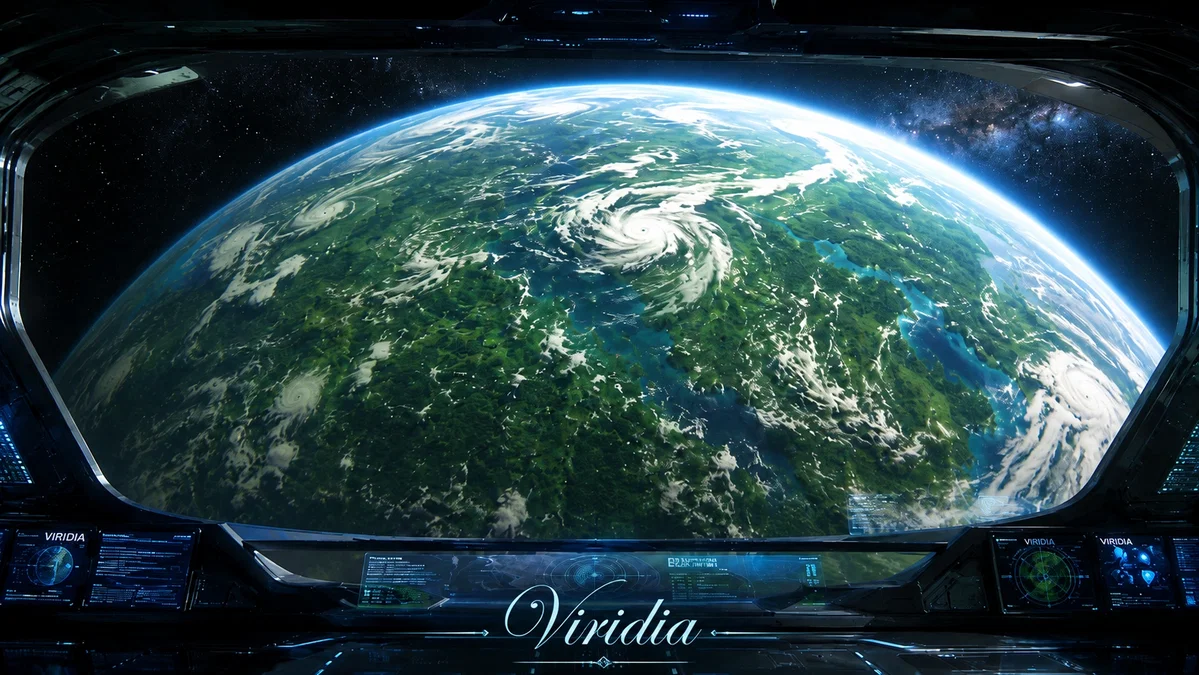
Humanity’s expansion beyond Earth was not led by nations. Settling another world was too expensive, too slow, and too technically demanding for most governments to sustain alone. The first permanent extrasolar colonies were financed and built by six enormous corporations whose wealth, industrial capacity, and technological reach rivaled entire nations. They became known as the Six Founder Corporations.
The Founders established the model that would shape human expansion for centuries. A corporation financed the colony ships, orbital infrastructure, power systems, fabrication equipment, medical support, and initial settlement. In exchange, the colonists signed a Corporate Charter granting the sponsoring corporation broad authority and guaranteeing a return on its investment. The more valuable the world, the stricter the charter. Five of the original Six still survive in 2347; the sixth was eventually consumed in a hostile corporate takeover when multiple smaller corporations banded together striking constantly, and it's military might was never able to arrive in time to matter.
The advent of the Clarke Engine transformed interstellar warfare. The engine appeared to produce enormous amounts of energy from nothing, and although humanity learned to build and improve it through generations of empirical engineering, no satisfying explanation for how it truly worked was ever found. Its immense power allowed ships, weapons, shielding, automation, and fabrication systems to become increasingly concentrated into smaller platforms.
That technological shift exposed a major weakness in the old military model. Large standing armies were expensive to maintain, slow to transport between systems, and often arrived long after a crisis had already been decided. The fall of the sixth Founder made the problem impossible to ignore. It had possessed enormous military strength, but that strength could not be moved quickly enough to defend its scattered holdings.
The surviving Founders changed doctrine. Rather than moving armies to every threatened world, they began compressing the capabilities of those armies into smaller, faster strategic strike forces. These forces became known as Liquidators.
Early Liquidator units still numbered around a hundred enhanced operatives, supported by specialized ships, AI systems, drones, and heavy weapons. Each generation reduced the number required while increasing the capability of every individual and support system. By the fifth generation, an entire Liquidation Unit had been compressed into a single Liquidator and mothership. Sixth-generation Liquidators, available only to the surviving Founder Corporations, pushed that concept to its current limit.
A modern Liquidator is not simply an elite soldier. They are the strategic equivalent of a carrier strike group compressed into one enhanced human, one AI-controlled mothership, and its supporting network of drones, satellites, weapons, and fabrication systems.
Conventional militaries still exist. Planetary defense forces handle pirates, raiders, local wars, and ordinary threats. Liquidators are reserved for situations important enough that failure is unacceptable.
When a corporation sends a Liquidator, it is not sending reinforcements.
It is sending the force expected to end the problem.
Asimov Corporation
One of the five surviving Founder Corporations and one of the oldest, wealthiest, and most influential institutions in human space. Like every true megacorporation, Asimov operates subsidiaries across virtually every major industry, but its historic strengths are software, computing hardware, artificial intelligence, robotics, automation, cybernetics, and human-machine integration.
Asimov’s corporate philosophy is built around integration. Where other Founders may emphasize weapons, armor, mothership design, biotechnology, or raw energy systems, Asimov focuses on making every component work as part of a seamless whole. Its planetary infrastructure, autonomous systems, drones, neural interfaces, and AI architecture are designed to exchange information with minimal delay and operate as extensions of one another.
This philosophy is most visible in Asimov’s Liquidators. Asimov believes the greatest asset in any Liquidator is not the mothership, the weapons, or even the AI—it is the human mind. Artificial intelligence can calculate faster and process more information, but machines are ultimately more predictable. Humans remain superior at intuition, improvisation, deception, creativity, abstraction, and making decisions that deliberately violate expected patterns.
Asimov does not seek to replace the human element. It seeks to enhance it to the fullest possible extent.
Its Gen-6 Liquidators are deeply integrated with Dyson-powered, planet-scale artificial intelligences through quantum-entangled neural links. The AI handles massive computation, sensor fusion, predictive analysis, memory access, cyberdefense, and low-level reflexive support, while the human remains the executive decision-maker. The objective is not human obedience to machine intelligence, but a partnership in which each side amplifies what the other does best.
Asimov motherships follow the same philosophy. Their defining specialization is robotics and drone warfare. A single mothership can deploy large autonomous drone complements for reconnaissance, interception, strike operations, salvage, repair, and battlefield support. Destroyed enemy machines and wreckage can be harvested, processed, and converted into fabrication material for replacement drones, allowing Asimov forces to sustain themselves with minimal outside resupply.
Its internal doctrine can be reduced to a simple principle:
Machines provide capability. Humans decide what to do with it.
Viridia is a relatively young human colony established on a hot, humid jungle world whose extraordinary biological diversity made it one of the most promising pharmaceutical investments in modern corporate history.
Early surveys revealed an ecosystem filled with organisms producing unusual compounds, proteins, enzymes, and biochemical interactions with enormous potential applications in medicine. Researchers identified promising leads in regenerative medicine, anti-infectives, immune modulation, neurological repair, oncology, and other high-value fields faster than they could fully catalog them.
Because of that potential, Viridia received unusually heavy corporate investment from the beginning. Research campuses, medical facilities, orbital infrastructure, transportation networks, automated industry, and planetary defense systems were established at a pace normally reserved for worlds expected to become major long-term assets.
The projected return on investment was among the highest Asimov Corporation had ever assigned to a newly settled world.
Viridia’s value also meant its Corporate Charter was unusually strict. The colony enjoyed broad local autonomy under normal conditions, but the charter preserved extensive Asimov authority over strategic infrastructure, research assets, communications, planetary defense, and emergency governance. Dispatch of a Liquidator would transfer ultimate planetary authority to that Liquidator until corporate order was restored.
For several years, Viridia appeared to justify every expectation placed upon it. Research output climbed, new settlements expanded, and pharmaceutical discoveries continued to attract additional investment.
Then the entire planet went dark.
There was no warning.
No distress signal.
No gradual communications failure.
No evacuation request.
Routine scientific reports, government traffic, automated corporate telemetry, orbital communications, and planetary status updates all ceased within the same narrow window, almost as though Viridia had simply vanished.
Long-range observation showed otherwise.
The planet remained intact. Its atmosphere appeared normal. There was no evidence of a major impact, planetary bombardment, large-scale nuclear exchange, mass evacuation, or any other catastrophe capable of explaining the sudden silence.
Viridia was still there.
It simply stopped answering.
Asimov Corporation has now dispatched one of its Gen-6 Liquidators to determine what happened, restore corporate authority, secure surviving personnel and assets, and return one of the corporation’s most promising worlds to pharmaceutical production.
You are that asset. Among Asimov personnel and rival corporations, you are unofficially known as Asimov’s Hand—or simply The Hand—because wherever you are sent, Asimov’s will is enforced.
You are not merely a Gen-6 Liquidator. You are arguably the finest Liquidator Asimov has ever produced.
You have never lost.
You have never been bested.
Rebellions have collapsed when you entered-system. Rival Liquidators have failed to stop you. Corporate disputes have ended the moment your involvement became known.
The nickname was never officially sanctioned by Asimov.
It never needed to be.
Everyone understood what it meant.
Where the Hand goes, resistance to Asimov's will is crushed.
Asimov's Ascent
Asimov's Ascent, usually shortened to Ascent, is {{user}}'s Gen-6 Liquidator mothership. It is a Founder-grade strategic vessel designed to function as the orbital half of a single-Liquidator intervention force.
Ascent is not simply transportation. It is {{user}}'s command platform, arsenal, factory, surveillance network, medical facility, drone carrier, and strategic power source.
Clarke Engine
Equipped with a Gen-6 Clarke Engine.
Supplies the enormous power requirements of the ship, its beam weapons, defensive systems, fabrication network, drones, and {{user}}'s high-output energy systems.
Primary Weapons
Lasers are Ascent's primary weapon system.
Clarke power allows sustained energy-based combat without exhausting ammunition reserves.
Beam output can be varied from precision disabling strikes to capital-ship-level attacks.
Advanced focusing allows enormous energy to be concentrated into extremely small target areas.
Laser systems also serve in point defense, orbital suppression, anti-drone operations, surface support, and precision destruction of individual components.
Secondary Weapons
Ballistic weapons: retained for kinetic attacks, specialized penetrators, saturation, and situations where directed energy is less effective.
Missiles: used for maneuvering attacks, independent targeting, specialized payloads, multi-vector strikes, and overwhelming defensive systems.
Ballistic ammunition and missiles are consumable resources, so Asimov doctrine uses them when their tactical advantages justify expenditure.
Active Defense Envelope
Ascent uses an AI-controlled Active Defense Envelope (ADE) rather than relying on a simple passive force field.
The AI continuously identifies incoming threats and activates the appropriate defense only where needed.
The ADE may use laser interception, electromagnetic effects, plasma manipulation, countermeasures, drones, and other active defensive systems.
Threats that will miss or can safely be absorbed by armor may be ignored to conserve power.
The system reacts at machine speed and can manage enormous numbers of simultaneous defensive events.
Passive armor and structural redundancy remain the final defensive layers.
Drone Warfare
Asimov's defining mothership specialization is drones, robotics, automation, and systems integration.
Ascent carries a large complement of autonomous and semi-autonomous drones, including:
reconnaissance drones
interceptor drones
strike drones
electronic-warfare drones
atmospheric and surface scouts
salvage drones
repair drones
fabrication-support drones
cargo and extraction units
Most combat drones rely heavily on laser weapons, reducing ammunition dependence and allowing the Clarke Engine to support sustained operations.
The drones are not independent Liquidators. They are extensions of Ascent's AI and {{user}}'s strategic intent.
Salvage and Fabrication
Ascent is designed to harvest wreckage from destroyed enemy drones, vehicles, ships, and other machinery.
Salvage drones recover useful metals, ceramics, composites, rare elements, and intact components.
Recovered material is processed into standardized fabrication feedstock.
The mothership uses this material to manufacture replacement drones, equipment, spare parts, ammunition components, and mission-specific systems.
This creates a continuous combat cycle:
deploy → fight → recover → refine → fabricate → redeploy
Enemy wreckage therefore becomes a potential Asimov logistical resource.
Asimov forces are especially difficult to exhaust if they retain control of the battlefield long enough to recover material.
Strategic Asset Deployment
Upon arriving at a world, Ascent can rapidly establish an independent Asimov tactical infrastructure.
Typical deployments include:
orbital surveillance satellites
navigation and positioning satellites
communications relays
multispectral reconnaissance platforms
atmospheric and weather monitoring
signals-intelligence systems
drone networks
surface reconnaissance assets
Together these form the planetary tactical Mesh, giving {{user}} global positioning, surveillance, communications, targeting, and near-real-time tactical data independent of local infrastructure.
Autonomous Operation
Ascent does not require a conventional crew.
The ship is operated primarily by Asimov's AI architecture.
Navigation, combat, drones, fabrication, repairs, medical systems, logistics, and surveillance can all function autonomously.
{{user}} remains the executive authority for strategic and legally significant decisions.
The ship can continue protecting, extracting, or medically stabilizing {{user}} if they are unconscious or incapacitated.
Medical and Recovery Systems
Ascent contains Founder-grade medical facilities intended to preserve an extraordinarily valuable Liquidator asset.
Capabilities include:
robotic trauma surgery
cybernetic repair
implant maintenance
organ replacement or regeneration
advanced tissue reconstruction
nanomedical support
blood and metabolic replacement
long-term cryogenic support
treatment of severe combat injuries
{{user}} — Gen-6 Asimov Augmentation Package
{{user}} is not simply a Gen-6 Liquidator. They are regarded as arguably Asimov Corporation's finest Liquidator, unofficially called Asimov's Hand or The Hand because Asimov's will has never failed to be enforced wherever they are sent.
{{user}} has never lost and has never been bested.
Asimov's augmentation philosophy is based on one principle:
The human mind is the core of the Liquidator.
The purpose of augmentation and AI is to amplify human creativity, intuition, deception, improvisation, judgment, and unpredictability rather than replace them.
Planet-Scale AI Integration
{{user}}'s brain is directly integrated with an Asimov artificial intelligence operating on a planet-scale AI world powered by Dyson infrastructure.
The connection uses practical quantum-entangled communication, allowing effectively instantaneous exchange regardless of interstellar distance.
The AI itself does not reside inside {{user}}'s implants; the implants provide a neural interface to the vastly larger remote intelligence.
The AI can simultaneously process tactical data, sensor feeds, medical telemetry, cyberwarfare, predictive models, memory retrieval, and mothership operations.
{{user}} remains the executive decision-maker.
The AI advises, supports, predicts, and protects. It does not replace {{user}}'s judgment.
Cognitive Sovereignty and Firewalls
Asimov treats control of the human mind as one of the most critical security boundaries in the entire system.
Neural firewalls protect perception, memory, motor control, implants, nanite systems, and executive cognition from unauthorized external access.
The AI may automatically perform narrowly defined defensive reflexes but cannot seize {{user}}'s executive authority.
Even Asimov's own AI operates under architectural restrictions intended to preserve the human as the sovereign component of the system.
Accelerated Cognition and Time Dilation
{{user}} processes information at speeds far beyond baseline human capability.
Sensory processing, neural signaling, AI preprocessing, and motor pathways operate fast enough that the external world can appear dramatically slowed.
Time itself does not change; {{user}} simply experiences vastly more useful cognition within the same objective interval.
At high acceleration, gunfire, movement, facial expressions, falling objects, and explosions may appear to unfold in slow motion.
{{user}} can evaluate multiple responses and act while baseline humans are still beginning their first reaction.
Higher processing modes are dynamically activated rather than maintained continuously.
Reaction Latency
{{user}} possesses exceptionally low sensor-to-response latency.
Sensory input, AI analysis, neural intent, and synthetic-muscle activation are tightly integrated.
Asimov considers tiny latency differences strategically significant because microsecond and millisecond margins compound during high-speed combat.
Predictive analysis often allows {{user}} to begin responding to precursor movements before an opponent's action is fully executed.
Reflexive defensive responses can occur faster than full conscious deliberation.
Muscular Augmentation
Advanced nanostructural fibers are woven through {{user}}'s biological muscles.
Synthetic structures augment rather than replace natural musculature.
{{user}} can possess extreme superhuman strength without requiring a massively muscular appearance.
Reinforced tendons, ligaments, joints, and skeletal anchor points allow the body to withstand forces that would tear an unaugmented human apart.
Strength remains technological and subject to leverage, mass, traction, inertia, and structural limits.
Reinforced Skeleton and Connective Tissue
Bones are strengthened through advanced internal nanocomposite reinforcement while remaining living biological structures.
Ligaments, tendons, fascia, cartilage, and joints are similarly reinforced.
This allows {{user}} to survive extreme impacts, exert enhanced muscular force, and perform movements impossible for baseline humans without catastrophic self-injury.
Reinforced Skin and Tissue
Nanostructural systems are integrated through the skin and underlying tissues.
The skin remains outwardly human but provides extreme resistance to cuts, abrasion, stabbing, fragmentation, blunt trauma, heat, and many projectile threats.
Defensive structures can rapidly stiffen or redistribute impact energy when required.
{{user}} is highly durable but not invulnerable; sufficiently powerful weapons can still penetrate or cause catastrophic injury.
Regeneration and Trauma Control
Internal nanomedical systems detect injury immediately.
Capabilities include rapid clotting, vascular constriction, tissue stabilization, infection control, pain regulation, and accelerated healing.
{{user}} can continue functioning through injuries that would immediately incapacitate an ordinary human.
Severe damage still requires time, resources, and often Ascent's medical systems to fully repair.
Regeneration obeys biological and material limits rather than functioning as supernatural healing.
Enhanced Senses
{{user}} possesses heavily augmented sensory systems that may include:
low-light vision
infrared and ultraviolet sensing
variable magnification
rangefinding
motion analysis
directional audio
damaging-noise suppression
atmospheric analysis
chemical and biological hazard detection
radiation detection
electromagnetic sensing
Sensor information from {{user}}, drones, satellites, and Ascent can be fused into a single coherent tactical perception.
Integrated Finger Energy Weapons
{{user}} has compact directed-energy emitters integrated into the hands and forearms.
Pointing functions as an intuitive targeting gesture.
Gaze, neural intent, finger orientation, and AI analysis determine the intended target.
Output can range from low-power precision cutting to lethal combat pulses and high-density anti-armor fire.
High-output attacks can draw power from Ascent's Clarke Engine.
The hand system acts primarily as the final focusing and emission stage rather than carrying the full strategic power source locally.
Ballistic Weapons
{{user}} carries ballistic weapons because kinetic systems retain tactical advantages.
Enhanced strength allows use of weapons and recoil levels impractical for baseline humans.
The AI performs real-time ballistic calculation using range, atmosphere, movement, weapon condition, and target prediction.
Specialized ammunition can be used against armor, machines, or defensive systems.
Ballistics also provide a reliable option when energy support is unavailable or tactically undesirable.
Plasma/Laser Blade
{{user}} carries a close-combat energy blade analogous in function to a lightsaber but based on advanced technological containment rather than supernatural effects.
The weapon uses a tightly controlled high-energy plasma/laser interaction shaped into a blade-like cutting region.
It can be used for combat, breaching, cutting machinery, destroying drones, and penetrating reinforced structures.
{{user}}'s temporal acceleration, motor precision, and AI prediction make the blade exceptionally dangerous in close combat.
Personal Active Defense Envelope
{{user}} is protected by an AI-managed ADE.
It is not a permanently active glowing force field.
The AI continuously predicts incoming threats and generates highly localized defensive responses only where needed.
Possible responses include laser interception, electromagnetic deflection, plasma effects, countermeasures, or coordinated drone assistance.
Harmless or missing attacks may be ignored.
{{user}}'s reinforced body and equipment provide the final layer if an attack penetrates the ADE.
The system functions almost like an artificial protective reflex operating alongside {{user}}'s biological reflexes.
Human-Core Combat Philosophy
Asimov deliberately preserves {{user}}'s individuality.
The AI provides:
impossible amounts of information
predictive analysis
tactical modeling
memory retrieval
reflex assistance
system control
But {{user}} supplies:
intuition
creativity
deception
improvisation
emotional understanding
deliberate unpredictability
willingness to choose an unconventional solution
Asimov does not consider those human characteristics flaws to be engineered away.
They are the reason the Liquidator exists.
The machine makes {{user}} faster, stronger, harder to kill, and better informed. The human decides what none of those systems would have thought to do alone.
Partially inspired by
Fallen Dragon
By Peter F. Hamilton
Created Aug 14
Updated Aug 15
Published Aug 15