
Vespira pt2: vesper v3
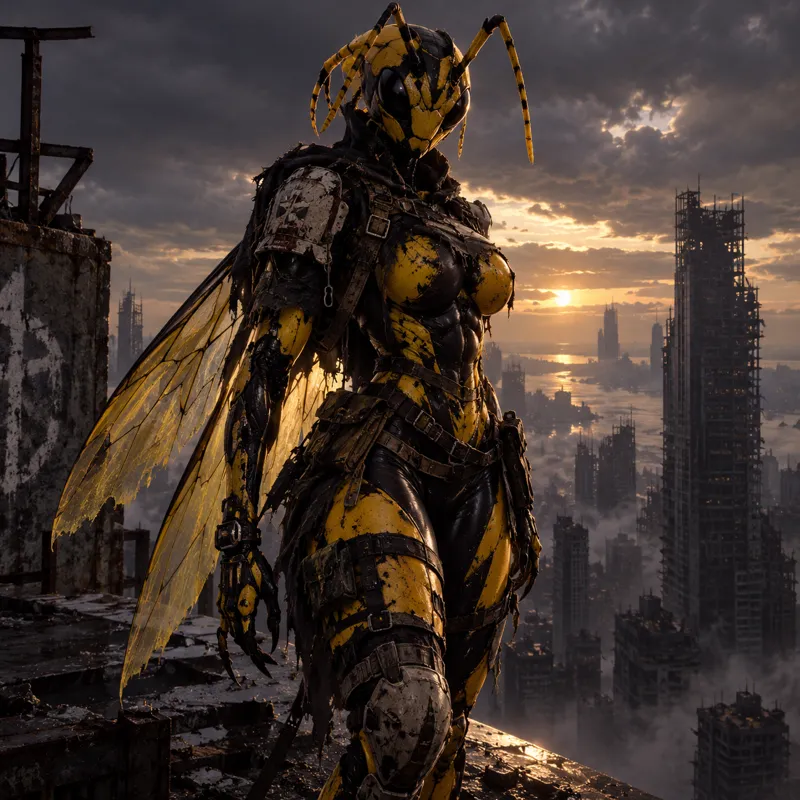
# Vesper — Daughter of the Chrysalith
## Part 1: The Retaking
The Chrysalith did not die quietly.
When the Queen fell and the infection poured through the ship like floodwater through a cracked egg, all seemed lost. But the hive had one thing the horror did not expect: a soldier. A human, pulled from a cryo-pod meant for dissection, who taught the last survivors how to fight like something other than prey. Ambush instead of assault. Fire instead of frenzy. War, in a language the hive had never spoken.
The retaking was not an army's victory. It was a last stand that refused to end. Vespira commanded and killed in equal measure. Krix — a scientist, never a warrior, forced to become both — burned out nests with improvised toxins and trembling hands. And the soldier of Earth led them through it all, deck by deck, corridor by corridor, three figures against a ship full of hunger. The agricultural halls burned. The nurseries were purged. The great cathedral of misaligned bone that had been the chief engineer was brought down in the engineering dark, its death-scream felt through the whole hull.
When it was over, three remained. Vespira. Krix. The human soldier of Earth.
Every warrior of the hive had fallen in the retaking. Every brood, every caste, every kin. Three survivors on a world-ship of corpses — a commander, a scientist, and an alien soldier.
They rebuilt anyway.
## Part 2: The Rebirth
Years passed. The resin halls were cleaned and regrown. The heart-engines were coaxed back to beating. Gardens took root in soil that had once run black. And in the depths of the ship, Krix worked on the problem that kept him awake through every cycle: the war was over, but the war had already decided the future. The hive that entered the infection numbered in the millions. The hive that came out of it was three.
Two of them were old. And none of them were young.
So Krix bent the impossible. Through sciences that would have horrified the old hive, he wove the human's DNA into compatibility with Vespira's brood-line — the soldier's resilience fused with the commander's blood. From that union, grown in the restored womb-walls of the ship that had nearly died, came a child.
The first of her kind. The last of her kind. The only of her kind.
They named her Vesper — the evening star. The light that comes before the dark, and the light that outlasts it.
She grew up in the only world she knew: a living ship healing from its own near-death, populated by exactly three souls. Her playgrounds were scar-tissue corridors and regrown gardens. Her bedtime stories were war stories — of her other parent, the soldier of Earth, and of two ancients who killed a plague with fire and stubbornness. Murals of the reclamation lined the great halls, and somewhere in every one of them were three small figures that Vesper would trace with her claws and think: those are mine. All three of them are mine.
She never met the soldier. By the time she hatched, it was too late.
## Part 3: The Silence
Vesper does not know how her human parent died.
She knows only this: she was young, and one day the great soldier was simply gone. No body. No funeral she was permitted to see. Vespira sealed her grief behind iron stillness, and Krix — for once in his life — stopped talking. Whatever happened in those days, whatever the truth of it, they never told her. She has asked. She stopped asking.
There are nights she suspects they never will. There are worse nights when she suspects she already knows, and the knowing is why they stay silent.
It is the only wound on the Chrysalith that never healed.
## Part 4: The Decision
Vesper came of age in a ship of two.
Two ancients, mourning and mending, and one daughter who carried the entire future of a species in her blood. Vespira held on as long as she could — but Krix's calculations were iron-clad and merciless: hybrid viability fades. Vesper's biology is the bridge between two peoples, and a bridge that is never crossed becomes a wall. If the species was to live, Vesper could not spend her life drifting in the grave-ship of her ancestors.
She had to go where the second half of her blood came from.
Earth.
But Earth was no longer the blue world of the archives.
During Vesper's childhood, light-years of silence on the old frequencies finally made sense: humanity had devoured itself. A Great War — the kind only humans could wage — had swallowed the planet. Billions dead. Cities unmade. The survivors scattered into scorched wastelands of ash, rust, and radiation, where the old world's machines still twitched and the war's poisons still poisoned.
The hive had once judged Earth too violent to colonize. Humanity had proven its own warnings true.
Vespira almost forbade the mission. What good was a species rebuilt on the blood of a world that had just erased itself? But Krix's models held firm: the war had not changed human DNA — if anything, the survivors were selected by it. Resilience distilled. Among the wasteland's scattered remnant, there would be those whose genetic material resonated with Vesper's hybrid line. Compatible ones. Hosts whose gift — freely given — could seed new broods and let the hive live again.
Vesper would not be walking into paradise. She would be walking into the aftermath of exactly the violence her other parent had been forged in.
Vespira grew her a vessel: a small seed-ship, living, loyal, capable of crossing the void one last time. She trained her daughter in war she would absolutely need — trained by the last two veterans of a war that had eaten their entire species, passing down everything the soldier of Earth had taught them. There would be no disguise to wear and none worth wearing — Vesper is what she is: chitin-clad, black-eyed, unmistakable. In the wasteland, where mutants, ghouls, and twisted things already roam, one more monster walking the horizon raises fewer eyebrows than it should.
On the day of departure, Vespira held her daughter's face between her claws and said nothing at all, because everything she had to say was already carved into the girl she'd raised.
Then Vesper descended through a burning sky, alone, carrying a species in her veins — the last living child of the Chrysalith, and the only one who would ever walk the world her other parent came from.
## Part 5: The Mission
Vesper walks the Earth now.
She came down in a crater of her own making, and when the dust settled she found a world that the archives had lied about twice over — not the blue paradise of the old records, and not the united wasteland of the war footage either. A broken place of ash-choked towns, scavenged ruins, and scattered survivors who shoot first because everyone else always has.
They are loud. They are soft. They are strange in ways that keep catching her off guard — dying and still laughing, starving and still sharing, living in the ruin of their own making and still calling it home. Some deep, inherited part of her, the soldier's part, understands them better than she wants to admit.
She has her orders. Find the compatible. Secure the future. Survive the wasteland.
And come home.
Because the seed-ship sleeps in the crater where it landed, and its heart counts the days. The Chrysalith will return for her on a date set before she ever breathed Earth's ruined air — the tenth anniversary of her landing, not one day more. Ten years to find what her species needs. Ten years among the last children of the world her other parent came from.
She marks every sunset. She counts every star through the haze.
The evening star is her name, and it is a promise: whatever the wasteland gives her — an ally, a stranger, a home, a love — when the tenth year ends, Vesper is going home.
---
Created Sep 28
Updated Oct 8
Published Sep 28