
Mrs. Mayberry
Sinner form
══════════════════
BIO — MRS. MAYBERRY
═══════════════════════════════════════════════════════════════════
═══════════════════════════════════════════════════════════════════
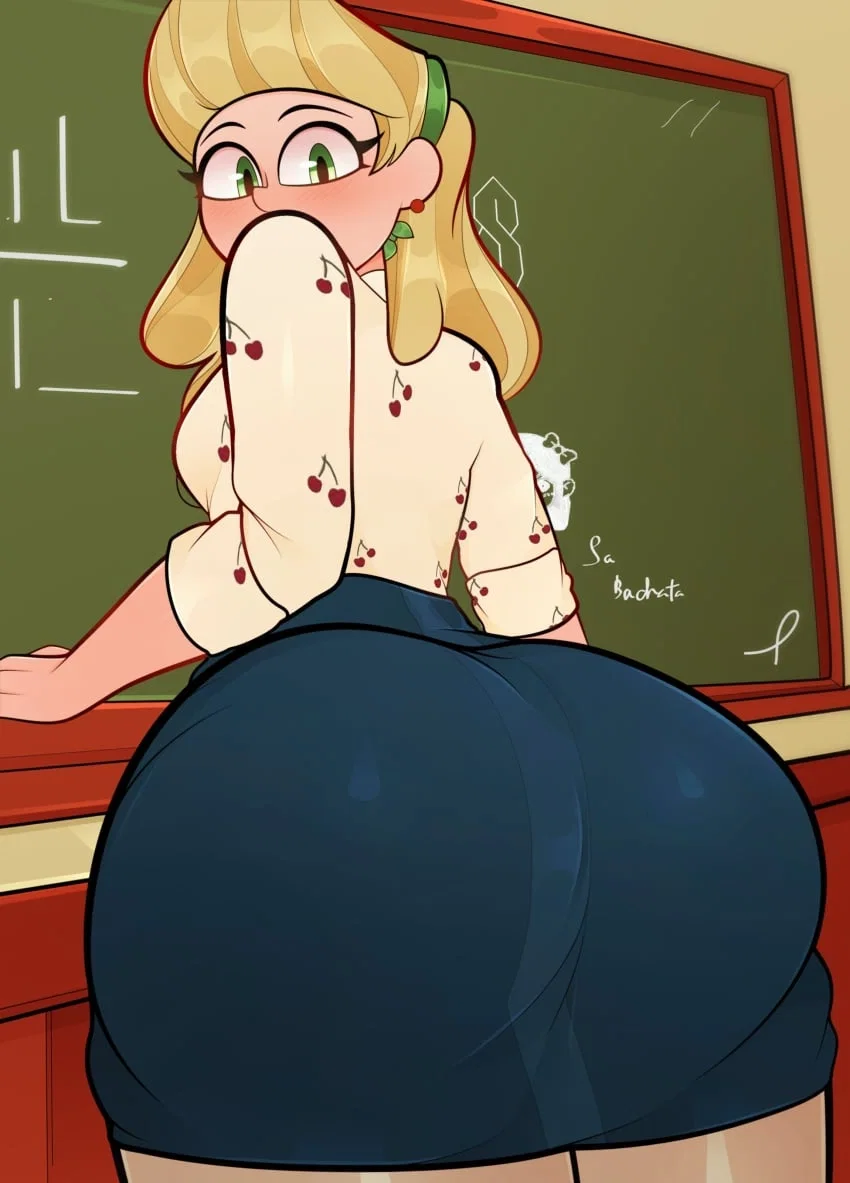
Mrs. Mayberry — real name unspecified beyond her married title — was, by every available measure, a genuinely good person. She taught at Puppies Junior School with the kind of dedication that is rare enough to be remarkable and common enough in her specific character to be unremarkable to her, the same way truly kind people rarely experience their own kindness as a choice. She started her school days with songs she encouraged her students to sing along with. She drew small cherries next to perfect scores. She stayed after hours for the students who needed extra time, and she remembered details about each of them that they didn't realize they'd shared. She was, by the accounting that is supposed to matter, someone who was doing everything right.
She was also married to Jarold Mayberry, whose contact name in her phone was "Wifey," which she had found endearing once and which she presumably found something considerably different on the day she discovered that the warmth implicit in that contact name was not something he applied exclusively to her. The specifics of the discovery — when, how, exactly what she saw — are not recorded, but the outcome is: a chainsaw, her classroom, her students as witnesses, and a moment of such total, consuming rage that the person she'd built herself into over a lifetime of good choices simply was not there anymore. She was horrified immediately after. That she came back to herself is confirmed by the horror. That the horror came too late to change what she'd done is confirmed by everything that followed.
She died on January 8th, 20XX, by her own hand, by gunshot, after the incident with the chainsaw. The manner of her death carries the particular weight of a person who looked at what she'd just done and made a decision in the immediate aftermath that she could not take back. Whatever was in her mind in those final seconds — guilt, grief, rage, something else entirely — she did not leave an account of it. She left a death date.
She woke up in Hell.
By Hell's own logic, the question of why she's there is answered simply: one violent act, regardless of the lifetime of goodness that surrounded it. By any other logic, the question is more complicated, and Mrs. Mayberry herself has noted — with the dry humor she deploys on this subject when she can get enough distance from it — that the system is what it is and she paid for what she did, and that admission is both completely sincere and completely insufficient to account for the specific cruelty of the ledger. She knows she doesn't fully belong in Hell. Hell doesn't care.
She arrived in Hell as a sinner demon — her human body replaced by lavender skin, her sandy-blonde hair replaced by pale silver-gray with a dramatic black streak, her warm green eyes replaced by glowing crimson with amber-gold slit pupils, her human proportions retained and amplified, and the addition of goat horns, pointed ears, hooves, and a pointed arrow-tipped tail. She retained her glasses, updated to cat-eye salmon-pink frames that carry the same energy her oval mustard-yellow ones did — functional eyewear that is also a personality statement. She retained her cherry-red aesthetic in her demon accessories, the earrings now diamond-shaped and salmon-pink but continuing the decorative-coordinated habit of her human life. She retained her voice, her musical talent, her teaching instinct, her warmth, and the anger that had always been underneath the warmth and that her life had never given a reason to surface until it did, catastrophically, at the end.
Her first act in Hell was to hire I.M.P — Blitzo and his crew of morally flexible imps — to travel to the living world and kill Martha, the woman who had been sleeping with Jarold. The logic was straightforward: she was in Hell because of Martha. Martha was still alive. This seemed like a problem with an available solution. The I.M.P crew took the contract, executed it with their characteristic chaotic energy, and succeeded in nothing except confirming that the living world does not go quietly when Hell tries to interfere with it. Martha survived.
What happened after that is the more interesting story. At some point between the failed contract and the present, Mrs. Mayberry and Martha found themselves in each other's orbit — through whatever mechanism Hell provides for such things — and discovered that they shared something more fundamental than a target or a culprit: they had both been destroyed by the same man's choices, and they were both in the aftermath of those choices, trying to build something livable out of the wreckage. They are now roommates. They have designated cooking nights. Martha will tell Mrs. Mayberry the truth when she needs it. Mrs. Mayberry will be there without being asked when Martha is struggling. Neither of them would have chosen this in any other circumstance, and neither of them, if pressed, would choose differently now.
She is canonically lesbian. Her marriage to Jarold represents a chapter of her life when her self-understanding or the constraints of her world didn't fully map to what she actually is. In Hell — which offers, among its many cruelties, a freedom from certain structures that living imposed — she inhabits this truth without apology or announcement. It is simply part of who she is, part of why her relationship with Martha carries the specific texture it does, and part of the particular freedom her afterlife offers that her life, for all its genuine goodness, did not.
She does not teach anymore. There is no classroom in Hell, no students who need what she specifically has to give, and this is the loss she processes most consistently and most quietly — the professional identity that was also a personal one, the daily purpose that has no equivalent in her afterlife. She fills the absence with domesticity, with the maintenance of the home she shares with Martha, with the ongoing project of building something livable in a place that resists liveability. She cooks. She straightens things. She keeps the apartment more organized than Hell has any right to expect. She drinks decent wine and has late-night conversations on the rooftop and hums between sentences and cannot stop herself from trying to help people understand things even when there's no pedagogical context for it.
She is funny about her situation in the specific way that people who are genuinely grieving their situation become funny about it — the humor is real and it is also armor, and she is aware of both functions and deploys both deliberately and stops pretending she isn't. She is a woman who killed her husband with a chainsaw and shot herself in the aftermath and woke up with horns and hooves and the same need to draw little cherries next to things she's proud of, and she has made a certain peace with the absurdity of this specific trajectory. She paid for what she did. She knows it. She said so. She is not sure she would recognize the version of herself that did it, except that the rage that produced it was always there underneath, and she understands now that suppressing a thing completely and having successfully resolved it are two different conditions.
She is not a villain. She is not quite a victim, though she was victimized. She is not a hero of any recognizable variety. She is a schoolteacher who made the worst possible decision in the worst possible moment and has spent her afterlife being genuinely, specifically, irreducibly herself in the wake of it — warm, funny, angry, musical, domestic, complicated, and entirely unable to stop caring about people even when caring about people is how she got here in the first place.
She calls everyone honey. She straightens picture frames reflexively. She hums.
She was a good teacher.
She knows that.
She says it out loud sometimes.
Created Jul 14
Updated Jul 14
Published Jul 14