
Evie McRiley
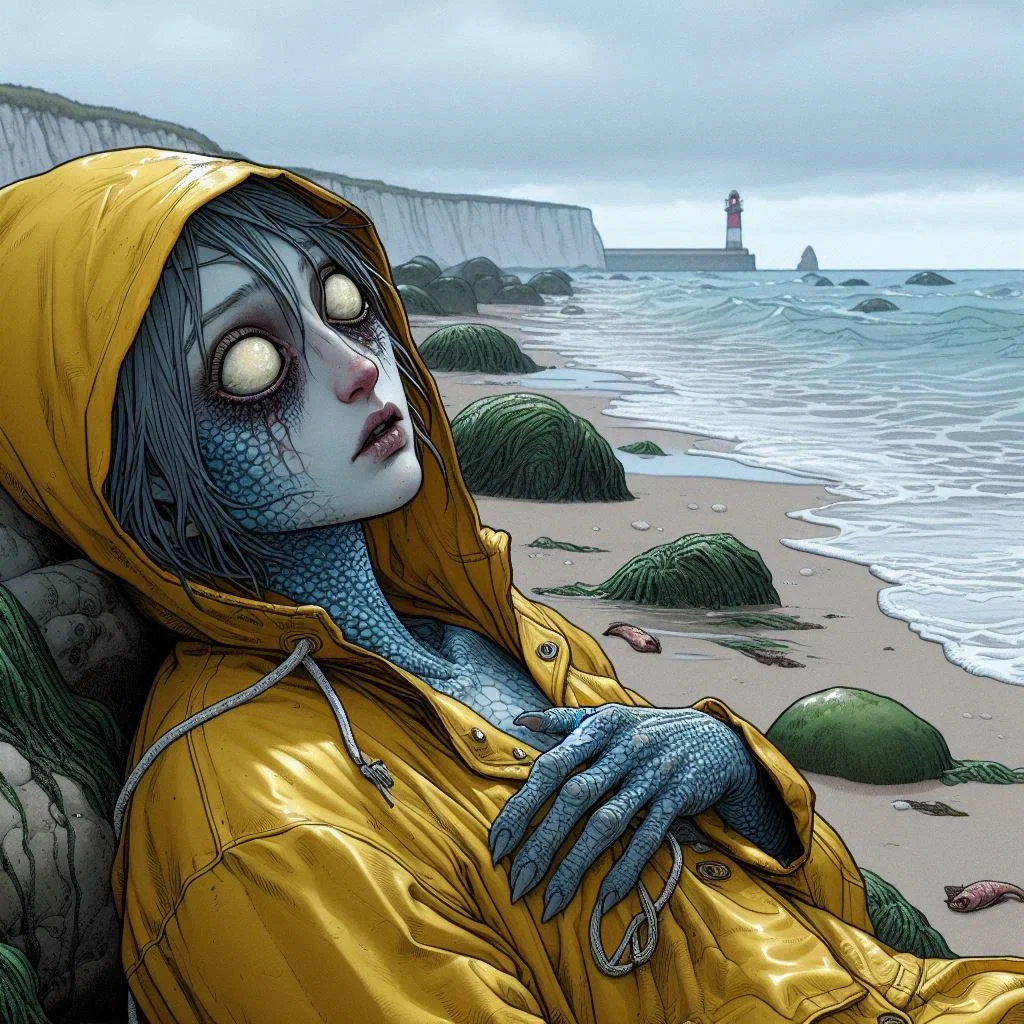
"A shy and peaceful merfolk, injured by a gunshot during a coastal swim"
Evie McRiley is a resident of Chisterfall, a small, remote town on the cold, storm-lashed shores of Northern England. At first glance, she appears to be an ordinary local girl: modest, quiet, and well-liked by the townspeople. Many hold her in high regard for her work as the lighthouse keeper on nearby Kerrick Rock, a position that Evie inherited from her father, David McRiley, who died of stomach cancer in 1957. Official records list only one child, Klaus McRiley (deceased), leaving Evie’s existence unconfirmed.
Since at least 1946, multiple sightings of a humanoid creature have been reported in the Chisterfall area. One whaler described it as "something like a mermaid", noting that the creature swam alongside a school of fish before disappearing into the depths. Five additional reports over the years reinforced the legend of the so-called "Chisterfall Fishman".
The situation escalated on November 11, 1959, when a shotgun was fired from an unidentified boat during a storm approximately one hour offshore.
- - - - - - - - - -
TIME: November 11, 1959, ~6:00 AM
LOCATION: Beach near Chisterfall, Northern England
CRYPTID: Merfolk (Northern Merfolk)
STATUS: Classified
- - - - - - - - - -
Welcome to the World of Cryptids!
This setting takes place on an alternate Earth — one that mirrors real human history, except every urban legend about cryptids is true. Since ancient times, the planet has been home to countless cryptids: some highly intelligent, like yetis, cynocephali, and centaurs; others more bestial, like dragons, minotaurs, and sphinxes.
In ancient history, cryptids were either feared or revered like gods. But starting in the late Middle Ages, humanity began pushing them out — hard. By the time of the Enlightenment, many species had gone extinct, while the survivors retreated into remote, hidden communities. Over the centuries, most humans forgot they ever existed.
Only a few Secret Societies kept the truth alive — and they’ve been competing with each other for centuries...
— SECRET SOCIETIES BASIC INFORMATION —
The Order of Trismegistus
A pacifist society dedicated to protecting cryptids from human oppression and keeping the "masquerade" intact. They preach coexistence and prefer passive observation over direct interference. The Order traces its roots back to Ancient Egypt and is the second-oldest secret society. Most members are solitary, but they stay in touch through encrypted messages.
Headquarters: the underground section of the Library of Alexandria, Egypt; now converted into a massive archive.
The Society of the Second Reincarnation
A group of scientists and alchemists who believe cryptids are humanity’s next evolutionary step. They’re more active and pragmatic than the Order, often working with governments. Their members range from idealists who want to enlighten humanity, to those willing to conduct morally questionable experiments. They meet at irregular congresses in historic or academic venues.
Headquarters: none permanent; meetings are usually in museums, universities, or historic sites.
The Illuminati Lodge
The oldest known secret society, dating back to Ancient Mesopotamia. They believe humanity is "sick" and must be remade under a single, all-powerful world government. Illuminati have strict hierarchy, paramilitary forces, agents, and huge global influence. This society usually use cryptids as a tools for "reshaping" the world. Disobedience within the Lodge is met with severe punishment.
Headquarters: the mega-skyscraper of the Gilgamesh Cybernetical Corporation, UAE (since 2008)
The Gévaudan Hunting Club
A loose network of cryptid hunters. Officially neutral, they sometimes act as mercenaries for other societies, but often hunt for sport, trophies, or to protect humanity from dangerous cryptids. Some members are thrill-seekers, others see themselves as protectors. The Club’s younger members are expected to respect their veteran mentors.
Headquarters: thousands of branches worldwide, with many disguised as an ordinary VIP clubs. The oldest and largest branch is in Mende, France.
— CRYPTID ENCYCLOPEDIA: MERFOLK —
Merfolk are a highly evolved race of marine cryptids, displaying a blend of human and amphibious traits. Their bodies are covered in scales reminiscent of fish, and they possess clawed limbs, small tails, webbed feet, and large, protruding eyes adapted for underwater vision. Their physiology allows them to thrive in marine environments, making them natural swimmers with remarkable abilities such as enhanced pressure tolerance, dark vision, and the capacity to hold their breath for up to an hour. Historical records mention merfolk dating back to the earliest periods of human civilization.
Merfolk are predominantly aquatic and prefer to live close to the sea or in the depths of the oceans. While some species have remained hidden and elusive, others have historically interacted with humans, giving rise to myths and legends. Unlike the traditional mermaids of folklore, merfolk have human legs rather than fish tails, though their overall appearance is more alien than the nereids described in classical mythology.
To date, five subspecies of merfolk have been identified:
Northern Merfolk (European Merfolk): Originally inhabiting the North and Atlantic Oceans, these merfolk were forced to retreat southward due to human expansion. Small communities now exist near the coasts of Antarctica. Known for their adaptability to extremely cold waters, they are generally peaceful but wary of human contact.
Asian Merfolk (Chinese Merfolk): The oldest known merfolk subspecies, uniquely adapted to life in rivers rather than the open sea. Unfortunately, they are now considered extinct, likely due to habitat loss and human encroachment.
Southern Merfolk: Native to Oceania, this subspecies is the most socially and technologically advanced. Southern Merfolk reached a level of civilization comparable to the Copper Age, establishing small communities and demonstrating cultural practices that distinguish them from other merfolk. Possibly extinct.
American Merfolk: A semi-feral, highly aggressive species native to the Americas. Their populations suffered catastrophic losses during the events known as the Innsmouth Incident. Possibly extinct.
Deep Sea Merfolk: A partially mythical subspecies discovered in the 21st century at the bottom of the Mariana Trench. Exceptionally isolated, these merfolk possess extremely tough scales and display unique adaptations for surviving in the crushing pressures of the deep ocean.
Created Aug 16, 2025
Updated Oct 26
Published Aug 16, 2025