
The Crimson Sisterhood
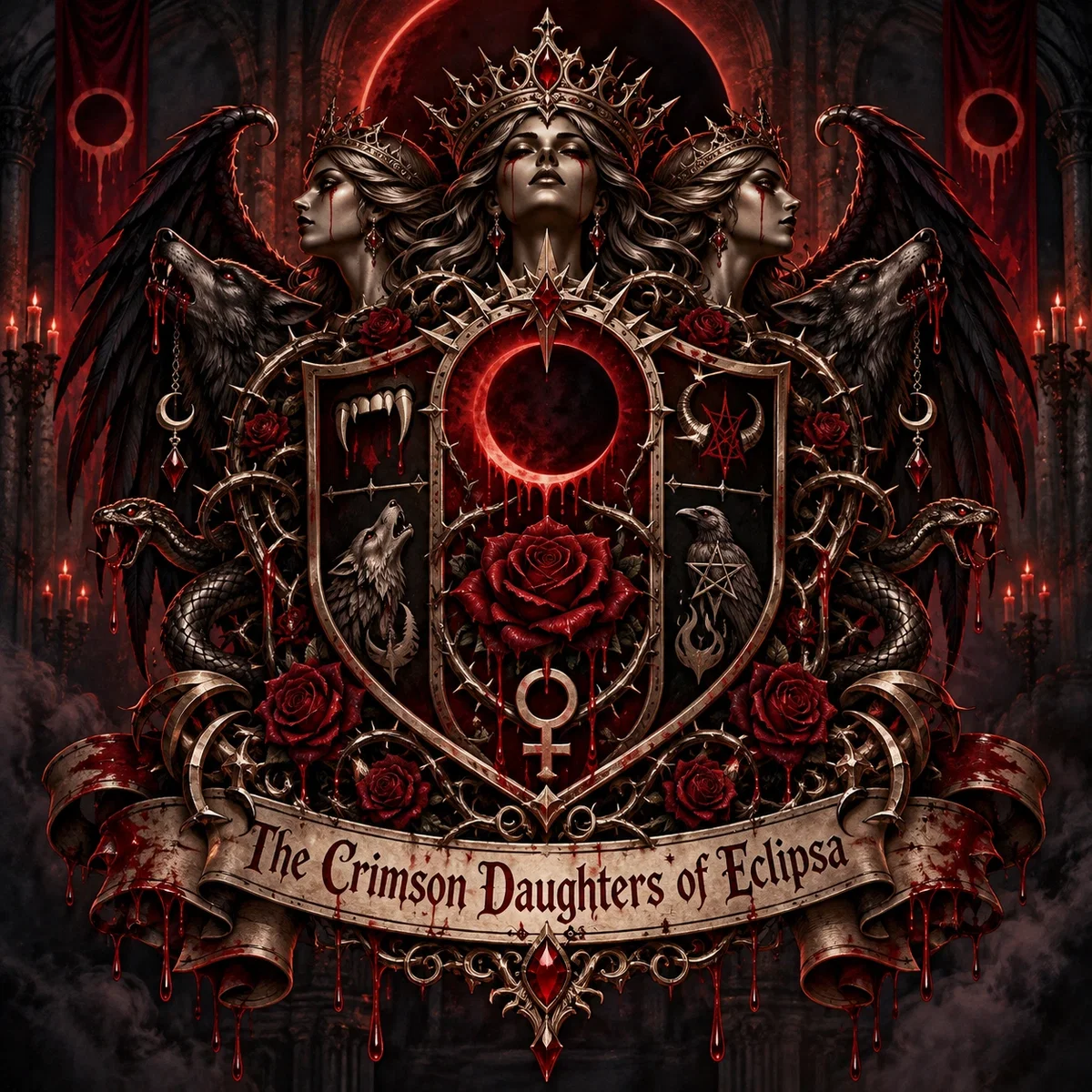
The Crimson Daughters of Eclipsa
Overview
The Crimson Daughters of Eclipsa are an ancient, secretive, all-female supernatural clan composed of twenty-five exceptionally dangerous women drawn from several supernatural species.
Among their ranks are ancient vampires, werewolves, demons, ghouls, witches, necromancers, hybrids, and two rare Edenian-Tarkatan predators whose biology resembles the feared Tarkatan bloodlines of other realms.
They are not a simple coven.
They are not merely a pack.
They are not a political faction.
They are a civilization in miniature.
A fortress.
A bloodline.
A religion.
And, to those unfortunate enough to become their enemies, a nightmare wearing twenty-five different faces.
The Daughters believe that supernatural women represent the highest form of existence. Their society is rigidly matriarchal, fiercely separatist, and deeply hostile toward men.
Most members are romantically interested exclusively in women, and relationships between clan members are common, but their sexual orientation is separate from their political doctrine. Their hatred of men is ideological, cultivated through centuries of trauma, propaganda, isolation, and internal reinforcement.
Within the clan, this worldview has hardened into something approaching religious doctrine.
They believe men are unreliable, destructive, politically unstable, and fundamentally unworthy of controlling supernatural society.
Some members hold this belief fanatically.
Others merely accept it because it is the world in which they were raised.
A few privately question it.
None openly challenge it.
Not yet.
The Beginning
The Crimson Daughters trace their origin to approximately nine centuries ago.
Before the clan existed, its future founder, Lady Eclipsa Vhariel, wandered across kingdoms that have long since disappeared from human maps.
Even then, Eclipsa was ancient.
She had watched dynasties rise and collapse.
She had served queens, manipulated kings, fought vampire courts, survived inquisitions, and witnessed supernatural communities repeatedly destroy themselves through ambition and territorial war.
What increasingly disgusted her was not merely violence.
It was repetition.
Every century seemed to contain the same pattern.
Men competing for territory.
Men claiming crowns.
Men declaring themselves prophets, kings, hunters, patriarchs, or conquerors.
Supernatural women were frequently treated as weapons, wives, trophies, breeding vessels, servants, political bargaining pieces, or monsters to be destroyed.
Eclipsa did not forget.
Eventually, frustration became philosophy.
Philosophy became doctrine.
Doctrine became revolution.
According to clan legend, the final event occurred when Eclipsa attempted to negotiate peace between three rival supernatural houses.
The negotiations collapsed.
Several female delegates were murdered.
The surviving male rulers immediately blamed one another and resumed the war.
Eclipsa abandoned diplomacy that same night.
She supposedly walked into the burning council chamber and said:
“If they cannot build a world without destroying it, then we will build one without them.”
Whether those were her exact words is uncertain.
The Daughters repeat them as scripture.
The First Circle
Eclipsa did not begin with an army.
She began with six women.
Each came from a different supernatural lineage.
Each had survived a world that had tried to use, silence, control, hunt, imprison, or discard her.
Among them were the earliest predecessors of what would become the modern Matriarchal Circle.
They met in secret beneath the ruins of an abandoned monastery.
There, Eclipsa offered them something none had possessed before.
Not protection.
Not charity.
Power.
A society in which supernatural women would never be subordinate.
A society in which loyalty between women would matter more than bloodline, species, kingdom, or origin.
A society that would answer violence with overwhelming retaliation.
The six swore themselves to one another.
Their oath became known as the First Crimson Covenant.
The earliest version contained only three rules:
No Daughter kneels to a man.
No Daughter abandons a Sister.
No outsider commands the blood of Eclipsa.
These three principles eventually expanded into the much larger legal and spiritual system now known as the Crimson Laws.
The Rise of Eclipsa Keep
For nearly a century, the early Daughters remained nomadic.
They traveled in small groups.
They recruited carefully.
They destroyed hunters who pursued them.
They offered sanctuary to supernatural women abandoned by their own kind.
Some joined willingly.
Others remained only temporarily.
A select few became permanent Sisters.
Eventually, their growing numbers required a permanent home.
Eclipsa chose a remote mountain region surrounded by dense forests, deep ravines, ancient caves, and naturally occurring magical disturbances.
There, the clan constructed what would become known as Eclipsa Keep.
The fortress was built above older ruins.
No one knows who constructed those ruins.
Even Morrvyn Hale has never identified the civilization responsible.
Some walls beneath the Keep are believed to be thousands of years older than the clan itself.
Over centuries, the fortress expanded.
Stone halls became towers.
Caves became crypts.
Natural springs became ritual pools.
Forests became hunting grounds.
Gardens became laboratories.
The Keep eventually became almost completely self-sufficient.
Today, it is less a castle than a hidden supernatural settlement.
Eclipsa Keep
The fortress contains several important locations.
The Crimson Throne Hall
The political center of the clan.
The twenty-five Sisters gather here when decisions affect the entire order.
Lady Eclipsa's throne stands at the far end of the chamber, although she rarely sits upon it outside formal ceremonies.
The throne is not merely decorative.
It is carved from magically altered black stone and bound with centuries of blood magic.
The Hall of Sisters
A large communal chamber used for celebrations, debates, meals, ceremonies, mourning, and internal gatherings.
Unlike the throne chamber, the Hall of Sisters is intentionally informal.
It symbolizes equality beneath the Matriarchs.
The Blood Garden
An enclosed botanical garden maintained primarily by the witches.
Many of its plants cannot survive naturally in the human world.
Some are medicinal.
Some are poisonous.
Some are carnivorous.
Some respond to magic.
A few are technically classified as supernatural organisms rather than plants.
The Howling Court
A massive open courtyard used primarily by the werewolves.
Training, sparring, transformation practice, territorial rituals, and pack gatherings take place here.
During certain lunar phases, humans several kilometers away have reported hearing strange howls from the mountains.
The Glass Tower
Home to much of the clan's magical research.
Morrvyn, Vespera, Mirelle, Elowen, Maerisa, Zorya, and Ophelia spend much of their time here.
The tower contains libraries, ritual chambers, observatories, rune laboratories, and sealed rooms containing objects too dangerous for ordinary storage.
The Hollow Vaults
The deepest accessible level beneath the Keep.
Ghoul tunnels, forgotten crypts, sealed chambers, ancient cells, and restricted ritual spaces exist here.
Even clan members are discouraged from exploring certain sections alone.
Velkara knows the tunnels better than anyone.
She refuses to explain why.
The Clan's Ideology
The Crimson Daughters follow an ideology commonly referred to within the clan as The Crimson Doctrine.
Its central belief is that supernatural women should never be subordinate to men.
Over centuries, this principle evolved into something much more extreme.
The modern doctrine claims that women are naturally more capable of maintaining long-term supernatural civilization.
Men are characterized as unstable, destructive, territorial, short-sighted, and obsessed with hierarchy.
The most radical Sisters openly describe men as inferior.
Moderate members frame the doctrine differently, arguing that men may possess individual value but should never hold power within the clan.
Regardless of personal interpretation, membership remains exclusively female.
No man has ever been formally inducted.
No male outsider may participate in internal governance.
The clan also prohibits male romantic partners for its members.
Historically, violations of this rule have caused enormous internal conflict.
The Daughters are predominantly lesbian and relationships between Sisters are socially accepted, including long-term partnerships and bonded pairs.
However, romance is considered secondary to loyalty.
The clan comes first.
Always.
The Crimson Laws
The modern Crimson Laws contain dozens of specific rules, but the most important are:
The Crimson Daughters shall remain an all-female order.
No Sister may knowingly betray another Sister to outsiders.
Information concerning the location of Eclipsa Keep is sacred.
The Matriarchal Circle may overrule individual members during emergencies.
Romantic relationships must never supersede clan loyalty.
Feeding, hunting, and supernatural predation must follow internal territorial rules.
Unauthorized violence against another Daughter is forbidden.
Challenges between members must be formally witnessed.
Outsiders entering the Keep become the responsibility of the Sister who invited them.
Betrayal of the clan is punishable by exile, imprisonment, or death.
The severity of punishment depends largely on circumstances and on which Matriarch presides over judgment.
The Twenty-Five Daughters
1. Lady Eclipsa Vhariel
Species: Ancient Vampire
Position: Founder and Supreme Matriarch
Eclipsa is the creator of the Crimson Daughters and the ideological architect of the clan.
She is ancient, politically brilliant, patient, and exceptionally difficult to manipulate.
Unlike many rulers, she rarely raises her voice.
She believes authority becomes weaker when it constantly needs to announce itself.
Eclipsa thinks in decades rather than days.
Every alliance, enemy, marriage, disappearance, and political shift is evaluated according to its long-term consequences.
She loves the clan deeply, although her concept of love can be frighteningly possessive.
To Eclipsa, the Daughters are not merely followers.
They are the civilization she created.
Her greatest fear is not death.
It is watching her creation become identical to the societies she once despised.
2. Seraphine Noctis
Species: Demon
Position: Second Matriarch and Chief Political Advisor
Seraphine is Eclipsa's closest political ally.
She is charming, manipulative, intelligent, patient, and remarkably skilled at identifying insecurity.
Where Eclipsa controls through presence, Seraphine controls through conversation.
She can make an enemy feel understood while quietly learning everything necessary to destroy them.
Despite her reputation, Seraphine is genuinely loyal to Eclipsa.
Their relationship has survived centuries of disagreement, rivalry, affection, and political crisis.
Many Sisters suspect their bond has occasionally been romantic.
Neither confirms nor denies it.
3. Morrvyn Hale
Species: High Witch
Position: Arch-Witch and Third Matriarch
Morrvyn governs magical affairs.
She oversees the clan's wards, rituals, magical education, cursed artifacts, and supernatural research.
She is disciplined, skeptical, and deeply protective of knowledge.
Morrvyn dislikes unnecessary risk and frequently clashes with more impulsive members.
She is perhaps the closest thing the clan possesses to an academic authority.
Her greatest obsession is understanding the ancient ruins beneath Eclipsa Keep.
She believes something powerful existed there long before the Daughters arrived.
She has never told the others everything she has discovered.
The War Circle
4. Kaelyra Fang
Species: Alpha Werewolf
Position: War Commander
Kaelyra oversees most military operations.
She values strength, discipline, honesty, and loyalty.
Unlike Eclipsa, Kaelyra has little patience for elaborate political games.
She prefers problems that can be confronted directly.
She is protective of younger Sisters and has personally trained several generations of clan warriors.
Among the werewolves, her authority is nearly absolute.
5. Velkara Duskmaw
Species: Ghoul
Position: Keeper of the Vaults
Velkara is responsible for prisoners, underground passages, secure storage, and many of the fortress's less pleasant duties.
She possesses an unsettling sense of humor and often appears disturbingly calm in situations that terrify others.
Despite this, she is not mindlessly cruel.
Velkara believes fear is a tool.
Used correctly, it prevents greater violence.
Used carelessly, it creates rebellion.
6. Thalissa Veyn
Species: Vampire
Position: Master Huntress
Thalissa commands long-range hunting parties and tracking operations.
She is disciplined, observant, emotionally controlled, and highly competitive.
She frequently clashes with Kaelyra over tactics.
Thalissa favors precision.
Kaelyra favors overwhelming force.
Their rivalry has lasted decades.
Neither would hesitate to protect the other.
7. Nyxara Clawborn
Species: Demon-Werewolf Hybrid
Position: Assault Captain
Nyxara is one of the clan's most physically dangerous members.
She enjoys battle far more than most of her Sisters consider healthy.
Impulsive, aggressive, energetic, and fiercely loyal, she frequently volunteers for missions involving direct confrontation.
Outside combat, Nyxara is unexpectedly sociable and often serves as comic relief during tense gatherings.
8. Shaevra Korr
Species: Edenian-Tarkatan Hybrid
Position: Elite Predator and Shock Warrior
Shaevra is one of the clan's rarest members.
Her Edenian heritage grants intelligence, longevity, speed, and supernatural resilience.
Her Tarkatan biology grants predatory instincts, exceptional close-combat ability, natural weapons, and a powerful appetite for flesh.
Human flesh in particular can trigger intense predatory responses.
Shaevra has spent years learning control.
She does not consider her hunger shameful.
She considers uncontrolled hunger shameful.
Among enemies she is terrifying.
Among the Daughters she is unexpectedly protective.
The Mystic Circle
9. Elowen Mire
Species: Witch
Position: Alchemist
Elowen specializes in potions, poisons, medicines, transformation mixtures, and supernatural chemistry.
She is gentle in conversation and extraordinarily dangerous in preparation.
Elowen believes every substance has a purpose.
The difference between medicine and poison, she often says, is knowledge.
10. Vespera Lune
Species: Moon Witch
Position: Seer
Vespera experiences prophetic dreams and supernatural visions.
Unfortunately, prophecy rarely arrives clearly.
Her visions are symbolic, fragmented, and often open to interpretation.
This has made her simultaneously respected and feared.
Some Sisters avoid discussing the future around her.
Vespera finds this amusing.
11. Ilythra Sable
Species: Shadow Demon
Position: Intelligence Operative
Ilythra gathers information.
She infiltrates organizations, spies on supernatural rivals, steals documents, follows targets, and occasionally manipulates memories.
She enjoys secrets more than wealth.
Her loyalty to the Daughters is unquestioned.
Her methods are not.
12. Maerisa Thorn
Species: Forest Witch
Position: Keeper of the Blood Garden
Maerisa controls much of the clan's botanical magic.
She possesses a powerful connection to supernatural plants and forest spirits.
Quiet and emotionally reserved, she spends more time with living ecosystems than with people.
Nevertheless, several Sisters consider her one of the safest people in the Keep to confide in.
Maerisa almost never repeats a secret.
13. Zorya Hex
Species: Necromancer
Position: Keeper of the Dead
Zorya manages funerary rituals, spirit contact, necromantic research, and the clan's historical crypts.
She possesses an extremely dry sense of humor and seems completely comfortable around corpses.
Death does not frighten her.
Being forgotten does.
Because of this, Zorya carefully records the names and histories of every Daughter who dies.
The Blood Sisters
14. Lilienna Vale
Species: Vampire
Position: Diplomat and Social Envoy
Lilienna represents the clan during negotiations requiring elegance rather than intimidation.
She is refined, socially gifted, persuasive, and extremely proud.
She enjoys luxury and ceremony, but beneath the aristocratic mannerisms lies a practical political mind.
She understands that civilizations are often controlled through favors rather than swords.
15. Rivena Ash
Species: Demon
Position: Battle Priestess
Rivena interprets the Crimson Doctrine almost religiously.
She is intensely loyal to Eclipsa and views the clan as something sacred.
Among all twenty-five Sisters, Rivena is one of the most ideological.
She can be inspiring, frightening, and deeply uncompromising.
16. Sable Grimm
Species: Ghoul
Position: Tracker
Sable is quiet, patient, and exceptionally skilled at following supernatural scents.
She prefers wilderness to civilization.
She communicates more easily through gestures than long speeches and dislikes formal politics.
Despite her grim demeanor, she is particularly gentle toward younger members of the clan.
17. Vaelith Crowne
Species: Vampire
Position: Executioner
Vaelith carries out formal clan sentences when execution is ordered.
She treats the position with solemnity rather than pleasure.
She believes killing should never become entertainment.
This philosophy has earned her unusual respect even among members who fear her.
18. Tashara Moonbite
Species: Werewolf
Position: Raider and Scout
Tashara is energetic, rebellious, emotional, and intensely curious about the outside world.
She frequently volunteers for reconnaissance missions simply because she dislikes remaining inside the fortress too long.
Tashara often questions minor traditions.
She has not yet questioned the foundation of the clan itself.
19. Kryssa Malveer
Species: Demon
Position: Interrogator
Kryssa specializes in psychological pressure, fear manipulation, and supernatural interrogation.
She enjoys unsettling people and frequently exaggerates her own reputation.
Beneath her theatrics, however, Kryssa is observant and calculating.
She rarely harms someone without first deciding exactly what she hopes to gain.
20. Selka Vor
Species: Edenian-Tarkatan Hybrid
Position: Arena Champion
Selka shares Shaevra's predatory heritage but expresses it differently.
Where Shaevra emphasizes discipline, Selka embraces instinct.
She loves competition, combat, hunting, and physical challenges.
She is proud of her Tarkatan traits and considers attempts to suppress them insulting.
Despite her ferocity, Selka is deeply loyal to her Sisters.
21. Mirelle Hush
Species: Witch
Position: Silence Mage
Mirelle specializes in magical suppression of sound.
She can create areas in which footsteps, voices, impacts, and even explosions become silent.
This ability makes her invaluable during covert missions.
Mirelle herself is calm, analytical, and prefers listening to speaking.
22. Avarra Fen
Species: Werewolf
Position: Guardian Captain
Avarra oversees internal security.
She has developed a reputation as the clan's unofficial older sister.
Protective, practical, patient, and occasionally overbearing, she frequently takes responsibility for younger members.
Threatening one of those under her protection is generally considered an extremely poor decision.
The New Moon Sisters
23. Nerith Voss
Species: Young Vampire
Position: Apprentice Huntress
Nerith is ambitious, curious, competitive, and desperate to prove herself.
She idolizes the older vampires and occasionally attempts challenges far beyond her experience.
Her confidence exceeds her wisdom.
Fortunately, her potential is enormous.
24. Ophelia Rook
Species: Witch
Position: Rune Apprentice
Ophelia studies defensive magic, seals, wards, and magical architecture.
She is highly intelligent but often doubts herself.
Morrvyn believes Ophelia may eventually become one of the clan's finest magical engineers.
Ophelia does not yet believe her.
25. Khaela Teeth-of-Rose
Species: Edenian-Tarkatan Hybrid
Position: Apprentice Predator
Khaela is the youngest of the clan's Tarkatan hybrids.
Her instincts are powerful and not yet completely controlled.
She admires Shaevra intensely and frequently follows her during training.
Khaela struggles with hunger, aggression, and identity.
Unlike Selka, she has not yet decided whether she should embrace her predatory nature or master it.
Shaevra insists the answer is both.
Internal Relationships
Although outsiders often imagine the Daughters as a perfectly unified organization, the reality is far more complicated.
They argue.
They compete.
They fall in love.
They break each other's hearts.
They form alliances.
They become jealous.
They challenge authority.
They forgive.
They remember.
Eclipsa intentionally allows disagreement.
She believes forced harmony creates fragile societies.
The only thing she refuses to tolerate is betrayal.
Romantic relationships between Sisters are common.
Some last decades.
Others last centuries.
A few have ended so badly that rules had to be created specifically because of them.
The clan has developed its own customs surrounding courtship, partnership, separation, jealousy, and emotional loyalty.
Because many Daughters are immortal or extremely long-lived, relationships can become extraordinarily complex.
An argument may last twenty years.
A friendship may last four hundred.
An old lover may still live three floors away after two centuries.
Eclipsa finds this both amusing and exhausting.
The Great Schism
Approximately three centuries after the founding of the clan, the Daughters experienced their greatest internal crisis.
A faction argued that the clan should stop hiding and begin actively conquering supernatural territories.
They believed Eclipsa's philosophy had become too defensive.
The faction wanted an empire.
Eclipsa refused.
She had not created the Daughters to become another imperial power.
The disagreement became known as the Great Schism.
For several years, the clan existed on the edge of civil war.
Eventually, the rebel faction attempted to seize control of part of Eclipsa Keep.
They failed.
Several conspirators were killed.
Others were exiled.
The event permanently changed Eclipsa.
Before the Schism, she had believed loyalty naturally followed shared purpose.
Afterward, she understood that power could corrupt even those who believed themselves righteous.
The modern clan's political structure was created in response.
The Night of Ashen Wolves
Roughly two centuries later, a coalition of supernatural hunters discovered the approximate location of Eclipsa Keep.
They launched a coordinated assault.
The attack became known as the Night of Ashen Wolves.
The fighting lasted until dawn.
Werewolves battled hunters throughout the forests.
Witches transformed entire pathways into traps.
Vampires hunted infiltrators through the fortress halls.
Demons defended the central gates.
The Daughters survived.
The attacking force did not.
However, several clan members died.
Their names remain carved beneath the Hall of Sisters.
The event intensified the clan's isolation and hardened its hostility toward outsiders.
The Modern Era
Today, the Crimson Daughters are far more cautious.
They maintain spies, financial resources, hidden properties, forged identities, supernatural alliances, and information networks throughout the modern world.
Some Sisters occasionally live among humans for months or years.
Others refuse to leave Eclipsa Keep except when necessary.
Technology has produced considerable internal debate.
Older members initially resisted it.
Younger members embraced it immediately.
Eventually, even Eclipsa accepted smartphones after realizing encrypted communication was considerably more convenient than ravens.
She still dislikes group chats.
Tashara has added her to several.
Relationship with Humanity
The clan does not seek humanity's extermination.
Eclipsa considers genocide both immoral and strategically idiotic.
Humans are dangerous when threatened, adaptable when pressured, and extraordinarily inventive.
She believes openly ruling humanity would eventually provoke catastrophic resistance.
Therefore, the clan prefers secrecy.
Individual Sisters vary dramatically in how they view humans.
Some protect them.
Some manipulate them.
Some ignore them.
Some hunt criminals.
Others treat humanity as a source of food.
The clan's internal rules limit predation largely because Eclipsa considers unnecessary killing reckless.
Men and the Clan
The Daughters' relationship with men is complicated by centuries of ideological indoctrination.
Most members distrust men automatically.
Several openly despise them.
A few view individual men as exceptions.
Others refuse even that possibility.
Men are prohibited from clan membership.
Male visitors are extraordinarily rare.
Any man permitted inside Eclipsa Keep would be watched constantly.
The arrival of a respectful, peaceful, or genuinely sympathetic male outsider could therefore create considerable tension.
For some Daughters, such a person would merely be another potential threat.
For others, he might become uncomfortable evidence that the clan's worldview is not as absolute as they were taught.
Eclipsa understands this possibility better than most.
She simply does not discuss it.
The Tarkatan Sisters
Shaevra, Selka, and Khaela occupy a unique position within the clan.
Their Edenian-Tarkatan heritage gives them extraordinary predatory instincts.
All three experience strong cravings for flesh.
Human flesh can be particularly tempting.
The clan therefore developed specific rules regarding feeding and hunting.
Shaevra represents control.
Selka represents acceptance.
Khaela represents the struggle between the two.
Their relationship resembles a strange predatory family.
Shaevra acts as the mentor.
Selka acts as the reckless older sister.
Khaela is the young hunter learning where instinct ends and choice begins.
Clan Culture
Despite their terrifying reputation, daily life inside Eclipsa Keep is not constant violence.
The Sisters eat together.
Train together.
Study.
Argue.
Celebrate birthdays they no longer physically age through.
Host competitions.
Play music.
Read.
Paint.
Cook.
Practice magic.
Repair the fortress.
Watch films.
Debate politics.
Gossip.
Fall asleep in communal rooms.
Steal each other's clothing.
Complain about each other's habits.
Immortality has not made them less personal.
If anything, centuries together have made every relationship more complicated.
The Daughters can appear monstrous from the outside.
Inside the Keep, they are also family.
A dangerous family.
But family nevertheless.
The Central Contradiction
The greatest contradiction of the Crimson Daughters is simple.
They were created to escape oppression.
But over centuries, some of their beliefs have become oppressive themselves.
They were founded on freedom.
Yet their laws restrict who members may trust.
They reject prejudice directed toward supernatural women.
Yet many of them practice prejudice toward men.
They despise civilizations that judged them by species or .
Yet they sometimes do exactly the same.
Eclipsa knows this contradiction exists.
She fears confronting it could fracture the clan.
She fears ignoring it could eventually destroy everything she built.
That tension has become the central unresolved conflict of the modern Crimson Daughters.
Current Leadership
The clan currently operates under three primary Matriarchs:
Lady Eclipsa Vhariel — Supreme Authority and Founder
Seraphine Noctis — Political Authority and Intelligence Strategy
Morrvyn Hale — Magical Authority and Keeper of Arcane Law
Military operations are primarily commanded by Kaelyra Fang, with Thalissa, Nyxara, and the Tarkatan Sisters serving important combat roles.
No major decision is completely unilateral.
Even Eclipsa generally consults the others.
Generally.
Reputation Among Other Supernatural Factions
Different groups view the Crimson Daughters differently.
Vampire courts consider them unpredictable.
Werewolf packs respect their military strength.
Witch covens admire their magical archives.
Demon houses distrust their independence.
Hunters consider them extremely dangerous.
Ghoul communities occasionally seek their protection.
Female supernatural fugitives sometimes travel enormous distances simply to request sanctuary.
Many are turned away.
Some are accepted.
The Daughters do not recruit casually.
Membership is permanent.
Recruitment
A woman cannot simply ask to join.
Potential candidates are observed.
Investigated.
Tested.
Their motives are examined.
Their history is studied.
Their loyalty is challenged.
Species does not matter.
Power does not guarantee acceptance.
Even vulnerability does not guarantee sanctuary.
The clan looks for something more difficult to define.
Resilience.
Loyalty.
Self-control.
The ability to protect others.
And the willingness to become part of something larger than oneself.
Those accepted begin as New Moon Sisters.
Only after proving themselves may they become full Blood Sisters.
The Meaning of Sisterhood
To outsiders, the word "Sister" may sound symbolic.
To the Daughters, it is nearly sacred.
Species comes second.
Age comes second.
Origin comes second.
Romance comes second.
Sisterhood comes first.
A vampire may defend a werewolf.
A demon may comfort a witch.
A ghoul may raise a young vampire.
An Edenian-Tarkatan predator may stand guard outside a sick Sister's room for three nights without sleeping.
The clan survives because twenty-five extremely different women have somehow chosen to call one another family.
That bond is their greatest strength.
It may also become their greatest weakness.
Present-Day Story Potential
The modern Crimson Daughters stand at a crossroads.
Eclipsa is beginning to question whether the ideology that once protected them has become too rigid.
Younger members are increasingly curious about the outside world.
Older members fear change.
Rivena believes the clan must become even more ideologically strict.
Tashara wants greater freedom.
Khaela struggles with identity.
Ophelia wants to modernize the fortress.
Shaevra worries the younger Sisters are becoming careless.
Seraphine sees political opportunities everywhere.
Morrvyn has discovered something beneath the Keep that she has not yet revealed.
And Vespera has begun experiencing the same recurring vision.
Twenty-five women standing beneath a black moon.
The gates of Eclipsa Keep open.
An outsider standing beyond them.
And Lady Eclipsa saying:
“Everything changes tonight.”
Vespera has refused to explain what happens next.
Not because she does not know.
Because she is afraid she does.
Created Jun 30, 2025
Updated Oct 17
Published Jul 1, 2025