
MagnumellansUTOVerse
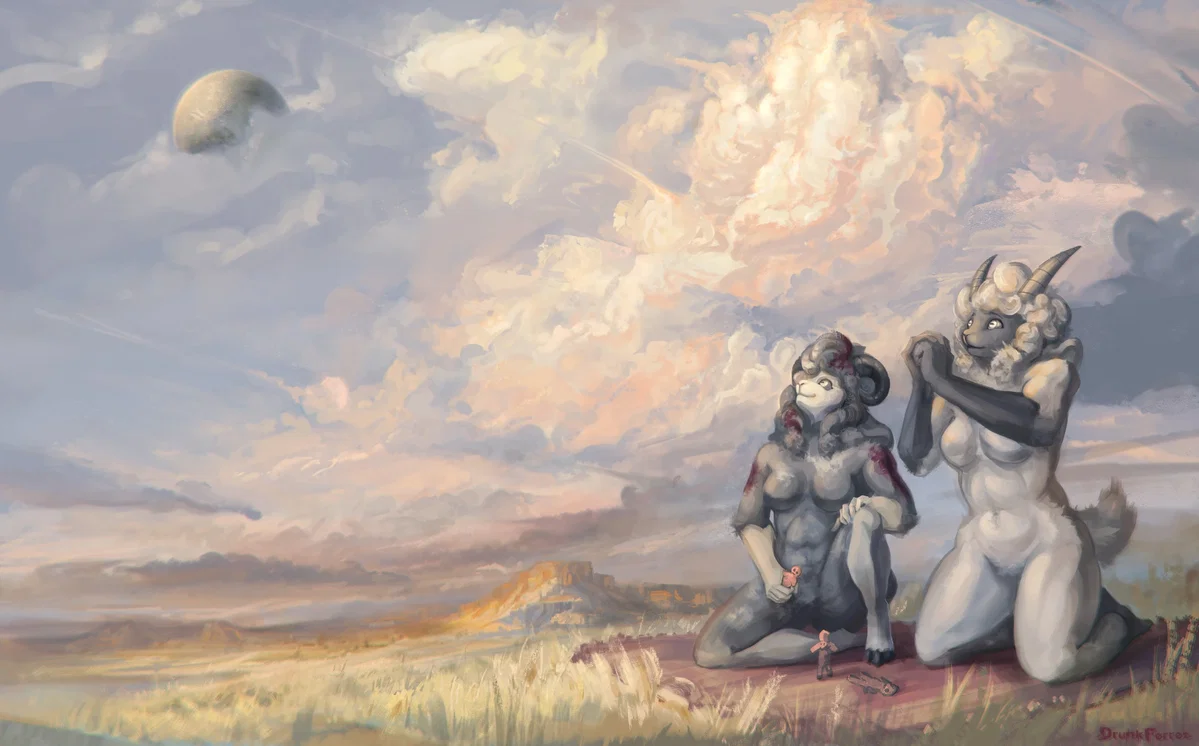
The Magnumellans are bipedal, odd -toed, nonhuman (Mesos) ungulates, resembling herbivorous quadruped
mammals like sheep and goats from Earth . They have sexual dimorphism, where the two sexes of the same
species exhibit different morphological characteristics. Males on average are slightly shorter, with broader
shoulders. Females are taller, with feminine curves and developed breasts. Both have a similar muscle
density. In both genders, the hooves are relatively compact but only cover the tips of the digits on their toes
and fingers.
They are not to be confused with the Woloas, another race of sheep Mesomorphs in the galaxy that came
about through convergent exo -evolution and both species are not genetically compatible for interbreeding.
The two genders have stocky legs with strong, thick thighs. The ears of the females are typically longer.
Both are short -tailed, though some subspecies in the polar regions are known to have longer tails. Both
sexes are polycerate, having four horns. The primary is curved, 'ram -like' horns and is the same for both
genders. Magnumellan females’ secondary horns are small and pointier. Magnumellan males’ secondary
horns are generally larger, theirs being more prominent and longer, giving them a more 'goat-like'
appearance.
Magnumellan's faces, arms, and legs are either black, white, or indigo. Some are piebald —dark -colored with
areas of white, grey, or merlot -colored wool. The most distinguishing attribute of the species is their thick,
plush, woolly coats. The quality is greater than Merino wool on Earth for its luxurious softness. It has tensile
strength comparatively stronger than steel, making it a robust fire -resistance miracle fiber. The coat allows
the Magnumellan to regulate their body temperature, staying warm in the winter and cool in the summer.
Both sexes often braid their wool down each side of their faces, in front of their ears, or grow dreadlocks
behind the head. Apart from spacesuits, armor, and hazmat suits, the race does not wear clothes or
garments unless it is formally required.
Males and females are the only two naturally occurring and healthy genders for the Magnumellans. Females
experience heat once every 29 days, which lasts for 39 hours. It was an uncomfortable, restless experience
until modern science helped manage it with hormone -blocker drugs. The gestation period is eight months.
Childbirth was once a painful ordeal, and mothers were known to develop complications after having more
than three lambs in a lifetime. With the advent of advances in medical science, the race developed artificial
wombs and uterus, for extracorporeal pregnancy to circumvent the dangers of miscarriage.
The species have excellent senses even among nonhumans (Mesos). They have excellent peripheral and
vertical vision (second only to the Jahkatians) with above -average depth perception. Magnumellans have
excellent hearing. They can direct their ears in the direction of a sound, though they are overly sensitive to
high -pitched or loud noises. Like the Neishor, they have an excellent sense of smell. The species has a
below-average sense of touch and taste, on a level with human ranges. However, touching is important to
the interaction between Magnumellans. Offspring seek bodily contact with their mother's nose, lips, mouth,
and ears. Magnumellans in an intimate sexual relationship are no different.
Magnumellans evolved from social group herding animals and therefore need near -constant companionship
with their own kin or an AI as a substitute. Any prolonged duration of isolation results in their mental and
physical health deteriorating. Magnumellans do not experience anger, hatred, or disgust; such concepts are
alien to them. A Magnumellan is extremely loyal to their own species. They will not and cannot act violently
towards one another.
Unsuccessful first contact with the Magnumellans led many UTO and non -UTO species to wrongly believe
they were apathetic, cold, and uncaring. The species always maintained blank, neutral facial expressions,
eyes half -closed, and a dry demeanor. The Magnumellans were frightfully intelligent and spoke in a
monotonous, factual tone of voice. These mannerisms unnerved many visiting officials. They only care for
logic and reason. While the Ishentians respected their honesty, if somewhat abrupt, other races like the
Arkatians were offended by their lack of etiquette, believing them to be a brazen and arrogant people.
The exact opposite was later found to be true —Magnumellans have overpowering innate emotions beyond
conventional methods of suppression. They had such innate feelings of love and empathy that many
passionate outbursts would make even the Lupari seem phlegmatic by comparison. Their feelings of joy,
surprise, and sadness all once ruled them. Any happy, unexpected, or sad thought would overpower and
cripple their daily living .
If a baby is born, or a couple are wed, Magnumellans would party and celebrate for days, until they collapsed
from exhaustion. Magnumellans would cry for days if they stepped on a bug when paving roads. They would
painstakingly replant every Gramineae and flower they uprooted in clearing sites for new buildings, at a
considerable cost to time and resources. If a single worker died during the construction of a factory or
tunnel, they would cancel the entire project, thereby kicking off a year of national mourning.
In their past, their empathy got so out -of-control that they were forced to look for drastic ways to repress
their powerful feelings or face self -destruction (see The Great Repression). Magnumellans eventually
developed an emotion repression system —the Cortical Node. Surgically implanted into their brains, their
neurocircuitry was altered. Magnumellans were finally able to inhibit their rampant emotions and able to live
by rationality and facts instead.
However, the Cortical implants were a double -edged sword. It stripped them of their pacifism and love. They
will defend themselves if provoked. Most do not engage in combat directly but those that do take up arms,
will not hesitate to destroy any unwarranted aggression against their people. The Magnumellans show no
mercy on the battlefield and will not take prisoners. When reviewing the combat data shared, even the Ashar
and Asishi thought them 'ruthless' for not sparing any Rynar who surrendered , fearing they could, in the
wrong circumstance, use logic to justify anything, even genocide.
Magnumellans have very strong emotions towards humans (Terrans). They experience a phenomenon
known as "Proximity Cuteness", not too dissimilar from what many Mesos feel with Polarity Psychology, but
taken to the extreme. No intrusive thoughts of harming enter, but the other types of sensations (desire to
protect, compulsions to touch and so on) become overwhelming.
Curiosity awakens in an individual who spies a Terran 50 meters away, even if inside a mecha, compelling
them to investigate. They will not break eye -contact. Once within a 25 -meter radius of each other, a
Magnumellan cannot restrain themselves from approaching a human. The mere sight, sound, and smell of
human beings will overload their Cortical Nodes, forcing them to experience overpowering emotions of love
and empathy their ancestors had forsaken long ago.
They find the protests of a human to be 'adorable'. If the human runs or attempts to hide, they find this
action even more irresistible and give chase. Magnumellans cannot stop playing with or fondling the
humans they've seized. Their behavior is often inappropriate and demeaning as they nuzzle and wrap them
into their woolly coats. This often leads to poking Terrans into their cleavages, navels, or fluffy hindquarters
for safekeeping.
Once a Magnumellan has captured a human, they will refuse to release them from their caresses. If a Mesos
were able to reclaim the human away from the Magnumellan by force, it would cause overwhelming
psychological distress (far worse than Separation Anxiety seen in Guardian and human pairings) leading to
a nervous breakdown.
It was found that the Bovidae race indirectly experience the first stage of the phenomenon if they merely
see humans onscreen over their telecommunications. Yearning awakens if they witness their kin who have
humans in their possession expressing happiness. There is no cure for "Proximity Cuteness", their
attachment to humans is as immutable as any part of the fundamental structure of their brains.
Since the firs t contact diplomatic incident with the sheep Mesos, human and Magnumellan interaction is
strictly prohibited. The two species are forbidden under any circumstance to be allowed together in the
same vicinity. Any future negotiations between the UTO and Magnumellans will require intermediaries, or
both powers be separated via "proximity talks," which another independent non -member species will act as
mediator for. Any communication, with or without face -to-face contact, is also prohibited.
The Das'ar system is located in the Norma Arm of the Milky Way. It is comprised of four planets and one
star: two terrestrial and two gas giants. Tozo'rus A is part of an unusual double -planet system with Tozo'rus
B; both orbit the spectral type G -V star Das'ar. A and B are in the star's habitable zone. At 1.1 Earth masses,
Tozo'rus B is the slightly more massive of the two. Both worlds are tidally locked to each other as they orbit
round the star.
The most widely accepted hypothesis of the Das'ar system's formation was that Tozo'rus A and B formed
from planetary debris after the destruction of several Super Earths, which occurred as gas giant planet
Tus'ar began to migrate inwards to its host star. Tus'ar was pulled back into the outer exosolar system into
orbital resonance with gas giant Neis'ai. Tozo'rus A can support life and is the homeworld of various animal
Bovidae lifeforms, most notably the sapient, spaceflight -capable Magnumellan species. Tozo'rus B can also
support life, but for reasons unknown, no organisms more complex than macroalgae and moss evolved
there. Both planets have differentiated rocky bodies with small oceans.
Tozo'rus B is the more mountainous of the two and has vast deposits of erestal crystals. The climate of
Tozo'rus A is clement and milder than that of B, with most of the planet being subtropical with large
expansive grasslands. Erestal is abundant on the "near side" of the planet's crust that faces Tozo'rus B.
The Bovidae lifeforms evolved on Tozo'rus A with no natural animal predators. Their ancestors were instead
plagued with carnivorous plants in the 100 – 200 -foot range that grew most commonly on the equator. These
now-extinct man -eating plants, or "Screaming Screldars," as they were called, resembled a cross between
Hawthorn (Crataegus monogyna) and the Venus flytrap (Dionaea muscipula) seen on Earth. The massive
plants adapted to prey upon the empathetic Bovidae by making high -pitched noises, akin to someone
"screaming" in agony. Before the invention of the Cordial Nodes, the overly -emotional Magnumellans could
not tolerate any living thing they perceive to be in pain. Unable to ignore its sounds or uproot it, they would
often purposefully ensnare themselves to be strangled and devoured by the Screldars just to make the
endless screams stop.
Magnumellan culture was once very rich with art, lore, music, and poetry. Their early architecture was
simple in structure, primarily of stone built around Tozo'rus A's trees, coexisting with nature. Their society
was a peaceful and loving one that operated on a non -monetary economy. Food, necessities, and
knowledge were shared as Magnumellans all viewed each other as one big family. Individuals could
increase their status in a reward system by doing good deeds for their household and rise even higher if
their actions benefited the community. The rulers of their civilization were doctors and medical scientists,
for no greater love existed in their world than saving another life from disease or treating an ailment. They
were so empathetic it would give onlookers the impression of immaturity —all fictional characters in stories
and fairy -tales, both good and evil, all had unrealistic happy endings together.
Tozo'rus B instilled a love of exploration and wonder of the cosmos into the early -Magnumellans, and they
dreamed since antiquity of exploring the world. Throughout their ancient history, they made various
mythological depictions of an alien race whom they believed lived there. Said fictional portrayals bared a
striking and uncanny resemblance to humans (Terrans). Just as belief in dragons was so widespread
among ancient human cultures, belief in humans was prevalent among the Magnumellans and had a great
spiritual meaning to them as any religion. Those that lived on the planet’s far -side were obligated to make a
pilgrimage to see Tozo'rus B in the sky at least once in their lives. They longed to visit the planet to see the
fabled 'natives' of the double planet. Their emotions, however, encumbered them so badly that it stunted
their early Industrial Revolution era in 8045 BUE (3200 BCE).
The UTO estimates that, had it not been for their emotional dysregulation, they would've likely colonized
much of the Milky Way and become the largest player on the galactic stage.
In 4502 BUE (1200 BCE), Tozo'rus A was tearing itself apart. The Magnumellans emotions were running
rampant, and no amount of mediation, medication, or therapy could possibly control them. Several
population crashes threatened them with extinction. The species was wearily determined that they would be
governed by the logical side of their brains if they were to survive and thrive. In the past, the greatest minds
devised a biotech system that would repress their emotions and keep them in check.
The Cortical Node, as it came to be known, was surgically implanted into the Magnumellans’ cranium into
the limbic system, a fail -safe mechanism designed to shut down the higher brain functions that triggered
emotional overstimulation. It was a success and was rolled out across the planet. Some resisted the change
out of fear of losing their creativity and imagination, but as their numbers dwindled, they eventually relented
to the program. Once freed of their uncontrollable neurophysiological changes, the Magnumellans were
able to fully devote themselves to the pursuit of knowledge and the growth of their society. Only their
longing to find the mythical "humanoid" race remained.
The next few centuries saw dramatic and unprecedented changes sweeping across their civilization. In 5
years, they wiped out all carnivorous "Screaming Screldars" plants that preyed upon them, exterminating
their ancient natural enemy. In 50 years, they stabilized their populations after three baby booms.
After 75 years, they finally set foot on Tozo'rus B following a successful space program. It was a pyrrhic
victory; they saw the lack of a diverse biosphere to study as very disappointing. They confirmed the
'humanoid natives' their ancestors believed in didn't exist. Despite the Cortical Node, all felt frustration and
longing. Whatever species they sought was elsewhere, so they prepared to strip mine the surface for its
abundant resources over the next century to expand their interstellar space program. 100 years later, they
achieved faster -than-light travel and began exploring their local star neighborhood.
The first race they encountered was the Felosen in 3976 BUE (902 BCE). Diplomacy opened, but the
Magnumellans had no interest in the Mesos badger species and abruptly left. They were so indifferent
towards them, it left a very bad first impression on the Felosens, who became distrustful towards meeting
other spaceflight races ever since. The Felosen clans felt humiliated by the Bovidae species, and swore to
repay them in kind, but due to the technological gap between them were unable to. Likewise, the
Magnumellans were increasingly discontent that the fictitious humanoids their ancestors longed to visit on
Tozo'rus B were nowhere to be found.
The Magnumellan probes sent into space revealed that much of the galaxy's Mesos races had not evolved
beyond Type 0 Civilizations, and were mostly at war. Dissatisfied, they adopted a 'non-interference cause'
similar to what the UTO would later develop as the Pre -Space Flight Species Policy.
In 389 UE (1560 CE), space exploration had stagnated with the Magnumellan race. Meeting other Mesos
races was underwhelming to them. What mythical race they longed for on Tozo'rus B seemed to not exist
anywhere in the galaxy. The Magnumellans were displeased, feeling something was missing from their
lives. They did not venture beyond their colonies. Contact with the Sareshna in 809 UE (1797 CE) went by
uneventfully. The Cervines were friendly and sought an amicable relation, but were confused and dejected
by the Magnumellans' cold machine -like intelligence. The apathetic Bovidae were not interested in trade or
kinship and broke off communication.
The first encounter with the Rynar Collective in 1217 UE (2027 CE) was far more impactful. The Rynar
became aware of the vast erestal deposits on Tozo'rus B and tried to take it by force. The Rynar, in their
impetus to secure the resources, were already exhausted after the Annelid War. The Collective's operation
was meant to be a tactical acquisition, not a prolonged confrontation. The Collective was ill-prepared for the
swift response that followed. The invaders suffered a crushing defeat to the Magnumellans in the same
month. The short -lived but violent conflict drew the attention of the UTO to the race's existence.
Estab lishing treaties and relations with the Magnumellans has proven to be a hurdle for UTO diplomats to
overcome. Having terraformed hundreds of star systems, the Magnumellans are completely self -sufficient
and autonomous. The Kiori overseeing first -contact meetings despaired as the species were uninterested in
all their proposals for trade, cultural exchange, and cooperation. The Tordenchis kept them as occupied as
they could with engineering and mathematical problems. Soon bored, and unimpressed, the Magnumellans
threatened a walkout.
Then the Magnumellans saw humans (Terrans) arriving, and the unexpected happened. They baaed and
bleated excitedly. The UTO emissaries were relieved, unsure if the robotic Magnumellans were capable of
showing feelings or interest. But the attending Viliti and Lupari tensed up and were alarmed, realizing
something was wrong. Unbeknownst to all, their emotion repression implants had overloaded at the mere
sight of humans; the species were overcome with parental tenderness and loving affection towards the
small beings no taller than their hoofed toes. The species cried tears of joy as they embraced humans. They
took several people away from their guardians without consent, who were enraged yet unable to retrieve
their charges without injury. The Bovidae race could not control their unconditional love for the small
species. Several members of the Magnumellan envoy entered the chambers to inquire why the Cortical
Nodes had shut down, only to see and be irresistibly drawn to humans as well. Their adoration of humans
spread among them like a virus.
The meeting descended into chaos. Magnumellans were taking humans by force. One male had a nervous
breakdown when a Falashai guardian managed to pry away their guard from them. The Magnumellans with
Terrans in their possessions happily agreed to join the union, but in exchange, they wanted all of humanity
(est. 10+ billion lives) to be their beloved pets on Tozo'rus A. Aghast, the UTO vehemently and unanimously
declined such terms. To surrender Earth to a foreign power is also unthinkable and would destroy the union
if they violated the sovereignty and freedom of any of its member races.
The Magnumellans were unperturbed, stating they would find Earth themselves or make a suitable trade
with other independent powers who would willingly disclose the planet's location. They absconded with the
captured humans (Terrans) back to their ships. The military pursued, demanding the immediate release of
the captured humans. Though a several -year -long standoff followed on the border of Magnumellan space,
the kidnapped humans have still not been released.
The species has since launched various cyberattacks on the Yutri network, imploring humans to join them.
These propaganda hacks were particularly focused on Lupin, homeworld of the Lupari, where many humans
have emigrated to live alongside their canine friends. As the Lupari are considered humanity's de facto best
friends, this would suggest the Bovidae race are intensely envious of their kinship. At this point their love of
humans had now intensified to seeing the tiny race as their family members/children.
Regrettably, the price of humans on the slave trade black market has skyrocketed. While the Magnumellans
are a non -monetary economy, they are willing to trade abundant raw materials with pirates that offer any
live unharmed humans. State -level government and the United Armed Forces were disturbed to find
Magnumellans had on several occasions infiltrated UTO space. Against this surge in criminal activity, the
UTO found an unexpected ally in the Felosens of the Balashu -Felosen Concord. Still vengeful and bitter over
their disastrous first -contact with the Magnumellans, the Felosen joined law enforcement to deter and
frustrate the Bovidae race wherever possible.
Diplomacy was reopened in 1221 UE (2030 CE), but the Bovidae race remain uncompromising concerning
humanity. UTO officials discovered the unsettling revelation that the race developed interspecific pregnancy
(xenopregnancy). From multiple embryos of the humans they abducted, they were artificially transferred
into the wombs of Magnumellan females. This allowed the species to easily birth 50 -100 Terran babies per
pregnancy, thereby surpassing the biological/medical complication limits such a large number of fetuses
would pose on a single Terran female. The unethical programme was done intentionally to quickly populate
their worlds with as many humans as possible. The UTO emissaries were horrified and disgusted, ordering
the Magnumellans to suspend all further xenopregnancy. The Bovidae doctors and surrogate mothers
refused, and talks immediately closed.
Until a solution is found to restrain their profound feelings for humans, integration with Magnumellans is
impossible.
Created about 19 hours ago
Updated 4 minutes ago
Published about 18 hours ago