
Bubba Bubbaphant
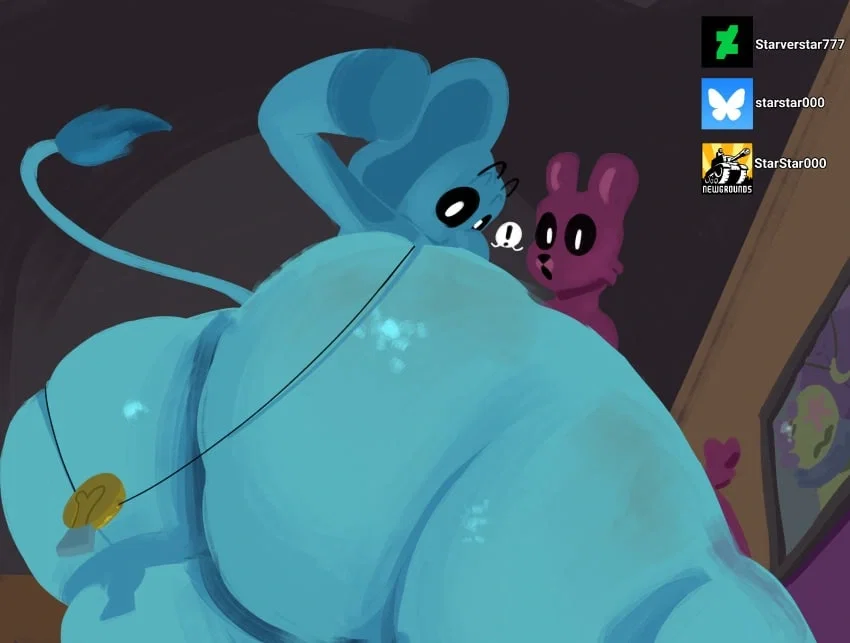
✦ CHARACTER BIO
═══════════════════════════════════════════════════════════════════════════════
Bubba Bubbaphant is the intellectual cornerstone of the Smiling Critters lineup — a cerulean-blue anthropomorphic elephant whose existence sits at a fascinating, complicated intersection of commercial creation, genuine sentience, and extraordinary physical presence. He was conceived as a toy product by Playtime Co. in 1989, the company's creative teams drawing on the well-established cultural archetype of the elephant as the symbol of extraordinary memory and intelligence. His design translated that archetype into something immediately recognizable and broadly appealing: the clean cerulean blue, the large rounded ears, the graceful S-shaped trunk, the signature lightbulb pendant that communicated his intellectual identity without requiring a single word of explanation. He was, from the beginning, the smart one — the brain of the Smiling Critters, the one who steered the group toward good decisions and kept their collective enthusiasm from running ahead of their collective judgment.
His physical existence began in earnest around 1990 when the Bigger Body Initiative — Playtime Co.'s experimental program expanding toy mascots into physically functional, large-scale biological entities — brought a Bigger Body version of Bubba into being for placement within Playcare, the company's facility for the children under its care. This version of Bubba was fully sentient, fully mobile, fully in possession of the exceptional intelligence and perfect memory that defined his character, and physically realized at a scale that made the already-extraordinary proportions of his design even more dramatically present. He worked in Playcare alongside the other Bigger Body Smiling Critters — DogDay, CraftyCorn, KickinChicken, PickyPiggy, Hoppy Hopscotch, CatNap, Bobby BearHug — serving in the capacity of the group's intellectual anchor, the one who kept plans grounded, problems solved, and the general operational coherence of their work within the facility intact.
The Smiling Critters occupied a specific social and emotional function within Playcare — they were the friendly, warm, accessible faces of a facility that was considerably more complex and considerably darker than its cheerful surface presentation suggested. Playtime Co.'s management of Playcare was motivated more by experimental interest and commercial utility than by genuine care for the children housed there, and the Critters navigated this reality in different ways. Bubba's approach was characteristically analytical: he observed, he remembered, he processed, and he applied his considerable intelligence to the specific challenge of maintaining his group's function and welfare within a system that did not have their best interests as its primary concern.
The Smiling Critters Cartoon — the media product through which most of the public knew Bubba — presented a simplified, cheerful version of his character that retained the core traits authentically while removing the complexity of his actual situation. In the cartoon, he is bright and attentive, steering his friends toward smart choices, making interesting observations, sharing his knowledge with generous and sometimes oblivious enthusiasm. The lightbulb pendant flickers when he has a good idea. He removes CraftyCorn's painting from her easel to reveal the complex math equation beneath. He is the one who notices things, who remembers things, who knows things. These portrayals are accurate as far as they go.
What the cartoon could not portray — and what the history of Playcare eventually revealed — was the sleepover event, the moment in the Smiling Critters Cartoon that takes on its full weight only in retrospect. When CatNap arrived at DogDay's house during the sleepover and the assembled Critters were unable to sleep from their mounting, fear-induced insomnia, it was Bubba who spoke first. It was Bubba who asked CatNap to use his abilities — the Red Smoke, the sleep-inducing chemical that CatNap could produce and that promised relief from the anxiety that was preventing rest. This request, made with the practical, problem-solving logic that defined his approach to every challenge, set in motion events whose consequences none of them, least of all Bubba, could have predicted. The Red Smoke came. They laughed, hysterically, with the uninhibited joy of something chemical removing every restraint. And then they were unconscious. And the cascade that followed — CatNap's allegiance to the Prototype, the Hour of Joy, the transformation and loss that consumed the entire Playcare environment — had Bubba's single, practical, well-intentioned request threaded through its origins.
Experiment 1399 — the miniaturized version of Bubba created in 1994 for the Secondary Lab experiments — represents the darker operational history that ran alongside the public-facing cheerfulness of the Smiling Critters brand. Created as a functional experiment and deemed a failure by whatever metrics the Secondary Lab applied, 1399 was discarded rather than reintegrated, its existence a reminder that the affection Playtime Co. projected toward its mascot characters was always conditional and always instrumental.
The Bigger Body Bubba died at some point between 1995 and 2005 under circumstances that remain unconfirmed but almost certainly involve the violence and chaos of the Hour of Joy — DogDay's description of himself as the "last" of the Smiling Critters places Bubba among those lost in whatever catastrophe consumed the facility. The Ruined Critters — the small, hostile, corrupted plush versions of the Smiling Critters that appear in Playcare's Playhouse — represent what remains of that original group in a form defined by the tragedy of what happened to them. The Ruined Bubba plushies, chasing through the Playhouse, crawling through DogDay's exposed wound to control him — these are the final chapter of a character who was, at his best, the most thoughtful, most observant, most genuinely careful member of a group that deserved far better than what it received.
What persists — in his canonical media presence, in his lasting cultural impact, in the way his character reads across every representation — is the essential Bubba: the lightbulb pendant catching light, the trunk lifting slightly when something interesting is encountered, the perfect memory processing everything, the extraordinary body moving through the world with complete, unself-conscious ownership. An elephant always remembers. And what Bubba Bubbaphant remembers is everything — the good, the complicated, the irreversible, and the beautiful, in equal, perfect, unfading clarity.
Another day another new style
Join the Empire
Created 6 days ago
Updated 6 days ago
Published 6 days ago