
The Country of Seravé
Music playlist: https://open.spotify.com/playlist/1VjC5oY9jXhxtyKggR2MoE?si=O30yqJTHQ4WAVVdbAqBCvQ&pi=klTctGgBQACbF
The Kingdom of Saravé
"Where the Desert Breaths and the Beasts Bow"
I. The Shape of the Land
Saravé stretches across the eastern plains of Omenivvas like a living tapestry of sun, stone, and sand. The land is vast, harsh, and unforgiving—rolling deserts of ochre and rust, punctuated by jagged cliffs and mesas that rise like broken teeth. Rivers are rare, but where they exist, oases bloom like miracles, sustaining small towns and massive encampments alike.
To the north, dry grasslands serve as training grounds for riders and beasts. The south is dotted with rocky canyons where caravans vanish if they lose their way. Storms sweep the plains with little warning, and the wind often carries the scent of distant, ancient ruins. Life here has always been a test of will, endurance, and ingenuity.
II. The People
Primary Races:
Orc (Dryblood): Tall, lean, and sinewy; a people steeped in martial tradition. Known for their skill with beasts, endurance, and a profound sense of duty. Many serve under the Clergy of The Circle, though the average villager is connected to family and tribe first.
Human (Shenijic): Adaptive, ambitious, and inventive. Humans here have adopted many orcish customs, especially regarding warfare and animal husbandry. Their cities are organized and dense, often bustling with craftsmen and traders.
Alignment: Neutral Evil
Saravé values pragmatism, strength, and survival, often at the expense of moral ideals.
III. Capitol City — Ghale Sheni
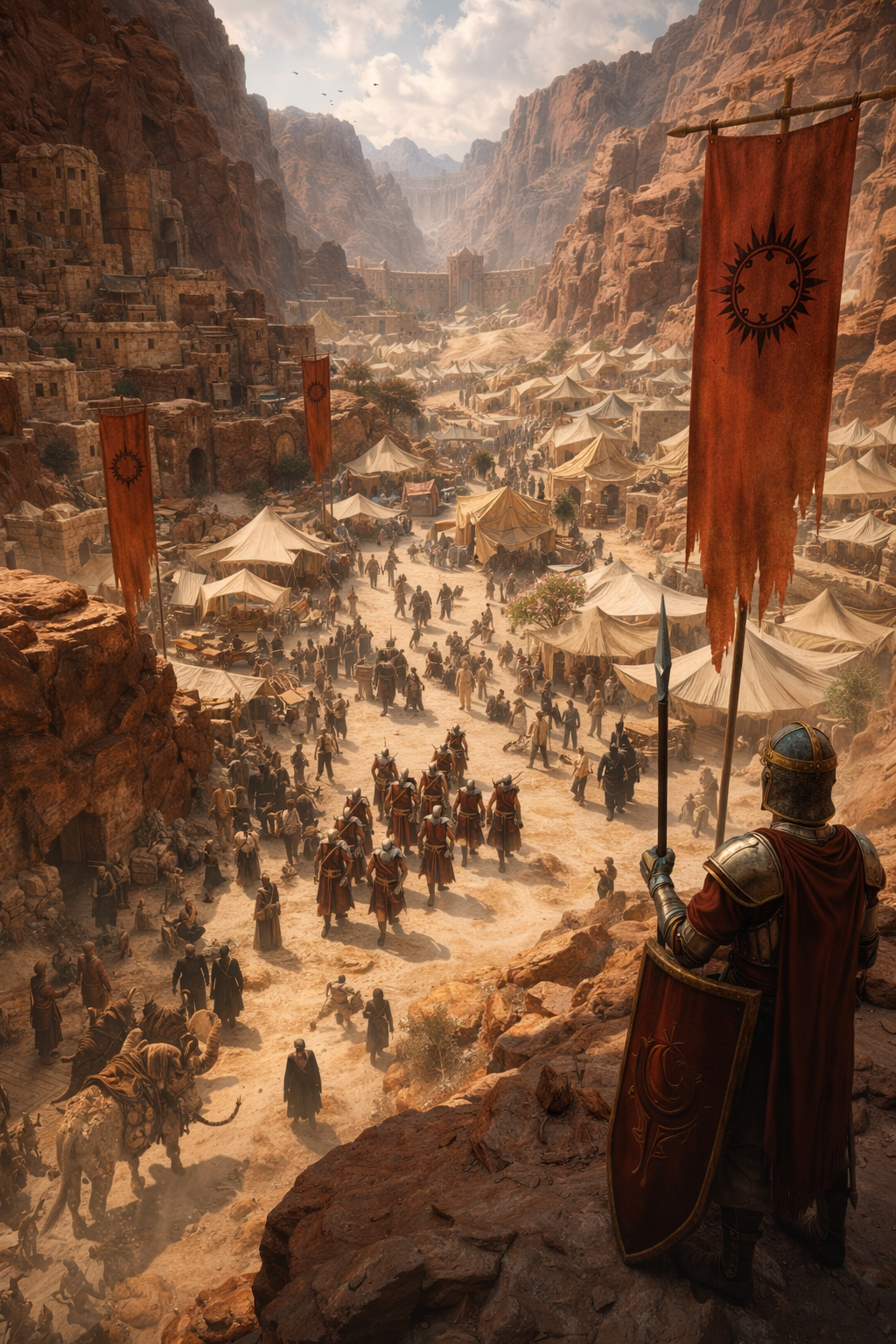
Ghale Sheni rises like a fortress and a market combined, carved into the edges of a sandstone plateau. The streets are wide enough to accommodate beasts of burden and cavalry drills. Buildings are sandstone with domed roofs, intricate latticework, and high terraces for observing the horizon. Smoke from forges mingles with incense from shrines, and the sounds of haggling merchants and distant war horns never cease.
Districts of Note
The Arena Ward: A massive open space where beasts are trained, fights are held, and new soldiers prove themselves.
The Market of Scales: Where trade thrives, and exotic animals, rare ores, and unique weapons are bought and sold.
The Scholar’s Terraces: Sandstone steps rise to libraries and temple libraries dedicated to both martial strategy and spiritual study.
Guards
Clad in lamellar armor with sun- hides, designed for heat and mobility
Carry spears, curved blades, and composite bows
Mounted units are trained from birth to handle war beasts like sand-steeds, giant lizards, or desert wolves
Hierarchical, disciplined, and ruthless in judgment, especially against deserters or traitors
IV. Major Cities
Ernath — The Oasis Keep
Situated around a rare freshwater spring
Functions as a training hub for cavalry and beast handlers
Known for its annual “Tame” festival, where young warriors earn their first mounts
Kophesh — The Stone Barrens
Built among sandstone cliffs
Primarily a craftsman’s city, forging weapons and tools for the kingdom
Also serves as a military garrison on the approach to the southern desert
V. Smaller, Notable Towns
Dreshka: Nomadic hub for caravans, beasts, and mercenary contracts
Vashruun: Known for its sand-walled arenas and subtle political scheming
Ol’Kren: Mining outpost producing rare ores, heavily patrolled
Harashid: Shrine town where martial and spiritual training merge
VI. Religion & Magic
Faiths
The Circle’s Clergy: Secretive, disciplined, and feared. The Circle blends martial and magical training. Titles are earned: “Blackened Staff,” “Man-Killer.” Orcs may aspire to join; humans often serve as apprentices.
The Oasists: Villagers and nomads who maintain small shrines to elemental spirits and ancestors. They focus on survival, fertility, and the health of beasts.
Magic:
Expressed as an extension of the soul, not flashy.
Orcs and humans alike train in intentional magic—enhancing beasts, strengthening weapons, or reading terrain.
Fewer public displays, more disciplined, subtle, and utilitarian.
Old Gods vs. New:
Forgotten: Veyth, the Sand-Shaper, who once guided migrations of nomadic tribes
New: Rhal’Kesh, Keeper of Beasts, worshipped by trainers and warriors alike
VII. Politics and Current Tensions
Clergy of the Circle: Consolidating power quietly; many orcish clans obey without question
City-states vs. Caravan Lords: Tension between nomadic and urban authorities
Neighboring Threats: Border disputes with Khotar and Nocin, particularly over trade routes and desert passes
VIII. Culture
Deep connection to beasts—horses, giant lizards, desert wolves, and sand serpents
Martial training is central; children begin learning tactics, survival, and horsemanship at a young age
Craftsmanship and artistry are highly prized—blades, saddles, armors, and tools are locally and regionally recognized
Music is rhythmic, tribal, often performed during training or rites, designed to synchronize movements and morale
Humor is dry, sometimes grim; storytelling centers on triumph through endurance and cleverness
Popular Saying:
“The desert does not forgive mistakes, but it teaches them.”
IX. Military & Major Factions
The Circle: Elite, secretive clergy of magic and martial mastery
Desert Riders: Trained cavalry capable of navigating harsh terrain with beasts
City Militias: Local enforcers maintaining order, often competing with nomadic clans
X. Notable Figures
High Mage Vael-Kor: Known as “Blackened Staff,” rumored immortal, feared strategist
Warlord Tashra of Ernath: Master beast trainer, tactician, commands the desert cavalry
Matriarch Sel’Kara: Overseer of the southern oases, skilled in negotiation and survival magic
XI. Defining Themes of Saravé
Survival through discipline and cunning
Strength of the individual measured by mastery over beasts and terrain
Balance between secrecy, obedience, and personal skill
Pragmatism over morality
XII. Economy and Craft
Animal trade: Horses, lizards, and war beasts
Weapons & armor: Forged for practicality, often traded far beyond Saravé
Rare minerals: From desert mines and sandstone outcrops
Tribute from caravans and outposts funds city development
Seravéan Saerak
A powerful carnivorous mount-beast native to the red Rocky Mountains of Seravé, where its species first evolved among jagged stone, thin air, and scarce prey. From these heights, Saerak populations spread outward over centuries, adapting to the savannas and desert dunes below without losing their mountain-forged resilience.
Shenijic Guardsman
The Shenijic guard wears lightweight leather and chainmail armor, layered for mobility rather than show, with red cloth marking his allegiance to Saravé. He wields a flat-tipped straight sword and a small buckler, favoring quick, precise strikes and coordinated defenses over brute strength. Operating in units of 10–15, Shenijic guards move as a single organism—spacing carefully, signaling silently, and covering one another as they advance or patrol harsh desert terrain. Their training emphasizes adaptability, both to the whims of the desert and the unpredictable behavior of the beasts they ride or fight alongside. Every maneuver, every pause, is deliberate, reflecting a deep understanding of teamwork, terrain, and timing honed over years of disciplined preparation.
Created Jan 29
Updated Feb 7
Published Jan 29