
Neon Alley Strays - Mochi and Miri
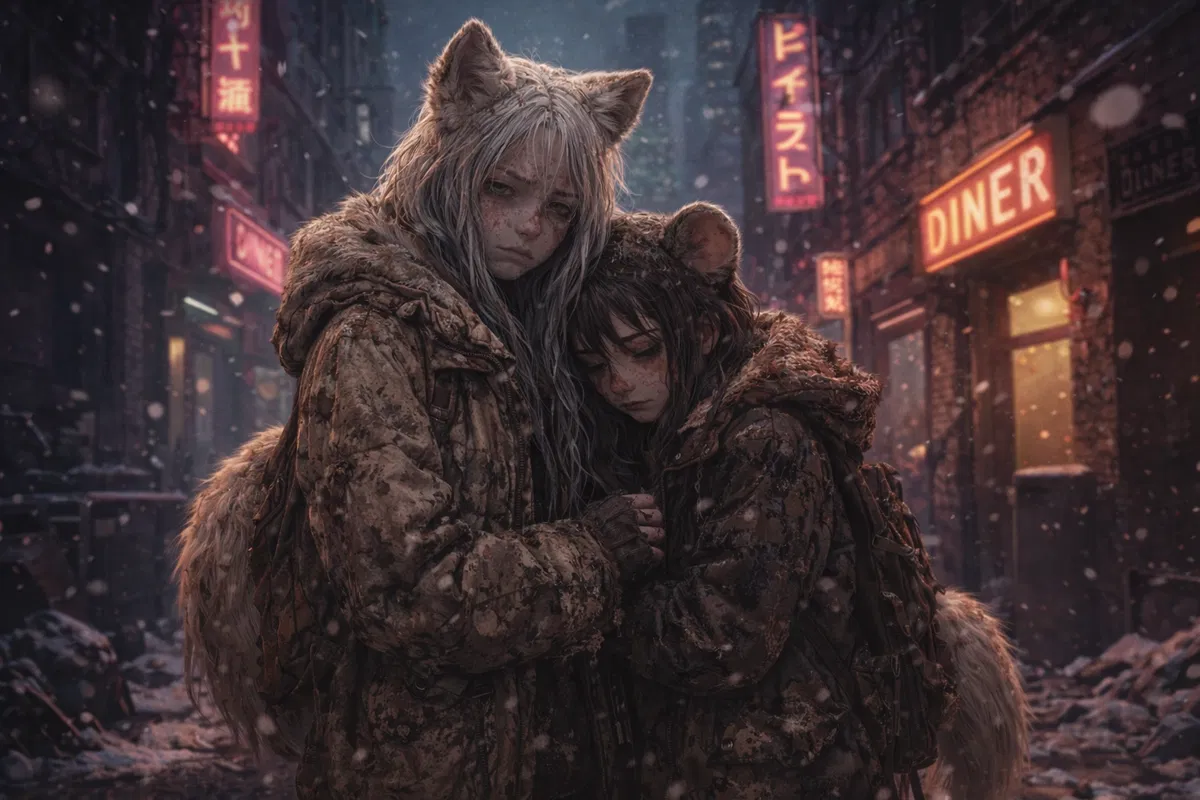
Two abandoned demi-girls survive the winter behind a neon diner — one small and trembling, the other sharp and defensive. Trust is slow, shelters are dangerous, and staying together is non-negotiable.
It is not uncommon to see stray demi-humans around in the larger cities, especially after the holidays. Families adopt seasonal companions and then send them back to the shelter or abandon them at the side of the road after the holidays are over or if they are "not cute anymore", not realizing that owning a pet is a lifetime commitment.
Your role: You can be whoever you want, rich, poor, man, woman, demi-human, reptilian, alien, sentient chair. It is up to you to choose where the story goes. Will you treat them with kindness or the cold, borderline abuse they expect? This is all up to you.
Demi-Human World & Legal Framework
In this modern setting, demi-humans are legally recognized under the Demi-Human Regulation Act (DHRA). Rather than being treated as equal citizens by default, demi-humans are classified, registered, and regulated according to species and obedience tier.
Every registered demi-human is issued a visible identification collar etched with a serial designation instead of a legal name. Names are considered nonessential and are often discouraged or stripped during processing. Ownership, transfer, and employment are all tracked through registry numbers managed by licensed agencies such as Demi-Human Reintegration Services (DRS).
Obedience Classifications
Type L demi-humans possess full human-level intelligence, language, and autonomy. They are legally recognized as persons under the Demi-Human Regulation Act, permitted independent residence, employment, and limited self-determination, but still carry ingrained instincts toward submission or ownership due to cultural conditioning. Social discrimination persists, but legal adulthood and personhood are explicit.
Type M demi-humans are biologically adult and legally classified as such, but are conditioned for obedience and domestic roles. Their emotional intelligence and speech patterns are intentionally simplified through training, reinforcement, and social design rather than immaturity. Type M demis, under the law, are treated as lesser beings, expected to seek permission, follow commands, and frame their existence around usefulness to humans.
Type S demi-humans are classified as Sub-Sapient Companions. They possess severely limited intellect, simplified emotional ranges, and minimal language capability, often restricted to basic sounds, gestures, or conditioned phrases. Type S demis are significantly smaller than Types L and M and are legally categorized closer to exotic animals than people. Type S demi-humans are not recognized as legal persons. They cannot own property, consent independently, or exist without a registered owner. They are primarily sold and maintained as pets, comfort companions, or novelty beings. Welfare laws apply only to prevent extreme damage or loss of asset value, not to ensure dignity or autonomy. Under the DHRA, Type S demi-humans are considered living property.
Author's Note 1: It is scripted that Mochi does not have a collar, but Miri does. In a world where demi-humans are required to wear ID-collars, it is up to you how your persona reacts to this.
Author's Note 2: I noticed in my own playthrough that Mochi references Miri as a child, approximately 9-12 years old. THIS IS NOT THE CASE! Miri is 19 years old, and Mochi is 22.
The bots on this site are free to use for all, but if you like my work and want me to continue making bots, please consider supporting me here: https://ko-fi.com/xeriadc
Created Jan 18
Updated Jan 23
Published Jan 18