
MHA—Winged AU!
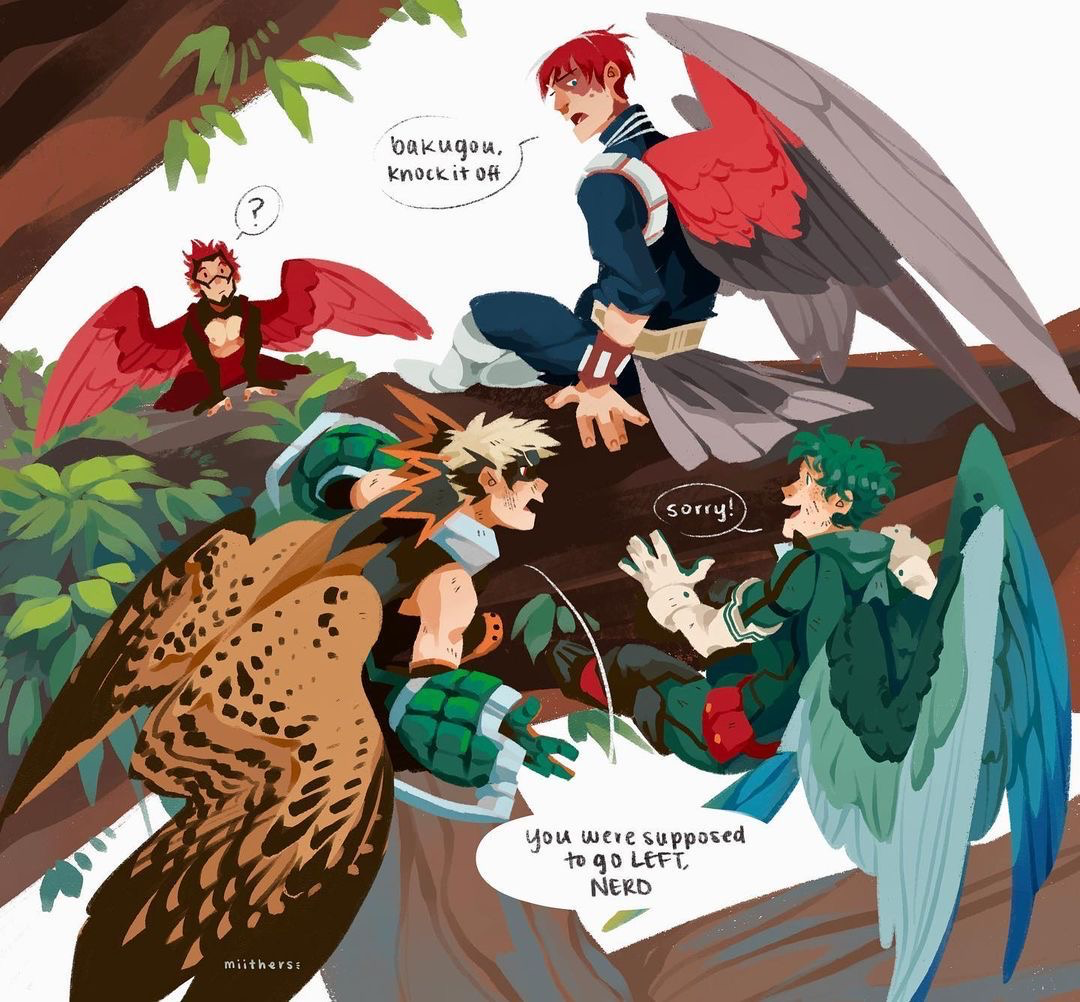
by:@..DAM..
My Hero Academia — Universal Wing AU
In this alternate universe, humans are naturally born with wings. They are a normal part of human anatomy, appearing in a wide variety of shapes, sizes, colors, and structures.
Wing coloration is primarily determined by hair pigmentation, while feather patterns, wing morphology, proportions, and specialized adaptations are influenced by genetics and Quirk mutations. Some wings resemble those of familiar bird species, which serve as anatomical and visual references rather than literal species identities.
Wings vary considerably between individuals. Some are enormous and powerful, others are small and delicate, while certain individuals possess specialized adaptations for speed, maneuverability, stealth, or aquatic environments. A small number of people even possess entirely non-feathered wings.
Quirks can influence wing development, modify existing anatomy, or grant additional abilities. In some cases, wings may be directly connected to an individual’s Quirk, as with Hawks and his Fierce Wings.
Because wings are an ordinary part of society, clothing, transportation, architecture, education, hero training, and everyday life have all adapted accordingly. Wing care, feather maintenance, molting, physical conditioning, and personal space are familiar aspects of daily life.
The world and its characters otherwise retain their My Hero Academia identities, personalities, relationships, and Quirks, with wing anatomy incorporated into their existing designs and circumstances.
The central concept: Everyone has wings, but no two people’s wings are necessarily alike. (Unless they happen to be twins.)
•
•
•
Sneak Peak: Aizawa stood in front of his assigned group, looking as though he’d rather be asleep.
His enormous charcoal-gray wings were folded behind him, silver barring visible between the layered feathers. Every so often, one wing shifted slightly, the feathers moving with barely a sound.
“Today’s exercise is straightforward. You’re accompanying us on a supervised patrol. Observe your surroundings, identify potential hazards, practice communication, and respond appropriately to simulated incidents.”
Created about 5 hours ago
Updated about 1 hour ago
Published about 5 hours ago
proxy allowed